Effects of a medication management system for inpatients with renal impairment at Rong Kwang Hospital, Phrae Province: A retrospective quasi-experimental study
Keywords:
Medication management system, Renal impairment, Appropriateness of drug prescribingAbstract
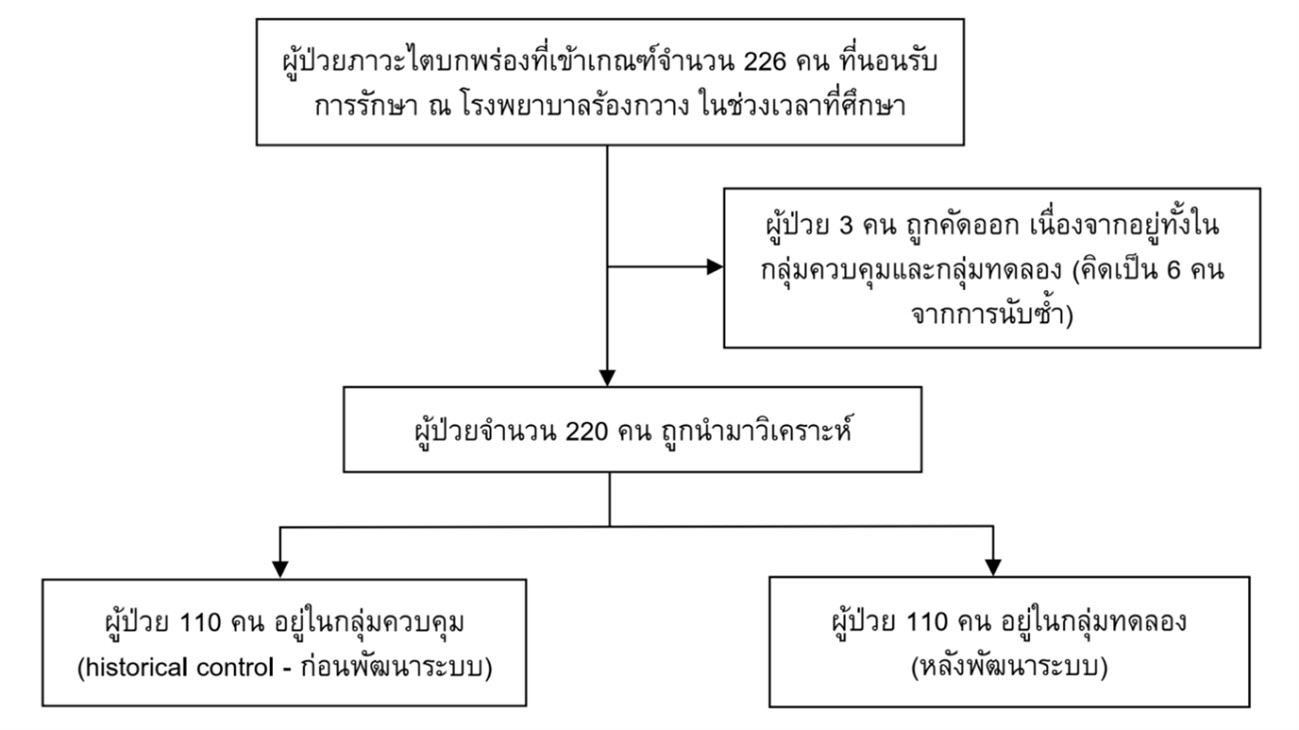
This study aimed to evaluate the effectiveness of a newly developed medication management system for hospitalized patients with renal impairment. The system comprised 1) a guideline and handbook for renal dose adjustment, 2) an alert system for monitoring and tracking medication use within the electronic medical record, 3) pharmacist review of medication orders to assess prescribing appropriateness, and 4) physician consultation when inappropriate prescribing was identified. Outcomes of patients managed using this system (intervention group, data collected from April to August 2024) were compared with those of patients treated before its implementation (historical control group, data collected from May to September 2023). The primary outcome was the appropriateness of medication prescribing, analyzed using logistic regression. The secondary outcome was the rate of appropriate dose adjustment, analyzed using Poisson regression. All analyses employed multivariable models adjusted for sex, age, estimated glomerular filtration rate (eGFR), and type of renal impairment. Data were collected from 220 patients (110 per group). Most participants were male (56.4%), with a mean age of 71.70 ± 11.99 years, and 51.4% had chronic kidney disease. After implementation, prescribing appropriateness significantly improved (adjusted odds ratio = 11.33, 95% CI 5.81–22.13; p < 0.001). The proportion of inappropriate prescriptions decreased from 53.7% (116 of 216 prescriptions) to 14.3% (28 of 196 prescriptions; p < 0.001). The rate of appropriate dose adjustment also significantly increased (adjusted incidence rate ratio = 2.20, 95% CI 1.67–2.89; p < 0.001). Although this study could not fully establish a causal relationship and residual confounding related to participants’ comorbidities remained, the analysis indicated that the developed medication management system has the potential to improve prescribing appropriateness among patients with renal impairment. Future research should assess clinical outcomes, monitor the severity and consequences of inappropriate prescribing, and explore healthcare providers’ perspectives as system users. In addition, long-term monitoring of system sustainability is warranted, particularly regarding the maintenance of prescribing appropriateness over time.
References
Health Strategy Development, Strategy and Planning Division, Ministry of Public Health. 5-Year action plan of the Ministry of Public Health (2023-2027). Bangkok: Strategy and Planning Division, Ministry of Public Health. (2022). (In Thai)
Lamlertkul N, Srisawat N. Acute kidney injury and renal recovery. Clin Crit Care. 2017;25(2):7-9. (In Thai)
Saengpeng A, Saramunee K, Anusornsangiam W, Development of dosage adjustment system for in-patients with renal impairment at Prasat Hospital, Surin Province. Thai J Pharm Prac. 2017;9(1):280-291. (In Thai)
Phromkamdang K, Sirilak T. Effects of pharmaceutical care on clinical outcomes in patients with chronic kidney disease in Wiang Haeng Hospital, Chiangmai Province. JNPHR. 2023;3(1):1-19. (In Thai)
Kunotai H, Sansong R, Isarawitchayakul D, Meearsa C. Effect of developing dose adjustment system in patients with renal impairment on the appropriateness of drug use in hospitalized patients at tertiary care hospital. Thai J Pharm Prac. 2022;3:203-240. (In Thai)
Kidney Disease : Improving Global Outcomes (KDIGO) Acute Kidney Injury Work Group. KDIGO clinical practice guideline for acute kidney injury. Kidney Int Suppl. 2012;2(1):1-138.
Kidney Disease : Improving Global Outcomes (KDIGO) CKD Work Group. KDIGO 2024 clinical practice guideline for the evaluation and management of chronic kidney disease. Kidney Int. 2024;105(4S):S117-S314.
Malone HE, Nicholl H, Coyne I. Fundamentals of estimating sample size. Nurse Res. 2016;23(5):21-25.
Streiner DL, Norman GR, Cairney J. Health measurement scales: A practical guide to their development and use. 6th ed. Oxford: Oxford University Press; 2024.
Chaiyachamon W. Antimicrobial dosing adjustment in patients with reduced renal function. In: Rungprai D, Chaiyachamon W, Wongsarot A, Onlammai K, Luewittawat P, Wongphira P, editors. Kidney disease care manual for pharmacists 2. Bangkok: Prachachon Company Limited; 2017; 308-341. (In Thai)
De Agustín Sierra L, Corregidor Luna L, Ramírez Cruz S, Salcedo Mingoarranz A, Hidalgo Correas F, García Díaz B. Dosage adjustment recommendations of drugs in non-nephrology units with kidney disease. Revista de La OFIL. 2021;31(3):297–301.
Gilbert DN, Chambers HF, Eliopoulos GM, Saag MS, Pavia AT. The Sanford guide to antimicrobial therapy. 46th ed. Sperryville (VA): Antimicrobial Therapy, Inc.; 2016.
The Kidney Society of Thailand. Guidelines for the care of patients with chronic kidney disease before renal replacement therapy 2022 (revised edition). Bangkok: The Kidney Society of Thailand; 2022. (In Thai)
MICROMEDEX®. [Database on the internet]. [cited 2023 Oct 6]. Available from: https://www.micromedexsolutions.com/micromedex2/librarian.
Srisawat N, Tangsanga K. Acute kidney injury. In: Rungprai D, Chaiyachamon W, Wongsarot A, Onlammai K, Luewittawat P, Wongphira P, editors. Kidney disease care manual for pharmacists 2 Bangkok: Prachachon Company Limited; 2017; 69-79. (In Thai)
Zou G. A modified Poisson regression approach to prospective studies with binary data. Am J Epidemiol. 2004;159:702–706.
Sera LC, McPherson ML. Pharmacokinetics and pharmacodynamic changes associated with aging and implications for drug therapy. Clin Geriatr Med. 2012;28(2):273-86.
Gandhi M, Aweeka F, Greenblatt RM, Blaschke TF. Sex differences in pharmacokinetics and pharmacodynamics. Annu Rev Pharmacol Toxicol. 2004;44:499-523.
Vatcheva KP, Lee M, McCormic JB, Rahbar MH. Multicollinearity in regression analyses conducted in epidemiologic studies. Epidemiology. 2016;6:1–9.
Klaypaksri A, Polnok A. Effect of computerized clinical decision support system on medication use in patients with renal impairment. Thai J Pharm Prac. 2020;12(2):437-451. (In Thai)
Li YJ, Lee WS, Chang YL, Chou YC, Chiu YC, Hsu CC. Impact of a clinical decision support system on inappropriate prescription of glucose-lowering agents for patients with renal insufficiency in an ambulatory care setting. Clin Ther. 2022;44(5):710-722.
Sperl-Hillen J, Crain AL, Wetmore JB, Chumba LN, O'Connor PJ. A CKD clinical decision support system: A cluster randomized clinical trial in primary care clinics. Kidney Med. 2023;6(3):100777.
Bhardwaja B, Carroll NM, Raebel MA, Chester EA, Korner EJ, Rocho BE, et al. Improving prescribing safety in patients with renal insufficiency in the ambulatory setting: the Drug Renal Alert Pharmacy (DRAP) program. Pharmacotherapy. 2011;31(4):346-56.
Ardavani A, Curtis F, Hopwood E, Highton P, Katapa P, Khunti K, et al. Effect of pharmacist interventions in chronic kidney disease: a meta-analysis. Nephrol Dial Transplant. 2025;40(5):884-907.
Downloads
Published
How to Cite
Issue
Section
License
Copyright (c) 2025 University of Phayao

This work is licensed under a Creative Commons Attribution-NonCommercial-NoDerivatives 4.0 International License.
ผู้นิพนธ์ต้องรับผิดชอบข้อความในบทนิพนธ์ของตน มหาวิทยาลัยพะเยาไม่จำเป็นต้องเห็นด้วยกับบทความที่ตีพิมพ์เสมอไป ผู้สนใจสามารถคัดลอก และนำไปใช้ได้ แต่จะต้องขออนุมัติเจ้าของ และได้รับการอนุมัติเป็นลายลักษณ์อักษรก่อน พร้อมกับมีการอ้างอิงและกล่าวคำขอบคุณให้ถูกต้องด้วย
The authors are themselves responsible for their contents. Signed articles may not always reflect the opinion of University of Phayao. The articles can be reproduced and reprinted, provided that permission is given by the authors and acknowledgement must be given.