ผลการพัฒนาระบบการจัดการด้านยาสำหรับผู้ป่วยภาวะไตบกพร่องที่รับการรักษาแบบผู้ป่วยใน ณ โรงพยาบาลร้องกวาง จังหวัดแพร่: การศึกษากึ่งทดลองย้อนหลัง
คำสำคัญ:
ระบบการดูแลด้านการใช้ยา, ภาวะไตบกพร่อง, ความเหมาะสมของการสั่งใช้ยาบทคัดย่อ
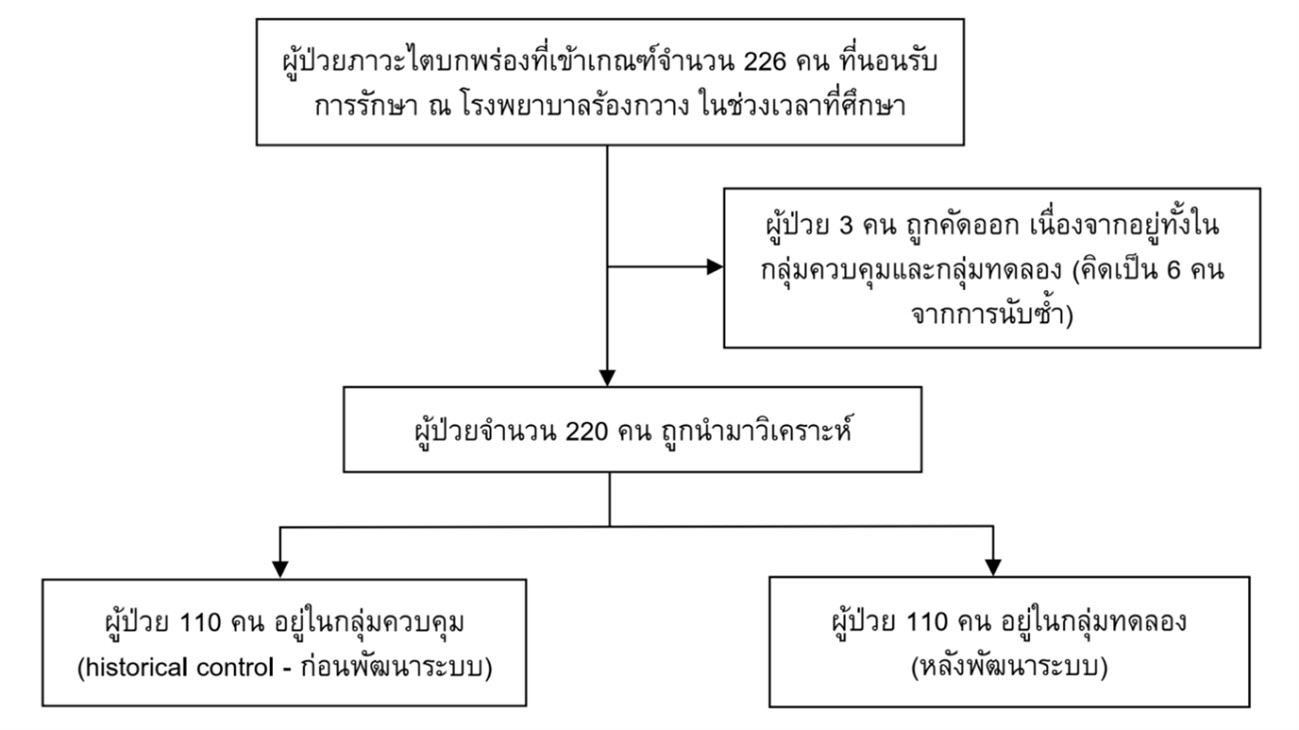
การศึกษานี้มีวัตถุประสงค์เพื่อประเมินประสิทธิผลของระบบการจัดการด้านยาที่พัฒนาขึ้นสำหรับผู้ป่วยภาวะไตบกพร่องซึ่งเข้ารับการรักษาในโรงพยาบาล ระบบดังกล่าวประกอบด้วย 1) แนวทางและคู่มือการปรับขนาดการใช้ยา 2) ระบบแจ้งเตือนเพื่อเฝ้าระวังและติดตามการใช้ยาในเวชระเบียนอิเล็กทรอนิกส์ 3) การทบทวนคำสั่งใช้ยาโดยเภสัชกรเพื่อประเมินความเหมาะสมของการสั่งใช้ยา และ 4) การส่งปรึกษาแพทย์ในกรณีที่พบคำสั่งใช้ยาไม่เหมาะสม โดยเปรียบเทียบผลลัพธ์ของผู้ป่วยที่ได้รับการดูแลด้วยระบบดังกล่าว (กลุ่มแทรกแซง ซึ่งรวบรวมข้อมูลระหว่างเมษายน ถึง สิงหาคม พ.ศ. 2567) กับผู้ป่วยที่ได้รับการดูแลก่อนการนำระบบมาใช้ (กลุ่มควบคุมในอดีต ซึ่งรวบรวมข้อมูลระหว่างพฤษภาคม ถึง กันยายน พ.ศ. 2566) ผลลัพธ์หลักคือความเหมาะสมของการสั่งใช้ยา วิเคราะห์ด้วยสถิติการถดถอยโลจิสติก ส่วนผลลัพธ์รองคืออัตราการปรับขนาดยาอย่างเหมาะสม วิเคราะห์ด้วยสถิติการถดถอยปัวซอง โดยการวิเคราะห์ทั้งหมดใช้โมเดลพหุตัวแปรปรับด้วยเพศ อายุ ค่าอัตราการกรองของไตโดยประมาณ (estimated glomerular filtration rate: eGFR) และชนิดของภาวะไตบกพร่อง โดยรวบรวมข้อมูลจากผู้ป่วยจำนวน 220 ราย (กลุ่มละ 110 ราย) พบว่าผู้เข้าร่วมส่วนใหญ่เป็นเพศชาย (ร้อยละ 56.4) มีอายุเฉลี่ย 71.70 ± 11.99 ปี และมีภาวะไตวายเรื้อรังร้อยละ 51.4 หลังการพัฒนาระบบพบว่าความเหมาะสมของการสั่งใช้ยาเพิ่มขึ้นอย่างมีนัยสำคัญทางสถิติ (adjusted odds ratio = 11.33, 95% CI 5.81–22.13; p < 0.001) โดยอัตราการสั่งใช้ยาไม่เหมาะสมลดลงจากร้อยละ 53.7 (116 รายการจาก 216 รายการสั่งยา) เป็นร้อยละ 14.3 (28 รายการจาก 196 รายการสั่งยา; p < 0.001) และอัตราการปรับขนาดยาอย่างเหมาะสมเพิ่มขึ้นอย่างมีนัยสำคัญ (adjusted incidence rate ratio = 2.20, 95% CI 1.67–2.89; p < 0.001) แม้ว่าการศึกษานี้ไม่สามารถสรุปความสัมพันธ์เชิงสาเหตุได้อย่างสมบูรณ์ และยังมีปัจจัยรบกวนคงค้างเกี่ยวกับโรคประจำตัวของผู้เข้าร่วมการศึกษา ผลการวิเคราะห์แสดงให้เห็นว่าระบบการจัดการด้านยาที่พัฒนาขึ้นมีศักยภาพในการเพิ่มความเหมาะสมของการสั่งใช้ยาในผู้ป่วยภาวะไตบกพร่อง การศึกษาในอนาคตควรประเมินผลกระทบทางคลินิก ติดตามระดับความรุนแรงของการสั่งใช้ยาไม่เหมาะสม และศึกษามุมมองของบุคลากรทางการแพทย์ในฐานะผู้ใช้งานระบบ รวมทั้งติดตามความยั่งยืนของระบบในระยะยาว โดยเฉพาะการคงไว้ซึ่งความเหมาะสมของการสั่งใช้ยาเมื่อเวลาผ่านไป
เอกสารอ้างอิง
Health Strategy Development, Strategy and Planning Division, Ministry of Public Health. 5-Year action plan of the Ministry of Public Health (2023-2027). Bangkok: Strategy and Planning Division, Ministry of Public Health. (2022). (In Thai)
Lamlertkul N, Srisawat N. Acute kidney injury and renal recovery. Clin Crit Care. 2017;25(2):7-9. (In Thai)
Saengpeng A, Saramunee K, Anusornsangiam W, Development of dosage adjustment system for in-patients with renal impairment at Prasat Hospital, Surin Province. Thai J Pharm Prac. 2017;9(1):280-291. (In Thai)
Phromkamdang K, Sirilak T. Effects of pharmaceutical care on clinical outcomes in patients with chronic kidney disease in Wiang Haeng Hospital, Chiangmai Province. JNPHR. 2023;3(1):1-19. (In Thai)
Kunotai H, Sansong R, Isarawitchayakul D, Meearsa C. Effect of developing dose adjustment system in patients with renal impairment on the appropriateness of drug use in hospitalized patients at tertiary care hospital. Thai J Pharm Prac. 2022;3:203-240. (In Thai)
Kidney Disease : Improving Global Outcomes (KDIGO) Acute Kidney Injury Work Group. KDIGO clinical practice guideline for acute kidney injury. Kidney Int Suppl. 2012;2(1):1-138.
Kidney Disease : Improving Global Outcomes (KDIGO) CKD Work Group. KDIGO 2024 clinical practice guideline for the evaluation and management of chronic kidney disease. Kidney Int. 2024;105(4S):S117-S314.
Malone HE, Nicholl H, Coyne I. Fundamentals of estimating sample size. Nurse Res. 2016;23(5):21-25.
Streiner DL, Norman GR, Cairney J. Health measurement scales: A practical guide to their development and use. 6th ed. Oxford: Oxford University Press; 2024.
Chaiyachamon W. Antimicrobial dosing adjustment in patients with reduced renal function. In: Rungprai D, Chaiyachamon W, Wongsarot A, Onlammai K, Luewittawat P, Wongphira P, editors. Kidney disease care manual for pharmacists 2. Bangkok: Prachachon Company Limited; 2017; 308-341. (In Thai)
De Agustín Sierra L, Corregidor Luna L, Ramírez Cruz S, Salcedo Mingoarranz A, Hidalgo Correas F, García Díaz B. Dosage adjustment recommendations of drugs in non-nephrology units with kidney disease. Revista de La OFIL. 2021;31(3):297–301.
Gilbert DN, Chambers HF, Eliopoulos GM, Saag MS, Pavia AT. The Sanford guide to antimicrobial therapy. 46th ed. Sperryville (VA): Antimicrobial Therapy, Inc.; 2016.
The Kidney Society of Thailand. Guidelines for the care of patients with chronic kidney disease before renal replacement therapy 2022 (revised edition). Bangkok: The Kidney Society of Thailand; 2022. (In Thai)
MICROMEDEX®. [Database on the internet]. [cited 2023 Oct 6]. Available from: https://www.micromedexsolutions.com/micromedex2/librarian.
Srisawat N, Tangsanga K. Acute kidney injury. In: Rungprai D, Chaiyachamon W, Wongsarot A, Onlammai K, Luewittawat P, Wongphira P, editors. Kidney disease care manual for pharmacists 2 Bangkok: Prachachon Company Limited; 2017; 69-79. (In Thai)
Zou G. A modified Poisson regression approach to prospective studies with binary data. Am J Epidemiol. 2004;159:702–706.
Sera LC, McPherson ML. Pharmacokinetics and pharmacodynamic changes associated with aging and implications for drug therapy. Clin Geriatr Med. 2012;28(2):273-86.
Gandhi M, Aweeka F, Greenblatt RM, Blaschke TF. Sex differences in pharmacokinetics and pharmacodynamics. Annu Rev Pharmacol Toxicol. 2004;44:499-523.
Vatcheva KP, Lee M, McCormic JB, Rahbar MH. Multicollinearity in regression analyses conducted in epidemiologic studies. Epidemiology. 2016;6:1–9.
Klaypaksri A, Polnok A. Effect of computerized clinical decision support system on medication use in patients with renal impairment. Thai J Pharm Prac. 2020;12(2):437-451. (In Thai)
Li YJ, Lee WS, Chang YL, Chou YC, Chiu YC, Hsu CC. Impact of a clinical decision support system on inappropriate prescription of glucose-lowering agents for patients with renal insufficiency in an ambulatory care setting. Clin Ther. 2022;44(5):710-722.
Sperl-Hillen J, Crain AL, Wetmore JB, Chumba LN, O'Connor PJ. A CKD clinical decision support system: A cluster randomized clinical trial in primary care clinics. Kidney Med. 2023;6(3):100777.
Bhardwaja B, Carroll NM, Raebel MA, Chester EA, Korner EJ, Rocho BE, et al. Improving prescribing safety in patients with renal insufficiency in the ambulatory setting: the Drug Renal Alert Pharmacy (DRAP) program. Pharmacotherapy. 2011;31(4):346-56.
Ardavani A, Curtis F, Hopwood E, Highton P, Katapa P, Khunti K, et al. Effect of pharmacist interventions in chronic kidney disease: a meta-analysis. Nephrol Dial Transplant. 2025;40(5):884-907.
ดาวน์โหลด
เผยแพร่แล้ว
รูปแบบการอ้างอิง
ฉบับ
ประเภทบทความ
สัญญาอนุญาต
ลิขสิทธิ์ (c) 2025 มหาวิทยาลัยพะเยา

อนุญาตภายใต้เงื่อนไข Creative Commons Attribution-NonCommercial-NoDerivatives 4.0 International License.
ผู้นิพนธ์ต้องรับผิดชอบข้อความในบทนิพนธ์ของตน มหาวิทยาลัยพะเยา ไม่จำเป็นต้องเห็นด้วยกับบทความที่ตีพิมพ์เสมอไป ผู้สนใจสามารถคัดลอก และนำไปใช้ได้ แต่จะต้องขออนุมัติเจ้าของ และได้รับการอนุมัติเป็นลายลักษณ์อักษรก่อน พร้อมกับมีการอ้างอิงและกล่าวคำขอบคุณให้ถูกต้องด้วย