Lived experiences of schoolteachers in managing health emergency situations in schools: A phenomenological study
Keywords:
Teachers' experience, School health emergency, Emergency situation management, Emergency preparedness, School support systemsAbstract
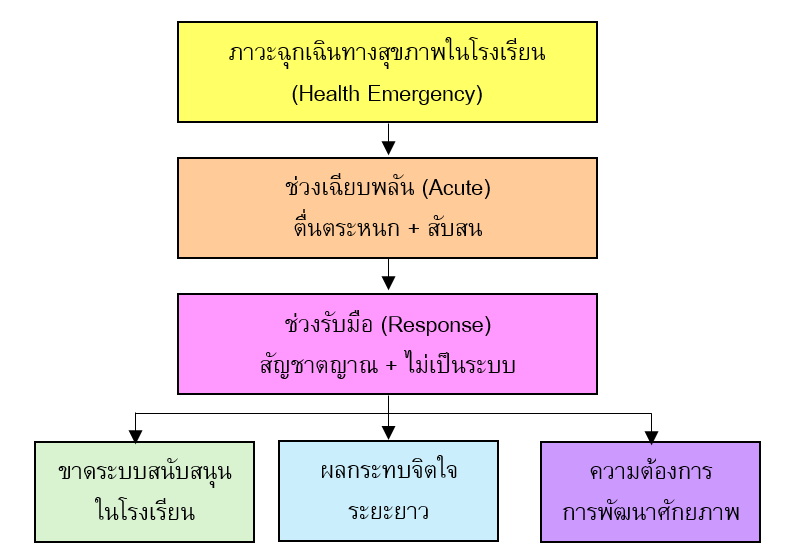
This descriptive phenomenological qualitative study aimed to describe and understand the real-life experiences of schoolteachers when facing health emergency situations in schools. Eighteen participants were recruited through qualification-based purposive sampling and chain-referral (snowball) sampling from primary and secondary schools in Uttaradit Province, Thailand, all of whom had encountered at least one health emergency at school. Data were collected through individual semi-structured in-depth interviews, using an interview guide developed specifically for this study and validated for content validity by three experts using the Index of Item-Objective Congruence (IOC = 0.67–1.00), with a mean interview duration of 56.4 minutes. Data analysis followed Colaizzi's seven-step phenomenological method, and trustworthiness was established using Lincoln and Guba's criteria. Five main themes emerged: (1) acute panic and confusion during the crisis; (2) instinct-driven action and accumulated personal experience; (3) the gap between theoretical knowledge and practical skills; (4) existing supports and gaps within the school support system; and (5) needs, obstacles, and expectations toward the healthcare system. The fundamental structure of the phenomenon revealed that teachers are positioned as first responders without adequate preparation in knowledge, skills, equipment, or institutional support, although some existing supports worth building upon were also identified, resulting in prolonged psychological impact and an urgent need for competency development through structured programs designed by emergency nursing specialists, which should incorporate initial assessment skills prior to decision-making and gender-sensitive first-aid guidelines for cross-gender student care. These findings provide a foundational evidence base for developing practice-oriented training programs that genuinely address teachers' needs, and for formulating school health safety policies in the Thai context.
References
Alruwaili A, Al Sulaiteen H, Alanazy A, Almousa Z, Alshaqaqiq M, Alhofufi A, Almulhem N, Alibrahim Z. Awareness of school teachers about students common emergencies during school time in the eastern region, Saudi Arabia: a cross-sectional study. J Family Med Prim Care. 2024;13(8):3059-66.
Harries MD, Saper JK, Macy ML, Martin-Gill C, Ramgopal S. Emergency Medical Services Responses to School-Based Medical Emergencies. Pediatrics. 2025;156(2):e2024068886.
Department of Disease Control, Ministry of Public Health, Thailand. Situation of child injury mortality in Thailand, 2015–2019 [Internet]. 2022 [cited 2022 Nov 10]. Available from: https://ddc.moph.go.th/dip/journal_detail.php?publish=13435.
Abdelrahman D, Aleyeidi NA, Alqahtani HT, Aldosari FN, Al Shammari TG, Alrusaini NK, Almahfouz RF, Altamimi SA, Alshehri SA, Alsubaie RM, Almuzaini RA, Innab JA, Alsuhaibani YA. Assessment of knowledge, attitude, and practice toward first aid among female school educators in Riyadh, Saudi Arabia: a cross-sectional study. Front Public Health. 2024;12:1482181.
Alsulami M, Madkhali AA, Alharbi MT, Alzahrani AR, Aljohani IN, Al-Thaqafy MS, Alsulami AA, Eldigre M, Aloraibi S. Knowledge and attitude of paediatric first aid among elementary schoolteachers in Jeddah, Saudi Arabia. J Family Med Prim Care. 2022;11(11):6795-800.
Dainty KN, Colquitt B, Bhanji F, Hunt EA, Jefkins T, Leary M, Ornato JP, Swor RA, Panchal A. Understanding the importance of the lay responder experience in out-of-hospital cardiac arrest: a scientific statement from the American Heart Association. Circulation. 2022;145(17):e852-e867.
O'Sullivan C, McNamara G, O'Brien A. Irish primary school teachers' experiences, training and knowledge in first aid. Int J Health Promot Educ. 2023;61(5):789-804.
Gereige RS, Gross T, Jastaniah E; Council on School Health and Committee on Pediatric Emergency Medicine. Individual medical emergencies occurring at school. Pediatrics. 2022;150(1):e2022057987.
Songwathana P, Timalsina R. Disaster preparedness among nurses of developing countries: an integrative review. Int Emerg Nurs. 2021;55:100955.
Onjon O, Kittirachakool N, Chinnacom D, Praditsithikorn N, Teerawattananon Y, Tantivess S. Resources for the elementary school health services in Thailand. J Health Syst Res. 2018;12(3):456-468.
Pansakun N, Kantow S, Pudpong P, Chaiya T. Assessment of nonprescription medicine and first aid knowledge among school health teachers in northern Thailand. Nat Life Sci Commun. 2024;23(3):e2024028.
Neyişci N. Emergency response competencies strengthened by sustainable education: first aid training program for teachers. Sustainability. 2024;16(18):8166.
Shorey S, Ng ED. Examining characteristics of descriptive phenomenological nursing studies: a scoping review. J Adv Nurs. 2022;78(7):1968-1979.
Al-amer R, Darwish M, Malak M, Ali AM, Al weldat K, Alkhamees A, Alshammari KS, Abuzied Y, Randall S. Nurses experience of caring for patients with COVID-19: a phenomenological study. Front Psychiatry. 2022;13:922410.
Jang HY, Yang JE, Shin YS. A phenomenological study of nurses' experience in caring for COVID-19 patients. Int J Environ Res Public Health. 2022;19(5):2924.
Yu W, Zhang Y, Xianyu Y, Cheng D. Stressors, emotions, and social support systems among respiratory nurses during the Omicron outbreak in China: a qualitative study. BMC Nurs. 2024;23(1):188.
Rovinelli RJ, Hambleton RK. On the use of content specialists in the assessment of criterion-referenced test item validity. Tijdschr Onderwijsresearch (Dutch J Educ Res). 1977;2:49-60.
Jiang J, Liu Y, Han P, Zhang P, Shao H, Peng H, Duan X. Psychological resilience of emergency nurses during COVID-19 epidemic in Shanghai: a qualitative study. Front Public Health. 2022;10:1001615.
Faraji A, Jalali A, Khatony A, Jalali R. Exploring nurses' experiences of recommended patient care: a descriptive phenomenological study. BMC Nurs. 2024;23:61.
Ahmed SK. The pillars of trustworthiness in qualitative research. J Med Surg Public Health. 2024;2: 100051.
Li N, Shen C, Yang X, Wang R, Gu LQ, Zhao W, Chu ZP. The real experience of lay responders performing cardiopulmonary resuscitation: a synthesis of qualitative evidence. Public Health Rev. 2024;45:1606650.
Zenani NE, Bello B, Molekodi M, Useh U. Effectiveness of school-based CPR training among adolescents to enhance knowledge and skills in CPR: a systematic review. Curationis. 2022;45(1):e1-e9.
Farokhzadian J, Mangolian Shahrbabaki P, Farahmandnia H, Taskiran Eskici G, Soltani Goki F. Nurses' challenges for disaster response: a qualitative study. BMC Emerg Med. 2024;24(1):1.
Farokhzadian J, Mangolian Shahrbabaki P, Farahmandnia H, Taskiran Eskici G, Soltani Goki F. Exploring the consequences of nurses' involvement in disaster response: findings from a qualitative content analysis study. BMC Emerg Med. 2024;24:74.
Cavallari JM, Trudel SM, Charamut NR, Suleiman AO, Sanetti LMH, Miskovsky MN, Brennan ME, Dugan AG. Educator perspectives on stressors and health: a qualitative study of U.S. K-12 educators in February 2022. BMC Public Health. 2024;24(1):2733.
Downloads
Published
How to Cite
Issue
Section
License
Copyright (c) 2026 University of Phayao

This work is licensed under a Creative Commons Attribution-NonCommercial-NoDerivatives 4.0 International License.
ผู้นิพนธ์ต้องรับผิดชอบข้อความในบทนิพนธ์ของตน มหาวิทยาลัยพะเยาไม่จำเป็นต้องเห็นด้วยกับบทความที่ตีพิมพ์เสมอไป ผู้สนใจสามารถคัดลอก และนำไปใช้ได้ แต่จะต้องขออนุมัติเจ้าของ และได้รับการอนุมัติเป็นลายลักษณ์อักษรก่อน พร้อมกับมีการอ้างอิงและกล่าวคำขอบคุณให้ถูกต้องด้วย
The authors are themselves responsible for their contents. Signed articles may not always reflect the opinion of University of Phayao. The articles can be reproduced and reprinted, provided that permission is given by the authors and acknowledgement must be given.