The work-related well-being constituents: A preliminary survey
คำสำคัญ:
Worker, Work-related, Health, Well-beingบทคัดย่อ
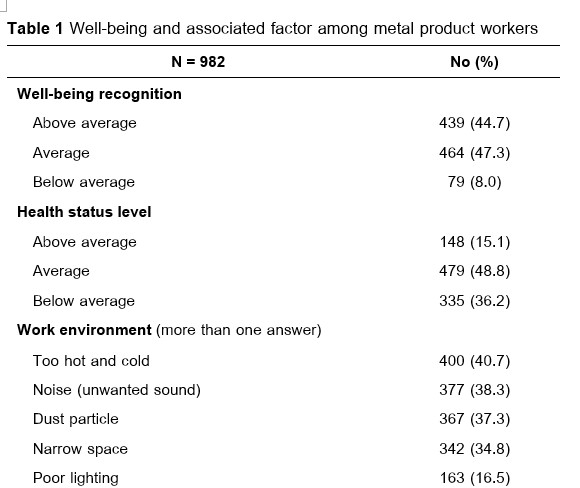
The aim of the study was to describe the work-related constituent; level of well-being, occupational illness, and workplace environment among 32 metal product SMEs. Overall, the well-being health status level in workplace was recognized in the above average and average 47.3 and 44.7%. Three most common barriers of physical occupational environment were reported: too hot and cold 40.7%, noise (38.3%), and dust particle (37.3%) followed by narrow space (34.8%), and poor lighting (16.5%), respectively. In conclusion, the early findings suggest that physical employee well-being is one of the obstacles, however other dimension of work-related well-being should be further explored.
เอกสารอ้างอิง
Country Diagnostic Study, Asian Development Bank. Thailand industrialization and economic catch-up. Mandaluyong, Philippines: Asian Development Bank; 2015. 77 p.
Grossmeier J, Fabius R, Flynn JP, Noeldner SP, Fabius D, Goetzel RZ, et al. Linking workplace health promotion best practices and organizational financial performance: tracking market performance of companies with highest scores on the HERO scorecard. J Occup Environ Med. 2016;58(1):16–23.
Fabius R, Thayer RD, Konicki DL, Yarborough CM, Peterson KW, Isaac F, et al. The link between workforce health and safety and the health of the bottom line: tracking market performance of companies that nurture a ‘‘culture of health’’. J Occup Environ Med. 2013;55:993–1000.
Gandy WM, Coberley C, Pope JE, Wells A, Rula EY. Comparing the contributions of well-being and disease status to employee productivity. J Occup Environ Med. 2014;56(3):252–257.
Alistair Dronan of Right Management. The Wellness imperative: Creating more effective organizations. Geneva, Switzerland: The World Economic Forum and Right Management; 2010. 20 p.
Shanafelt TD, Noseworthy JH. Executive leadership and physician wellbeing: Nine organizational strategies to promote engagement and reduce burnout. Mayo Clin Proc. 2017;92(1):129–146.
Diener E. Subjective well-being: the science of happiness and a proposal for a national index. Am Psychol. 2000;55(1):34–43.
Korunka C, Scharitzer D, Carayon P, Hoonakker P, Sonnek A, Sainfort F. Customer orientation among employees in public administration: a transnational, longitudinal study. Appl Ergon. 2007;38(3):307–315.
Gallup. Gallup-Healthways Well-Being Index: Methodology Report for Indexes. Gallup, Inc; 2009.
Ryff CD, Singer B. Psychological well-being: meaning, measurement, and implications for psychotherapy research. Psychother Psychosom. 1996;65(1):14–23.
Makikangas A, Kinnumen U, Feldt T. Warr's scale of job-related affective well-being: A longitudinal examination of its structure and relationships with work characteristics. Work Stress. 2007;21(3):197-219.
ดาวน์โหลด
เผยแพร่แล้ว
รูปแบบการอ้างอิง
ฉบับ
ประเภทบทความ
สัญญาอนุญาต
ลิขสิทธิ์ (c) 2020 วารสารนเรศวรพะเยา

อนุญาตภายใต้เงื่อนไข Creative Commons Attribution-NonCommercial-NoDerivatives 4.0 International License.
ผู้นิพนธ์ต้องรับผิดชอบข้อความในบทนิพนธ์ของตน มหาวิทยาลัยพะเยา ไม่จำเป็นต้องเห็นด้วยกับบทความที่ตีพิมพ์เสมอไป ผู้สนใจสามารถคัดลอก และนำไปใช้ได้ แต่จะต้องขออนุมัติเจ้าของ และได้รับการอนุมัติเป็นลายลักษณ์อักษรก่อน พร้อมกับมีการอ้างอิงและกล่าวคำขอบคุณให้ถูกต้องด้วย