การเปรียบเทียบชนิดของน้ำมันในการสกัดน้ำมันไพลและวิเคราะห์องค์ประกอบทางเคมีของน้ำมันไพลด้วยเทคนิคแก๊สโครมาโทกราฟี-แมสสเปกโตรเมทรี
คำสำคัญ:
ไพล, น้ำมันไพล, แก๊สโครมาโทรกราฟี-แมสสเปคสเปคโทรมิเตอร์บทคัดย่อ
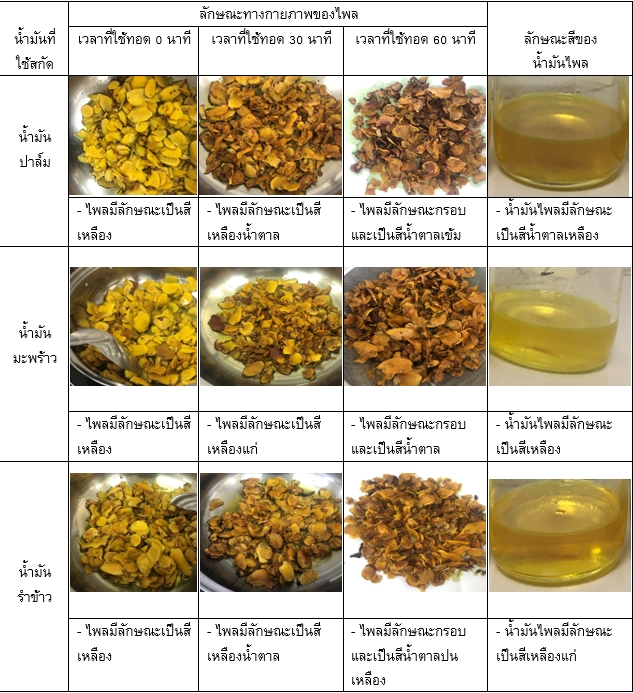
งานวิจัยนี้มีวัตถุประสงค์เพื่อศึกษาเปรียบเทียบน้ำมันที่ใช้ในการสกัดน้ำมันไพลต่อชนิดและปริมาณขององค์ประกอบทางเคมีซึ่งวิเคราะห์สารสำคัญของน้ำมันไพลด้วยเทคนิคแก๊สโครมาโทกราฟี-แมสสเปกโตรเมทรี ไพลสดสกัดโดยวิธีการทอดด้วยน้ำมัน 3 ชนิด ได้แก่ น้ำมันปาล์ม น้ำมันมะพร้าว และน้ำมันรำข้าวเพื่อสกัดน้ำมันไพล บันทึกลักษณะทางกายภาพของไพลในการทอดด้วยน้ำมันชนิดต่างๆ ณ เวลา 0, 30 และ 60 นาที และลักษณะสีของน้ำมันไพล หลังจากนั้นทำการวิเคราะห์สารสำคัญในน้ำมันไพลด้วยเทคนิคแก๊สโครมาโทกราฟี-แมสสเปกโตรเมทรี ผลการวิเคราะห์น้ำมันไพลที่สกัดโดยการใช้น้ำมันต่างชนิดกัน พบว่า ไพลที่สกัดโดยน้ำมันทุกชนิดพบสารสำคัญหลายชนิดใกล้เคียงกัน ในปริมาณที่แตกต่างกัน ได้แก่ hexanal, alpha-thujene, alpha-pinene, sabinene, beta-pinene, alpha-phellandrene, alpha-terpinene, p-cymene, alpha-limonene, beta-phellandrene, gamma-terpinene, alpha-terpinolene และ 1- isopropyl-4-methyl-3-cyclohexen-1-ol ซึ่งสารส่วนใหญ่ที่พบ จัดอยู่ในกลุ่ม monoterpenes จากผลการวิเคราะห์โดย GC-MS พบว่า ไพลที่สกัดได้จากน้ำมันทั้งสามชนิดให้สารที่ชื่อว่า 1- isopropyl-4-methyl-3-cyclohexen-1-ol หรือที่รู้จักกันในชื่อ terpinen-4-ol ในปริมาณที่สูงกว่าสารอื่น ๆ โดยให้ปริมาณสูงที่สุดเมื่อสกัดด้วยน้ำมันมะพร้าว ผลการทดลองชี้ให้เห็นว่าน้ำมันที่ใช้ในสกัดน้ำมันไพลที่แตกต่างกันมีผลต่อปริมาณสารสำคัญในน้ำมันไพล ดังนั้น ชนิดของน้ำมันที่ใช้ในการสกัดจึงเป็นปัจจัยหนึ่งที่มีผลต่อชนิดและปริมาณสารสำคัญในน้ำมันไพล อย่างไรก็ตาม ยังต้องมีการศึกษาปัจจัยอื่นๆ ที่เกี่ยวข้อง เพื่อเป็นประโยชน์ในการเลือกน้ำมันหรือวิธีที่เหมาะสมในการสกัดไพลเพื่อนำมาสร้างผลิตภัณฑ์สุขภาพในอนาคต
เอกสารอ้างอิง
Bua-in S, Paisooksantivatana Y. Essential oil and antioxidant activity of Cassumunar Ginger (Zingiberaceae: Zingiber montanum (Koenig) Link ex Dietr.) collected from various parts of Thailand. Kasetsart J (Nat Sci). 2009;43:467-75.
Han AR, Kim H, Piao D, Jung CH, Seo EK. Phytochemicals and Bioactivities of Zingiber cassumunar Roxb. Molecules. 2021;26(8):2377.
Jeenapongsa R, Yoovathaworn K, Sriwatanakul KM, Pongprayoon U, Sriwatanakul K. Anti-inflammatory activity of (E)-1-(3,4-dimethoxyphenyl) butadiene from Zingiber cassumunar Roxb. J Ethnopharmacol. 2003;87(2-3):143-8.
Masuda T, Jitoe A, Mabry T J. Isolation and structure determination of cassumunarins A, B, and C: new anti-inflammatory antioxidants from a tropical ginger, Zingiber cassumunar. J Am Oil Chem Soc 1995; 72(9): 1053-7.
Poachanukoon O, Meesuk L, Pattanacharoenchai N, Monthanapisut P, Dechatiwongse Na Ayudhya T, Koontongkaew S. Zingiber cassumunar ROXb. and its active constituent inhibit MMP-9 direct activation by house dust mite allergens and MMP-9 expression in PMA-stimulated human airway epithelial cells. Asian Pac J Allergy Immunol. 2015;33(1):42-51.
Department of Thai traditional and alternative medicine, Ministry Of Public Health. National master plan On the Development of Thai Herbs, Vol. 1, 2017–2021, First Edition, Nonthaburi: TS Interprint; 2016. 200 pages.
National Drug System Development Board. Appendix 4 List of herbal medicines. In: Announcement of the National Drug System Development Board Re: National List of Essential Drugs B.E. 2021.
Government Gazette, Volume 138, Special Section 165 D; 2021. P. 276-335.
Agustin MB, Phutdhawong W, Sengpracha W, Suvannachai N. A Survey on the Fatty Acid Composition of Commercial Palm Oil in Thailand. KMITL Science Journal. 2006;6(2b).
Giakoumis EG. Analysis of 22 vegetable oils’ physico-chemical properties and fatty acid composition on a statistical basis, and correlation with the degree of unsaturation. Renew Energy. 2018;126(C):403-19.
Sukatta U, Rugthaworn P, Punjee P, Chidchenchey S, Keeratinijakal V. Chemical composition and physical properties of Oil from plai (Zingiber cassumunar Roxb.) obtained by hydro distillation and hexane extraction. Kasetsart J (Nat Sci). 2009;43(5):212-7.
Che man YB, Wan Hussin WR. Comparison of the frying performance of refined, bleached and deodorized palm olein and coconut oil. J Food Lipids. 1998; 5:197-210.
Dorni C, Sharma P, Saikia G, Longvah T. Fatty acid profile of edible oils and fats consumed in India. Food Chem. 2018;238:9-15.
Mishra S, Manchanda SC. Cooking oils for heart health. J. Preventive Cardiology. 2012;1(3):123-31
Srivastava Y, Semwal AD. A study on monitoring of frying performance and oxidative stability of virgin coconut oil (VCO) during continuous/prolonged deep fat frying process using chemical and FTIR spectroscopy. J Food Sci Technol. 2015;52:984-91.
Matthäu B. Use of palm oil for frying in comparison with other high-stability oils. Eur J Lipid Sci Technol. 2007;109:400-9.
Duan L, Dou LL, Guo L, Li P, Liu EH. Comprehensive evaluation of deep eutectic solvents in extraction of bioactive natural products. ACS Sustain Chem Eng. 2016;4:2405-11.
Huang H, Xu Q, Belwal T, Li L, Aalim H, Wu Q, et al. Ultrasonic impact on viscosity and extraction efficiency of polyethylene glycol: A greener approach for anthocyanins recovery from purple sweet potato. Food Chem. 2019;283:59-67.
Kar F, Arslan N. Effect of temperature and concentration on viscosity of orange peel pectin solutions and intrinsic viscosity–molecular weight relationship. Carbohydr Polym. 1999;40(4);277-284.
Bora PK, Saikia J, Kemprai P, Saikia SP, Banik D, Haldar S. Evaluation of Postharvest Drying, Key Odorants, and Phytotoxins in Plai (Zingiber montanum) Essential Oil. J Agric Food Chem. 2021;69(19):5500-9.
Morcia C, Malnati M, Terzi V. In vitro antifungal activity of terpinen-4-ol, eugenol, carvone, 1,8-cineole (eucalyptol) and thymol against mycotoxigenic plant pathogens. Food Addit Contam Part A Chem Anal Control Expo Risk Assess. 2012;29(3):415-22.
Zhang Y, Feng R, Li L, Zhou X, Li Z, Jia R, et al. The Antibacterial Mechanism of Terpinen-4-ol Against Streptococcus agalactiae. Curr Microbiol. 2018;75(9):1214-20.
Bora H, Kamle M, Mahato DK, Tiwari P, Kumar P. Citrus Essential Oils (CEOs) and Their Applications in Food: An Overview. Plants. 2020; 9(3):357.
Su Y-C, Hsu K-P, Hua K-F, Ho C-L. Composition, in Vitro Anti-inflammatory, Antioxidant and Antimicrobial Activities of Essential Oils from Leaf and Twig Parts of Cupressus Cashmeriana. Nat Prod Commun. 2015;10(8):1461-4.
Bayala B, Bassole IH, Scifo R, Gnoula C, Morel L, Lobaccaro JM, et al. Anticancer activity of essential oils and their chemical components - a review. Am J Cancer Res. 2014;4(6):591-607.
ดาวน์โหลด
เผยแพร่แล้ว
รูปแบบการอ้างอิง
ฉบับ
ประเภทบทความ
สัญญาอนุญาต
ลิขสิทธิ์ (c) 2022 วารสารนเรศวรพะเยา

อนุญาตภายใต้เงื่อนไข Creative Commons Attribution-NonCommercial-NoDerivatives 4.0 International License.
ผู้นิพนธ์ต้องรับผิดชอบข้อความในบทนิพนธ์ของตน มหาวิทยาลัยพะเยา ไม่จำเป็นต้องเห็นด้วยกับบทความที่ตีพิมพ์เสมอไป ผู้สนใจสามารถคัดลอก และนำไปใช้ได้ แต่จะต้องขออนุมัติเจ้าของ และได้รับการอนุมัติเป็นลายลักษณ์อักษรก่อน พร้อมกับมีการอ้างอิงและกล่าวคำขอบคุณให้ถูกต้องด้วย