คุณลักษณะของเศษเหลือทิ้งสับปะรดภูแล และศักยภาพการนำไปใช้ตามแนวคิดเศรษฐกิจหมุนเวียน
คำสำคัญ:
ความสามารถต้านออกซิเดชัน, เศรษฐกิจหมุนเวียน, เส้นใยอาหาร, พอลิฟีนอล, เศษเหลือทิ้งสับปะรดบทคัดย่อ
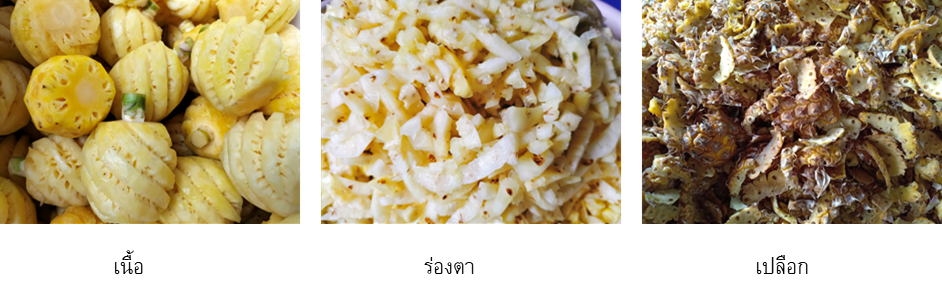
สับปะรดภูแลเป็นผลไม้เศรษฐกิจของจังหวัดเชียงราย ในระหว่างการตัดแต่งสับปะรดจะสร้างเศษเหลือทิ้งมากกว่าร้อยละ 50 ของน้ำหนักทั้งหมด งานวิจัยนี้ศึกษาสมบัติทางเคมีกายภาพของเส้นใยอาหารและสารสกัดที่ได้จากการสกัดส่วนเนื้อ ร่องตา และเปลือกสับปะรดด้วยเอทานอล ผลการศึกษาพบว่า สารสกัดจากเปลือกสับปะรดมีปริมาณของฟีนอลิก ฟลาโวนอยด์ และความสามารถต้านออกซิเดชันมากกว่าสารสกัดจากส่วนเนื้อ และร่องตาของสับปะรดอย่างมีนัยสำคัญ ในขณะที่เมื่อใช้ความเข้มข้นของเอทานอลสูงขึ้นในการสกัดเปลือกสับปะรดมีผลทำให้ปริมาณฟีนอลิก และฟลาโวนอยด์มีแนวโน้มลดลง เส้นใยอาหารจากส่วนของเปลือกและร่องตาสับปะรดมีความสามารถในการจับน้ำมันและการอุ้มน้ำดีกว่าเส้นใยอาหารที่ได้จากส่วนเนื้อของสับปะรด เส้นใยอาหารจากส่วนของเปลือกและร่องตาสับปะรดที่ได้จากกรรมวิธีการสกัดด้วยเอทานอลความเข้มข้นร้อยละ 80 และ 90 มีความสามารถในการพองตัวที่ดี มีค่าเท่ากับ 10 มิลลิลิตรต่อกรัมน้ำหนักแห้ง เส้นใยอาหารจากส่วนของเนื้อสับปะรดมีค่าดัชนีความขาวมากกว่าเส้นใยอาหารที่ได้จากร่องตาและเปลือกของสับปะรด ในขณะที่การใช้ความเข้มข้นของเอทานอลที่แตกต่างกันไม่มีผลต่อค่าดัชนีความขาวของเส้นใยอาหารที่ผลิตได้ ดังนั้นเศษเหลือทิ้งจากสับปะรดจัดเป็นแหล่งของพอลิฟีนอลและเส้นใยอาหารที่มีแนวโน้มเหมาะสมสำหรับการใช้เป็นสารให้ประโยชน์เชิงหน้าที่ในภาคอุตสาหกรรมเพื่อขับเคลื่อนอุตสาหกรรมเกษตรด้วยแนวคิดเศรษฐกิจหมุนเวียนที่ยั่งยืน
เอกสารอ้างอิง
Ming R, VanBuren R, Wai CM, Tang H, Schatz MC, Bowers JE, et al. The pineapple genome and the evolution of CAM photosynthesis. Nat Genet. 2015;47(12):1435-1442.
Food and Agriculture Organization of the United Nations (FAO). Faostat Database. Retrieved Feb 22, 2023, from https://www.fao.org/faostat.
Ketnawa S, Chaiwut P, Rawdkuen S. Pineapple wastes: A potential source for bromelain extraction. Food Bioprod Process. 2012;90(3):385–391.
Dorta E, Sogi DS. Value added processing and utilization of pineapple by-products. In Handbook of Pineapple Technology: Production, postharvest science, processing and nutrition, Lobo MG, Paull RE (Eds.). Oxford: Wiley; 2017: pp. 196-220.
Garcia-Amezquita LE, Tejada-Ortigoza V, Serna-Saldivar SO, Welti-Chanes J. Dietary fiber concentrates from fruit and vegetable by-products: processing, modification, and application as functional ingredients. Food Bioprocess Technol. 2018;11:1439–1463.
Wanlapa S, Wachirasiri K, Sithisam-ang D, Suwannatup T. Potential of selected tropical fruit peels as dietary fiber in functional foods. Int J Food Prop. 2015;18(6):1306-1316
.
Weerawatanakorn M. Chemical reactions between proteins and polyphenols and human biological consequences of reaction. BUSCIJ. 2013;18(1):210-218.
Horwitz W, Editor. Official methods of analysis of AOAC INTERNATIONAL, 18th ed., AOAC INTERNATIONAL: Gaithersburg; 2005. Official Method 2005.08.
Sharma P, Gujral HS. Antioxidant potential of wheat flour chapattis as affected by incorporating barley flour. LWT-Food Sci Technol. 2014;56(1):118-123.
Zhishen J, Mengcheng T, Jianming W. The determination of flavonoid contents in mulberry and their scavenging effects on super-oxide radicals. Food Chem. 1999;64(4):555-559.
Wicharaew K, Prommajak T, Ruenwai R. Effect of extraction methods on the physicochemical properties of fiber from bamboo shoot waste. Malays Appl Biol. 2019;48(4):39-45.
Luo X, Wang Q, Fang D, Zhuang W, Chen C, Jiang W, et al. Modification of insoluble dietary fibers from bamboo shoot shell: Structural characterization and functional properties. Int J Biol Macromol. 2018;120:1461–1467.
Luo X, Wang Q, Zheng B, Lin L, Chen B, Zheng Y, et al. Hydration properties and binding capacities of dietary fibers from bamboo shoot shell and its hypolipidemic effects in mice. Food Chem Toxicol. 2017;109:1003-1009.
Ullah I, Hu Y, You J, Yin T, Xiong S, Din Z, et al. Influence of okara dietary fiber with varying particle sizes on gelling properties, water state and microstructure of tofu gel. Food Hydrocoll. 2019;89:512-522.
Hossain MA, Mizanur Rahman SM. Total phenolics, flavonoids and antioxidant activity of tropical fruit pineapple. Food Res Inter. 2011;44(3):672–676.
Li T, Shen P, Liu W, Liu C, Liang R, Yan N, Chen J. Major polyphenolics in pineapple peels and their antioxidant interactions. Int J Food Prop. 2014;17(8):1805-1817.
Banerjee J, Singh R, Vijayaraghavan R, MacFarlane D, Patti AF, Arora A. Bioactives from fruit processing wastes: Green approaches to valuable chemicals. Food Chem. 2017;225:10-22.
Kongsuwan A, Suthiluk P, Theppakorn T, Srilaong V, Setha S. Bioactive compounds and antioxidant capacities of phulae and nanglae pineapple. Asian J. Food and Agro-Ind. 2009;2:S44-S50.
Yoyponsan P, Thuengtung S, Ogawa Y, Naradisorn M, Setha S. Influence of harvest maturity and storage condition on changes on volatile compounds of ‘Phulae’ pineapple fruit. JFAT. 2019;5:128-139.
Rico X, Gullón B, Alonso JL, Yáñez R. Recovery of high value-added compounds from pineapple, melon, watermelon and pumpkin processing by-products: An overview. Food Res Inter. 2020;132:109086.
Campos DA, Ribeiro TB, Teixeira JA, Pastrana L, Pintado MM. Integral valorization of pineapple (Ananas comosus L.) by-products through a green chemistry approach towards added value ingredients. Foods. 2020;9(1):60.
Lasunon P, Phonkerd N, Tettawong P, Sengkhamparn N. Total phenolic compound and its antioxidant activity of by-product from pineapple. Food Res. 2022:6(4);107-112.
Managa MG, Akinola SA, Remize F, Garcia C, Sivakumar D. Physicochemical parameters and bioaccessibility of lactic acid bacteria fermented chayote leaf (Sechium edule) and pineapple (Ananas comosus) smoothies. Front Nutr. 2021;8:649189.
Costa MGM, Fonteles TV, de Jesus ALT, Sueli Rodrigues S. Sonicated pineapple juice as substrate for L. casei cultivation for probiotic beverage development: process optimisation and product stability. Food Chem. 2013;139(1-4),261-266.
Nguyen BT, Bujna E, Fekete N, Tran ATM, Rezessy-Szabo JM, Prasad R, Nguyen QD. Probiotic beverage from pineapple juice fermented with Lactobacillus and Bifidobacterium strains. Front Nutr. 2019;6:54.
Cassellis MER, Pardo MES, López, MR, Escobedo RM. Structural, physicochemical and functional properties of industrial residues of pineapple (Ananas comosus). Cellul Chem Technol. 2014;48(7-8): 633-641.
Chiewchan N, Devahastin S. editor. 10-Microstructure, constituents, and their relationship with quality and functionality of dietary fibers. In Woodhead Publishing Series in Food Science, Technology and Nutrition. Food Microstructure and Its Relationship with Quality and Stability. Duxford: Woodhead Publishing; 2018.193-216.
Nassar AG, AbdEl-Hamied AA, El-Naggar EA. Effect of citrus by-products flour incorporation on chemical, rheological and organolepic characteristics of biscuits. World J Agric Sci. 2008;4(5):612-616.
ดาวน์โหลด
เผยแพร่แล้ว
รูปแบบการอ้างอิง
ฉบับ
ประเภทบทความ
สัญญาอนุญาต
ลิขสิทธิ์ (c) 2023 มหาวิทยาลัยพะเยา

อนุญาตภายใต้เงื่อนไข Creative Commons Attribution-NonCommercial-NoDerivatives 4.0 International License.
ผู้นิพนธ์ต้องรับผิดชอบข้อความในบทนิพนธ์ของตน มหาวิทยาลัยพะเยา ไม่จำเป็นต้องเห็นด้วยกับบทความที่ตีพิมพ์เสมอไป ผู้สนใจสามารถคัดลอก และนำไปใช้ได้ แต่จะต้องขออนุมัติเจ้าของ และได้รับการอนุมัติเป็นลายลักษณ์อักษรก่อน พร้อมกับมีการอ้างอิงและกล่าวคำขอบคุณให้ถูกต้องด้วย