ผลของยีสต์ Torulaspora delbrueckii และ Metschnikowia pulcherrima ต่อกิจกรรม การหมักและคุณภาพทางประสาทสัมผัสของไซเดอร์ลิ้นจี่ (พันธุ์ฮงฮวย) ชนิดมีแก๊ส
คำสำคัญ:
ไซเดอร์ลิ้นจี่ชนิดมีแก๊ส, Torulaspora delbrueckii, Metschnikowia pulcherrima, กิจกรรมการหมัก, คุณภาพทางประสาทสัมผัสบทคัดย่อ
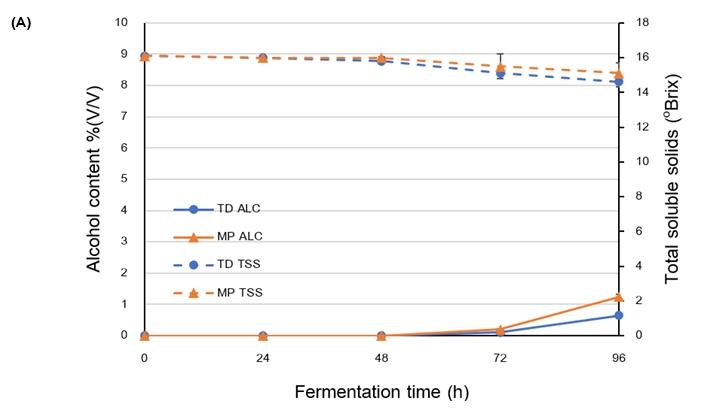
งานวิจัยนี้นำลิ้นจี่ผลร่วงซึ่งมีราคาจำหน่ายต่ำและมีอายุการเก็บรักษาสั้น มาใช้เป็นวัตถุดิบในการผลิตไซเดอร์ลิ้นจี่ชนิดมีแก๊ส โดยหมักน้ำลิ้นจี่ด้วยยีสต์ non-Saccharomyces 2 สายพันธุ์ (Torulaspora delbrueckii; TD และ Metschnikowia pulcherrima; MP) ในขวดแก้วที่ปิดสนิท บ่มที่อุณหภูมิห้อง (30±3 องศาเซลเซียส) เป็นเวลา 96 ชั่วโมง ตรวจสอบกิจกรรมการหมักของยีสต์ ทุก 24 ชั่วโมง ผลการวิจัยพบว่ายีสต์ TD เริ่มกิจกรรมการหมักไซเดอร์ลิ้นจี่ก่อนยีสต์ MP แต่มีอัตราการเปลี่ยนน้ำตาลไปเป็นแอลกอฮอล์และแก๊สคาร์บอนไดออกไซด์ต่ำกว่ายีสต์ MP ไซเดอร์ลิ้นจี่ชนิดมีแก๊สที่ผลิตด้วยยีสต์ TD มีคะแนนการทดสอบทางประสาทสัมผัสในด้านความเข้มของกลิ่นผลไม้ เขตร้อน ความชอบในด้านกลิ่น กลิ่นรส และความชอบโดยรวม สูงกว่าไซเดอร์ลิ้นจี่ชนิดมีแก๊สที่หมักด้วยยีสต์ MP
เอกสารอ้างอิง
Office of Agricultural Economics. [internet]. Accessed 2022 March 13. Available from: http://mis- app.oae.go.th/product/%E0%B8%A5%E0%B8%B4%E0%B9%89%E0%B8%99%E0%B8%88% E0%B8%B5%E0%B9%88.
Bangkokbiznews [internet]. Accessed 2022 May 5. Available from: https://www.bangkokbiznews.com/news/1002717.
Panee Sirisa-ard [internet]. Accessed 2021 December 24. Available from: https://www.pharmacy.cmu.ac.th/web2553/n56.php.
Joshi VK, Attri BL. Chapter 7 Specific features of table wine production. In: Kosseva M, Joshi VK, Panesar PS. Science and technology of fruit wine production. 1sted, 318-319. London, UK: Elsevier, Inc.; 2017.
Jarvis B. Cider (Cyder; Hard Cider). In: Batt CA, Tortorello ML. Encyclopedia of food sciences and nutrition, vol 1. 2nd ed, 437–443. Ross-on-Wye, UK: Elsevier, Inc.; 2014.
Mahannopkul W, Inprasit K. Banana cider production. Bull Dept Sci Ser. 2012;60(188):8-9.
Lobo AP, García DY, MangasSánchez J, Madrera RR, SuárezValles B. Phenolic and antioxidant composition of cider. J Food Compos Anal. 2009;22(7–8):644-648.
Zuriarrain A, Zuriarrain J, Puertas IA, Dueñas TM, Ostra M, Berregi I. Polyphenolic profile in cider and antioxidant power. J Sci Food Agric. 2015;95(14):2931-2943.
Allied Market Research [internet]. Accessed 2019 October 25. Available from: https://www.alliedmarketresearch.com/cider-market.
Yongpisanphob W [internet]. Accessed 2019 May 3. Available from: https://www.krungsri.com/th / research/industry/industry-outlook/Food-Beverage/Beverage/IO/io-beverage-20-th.
Alicia G, Teun B, Zoran G, Michael K. Evaluation of non-Saccharomyces yeasts in the fermentation of wine, beer and cider for the development of new beverages. J Inst Brew. 2018;124:389–402.
Sgouros G, Chalvantzi I, Mallouchos A, Paraskevopoulos Y, Banilas G, Nisiotou A. Biodiversity and enological potential of non-Saccharomyces yeasts from Nemean vineyards. Fermentation. 2018;4(32):1-13.
Kręgiel D, Pawlikowska E, Antolak H, Dziekońska-Kubczak U, Pielech-Przybylska K. Exploring use of the Metschnikowia pulcherrima clade to improve properties of fruit wines. Fermentation. 2022;8(247):1-16.
Zhang B, Liu H, Xue J, Tang C, Duan C, Yan G. Use of Torulaspora delbrueckii and Hanseniaspora vineae co-fermentation with Saccharomyces cerevisiae to improve aroma profiles and safety quality of Petit Manseng wines. LWT. 2022;161(113360):1-8.
Karabegović I, Malićanin M, Danilovic B, Stanojevic J, Stojanovic SS, Nikolic N, Lazic M. Potential of non-Saccharomyces yeast for improving the aroma and sensory profile of Prokupac red wine. IVES. 2021;2:181-195.
González-R. E, Pascual O, Kontoudakis N, Esteruelas M, Esteve-Z B, Mas A, Canals JM, Zamora F. Oenological consequences of sequential inoculation with non-Saccharomyces yeasts (Torulaspora delbrueckii or Metschnikowia pulcherrima) and Saccharomyces cerevisiae in base wine for sparkling wine production. Eur Food Res Technol. 2015;240:999–1012.
Sadineni V, Kondapalli N, Obulam VSR. Effect of co-fermentation with Saccharomyces cerevisiae and Torulaspora delbrueckii or Metschnikowia pulcherrima on the aroma and sensory properties of mango wine. Ann Microbiol. 2012;62:1353–1360.
Einfalt D. Barley‑sorghum craft beer production with Saccharomyces cerevisiae, Torulaspora delbrueckii and Metschnikowia pulcherrima yeast strains. Eur Food Res Technol. 2021;247:385–393.
Bely M, Stoeckle P, Masneuf-Pomarède I, Dubourdieu D. Impact of mixed Torulaspora delbrueckii–Saccharomyces cerevisiae culture on high-sugar fermentation. Int J Food Microbiol. 2008;122:312–320.
Dutraive O, Benito S, Fritsch S, Beisert B, Patz C, Rauhut D. Effect of Sequential Inoculation with Non-Saccharomyces and Saccharomyces Yeasts on Riesling Wine Chemical Composition. Fermentation. 2019;5(79):1-16.
AOAC. Official methods of analysis. Association of official chemist. Washington; 1995.
Civille GV, Carr BT. Sensory evaluation techniques. 5th ed, 630. Boca Raton: CRC Press; 2015.
Ribereau-Gayon P, Glories Y, Maujean A, Dubourdieu D. Chapter 1 Organic Acids in Wine. In: andbook of enology volume 2; The chemistry of wine stabilization and treatments. 2nd ed, 451. West Sussex, UK: John Wiley & Sons Ltd.; 2006.
The Australian Wine Research Institute [internet]. Accessed 2021 October 10. Available from:
https://www.awri.com.au/industry_support/winemaking_resources/frequently_asked_questions/acidity_ and_ph/
Morata A, Loira I, Escott C, Fresno JM, Bañuelos MA, Lepe JAS. Applications of Metschnikowia pulcherrima in wine biotechnology. Fermentation. 2019;5(63):1-9.
Benito S. The impact of Torulaspora delbrueckii yeast in winemaking. Appl Microbiol Biotechnol. 2018;102:3081–3094.
Jolly NP, Augustyn OPH, Pretorius IS. The role and use of non-Saccharomyces yeasts in wine Production. S Afr J Enol Vitic. 2006;27(1):15-38.
Feng CT, Du X, Wee J. Microbial and chemical analysis of non-Saccharomyces yeasts from
Chambourcin hybrid grapes for potential use in winemaking, Fermentation. 2021;7(15):1-23.
Chen K, Escott C, Loira I, del Fresno JM, Morata A, Tesfaye W, Calderon F, Suárez-Lepe JA, Han S, Benito S. Use of non-Saccharomyces yeasts and oenological tannin in red winemaking: influence on colour, aroma and sensorial properties of young wines. Food Microbiol. 2018;69:51–63.
Chen D, Liu S-Q. Impact of simultaneous and sequential fermentation with Torulaspora delbrueckii and Saccharomyces cerevisiae on non-volatiles and volatiles of lychee wines. LWT-Food Sci Technol. 2016;65:53–61.
Panjai L, Ongthip K, Chomsri N. Complex fruit wine produced from dual culture fermentation of pineapple juice with Torulaspora delbrueckii and Saccharomyces cerevisiae. As J Food Ag-Ind. 2009; 2(02):135-139.
ดาวน์โหลด
เผยแพร่แล้ว
รูปแบบการอ้างอิง
ฉบับ
ประเภทบทความ
สัญญาอนุญาต
ลิขสิทธิ์ (c) 2023 มหาวิทยาลัยพะเยา

อนุญาตภายใต้เงื่อนไข Creative Commons Attribution-NonCommercial-NoDerivatives 4.0 International License.
ผู้นิพนธ์ต้องรับผิดชอบข้อความในบทนิพนธ์ของตน มหาวิทยาลัยพะเยา ไม่จำเป็นต้องเห็นด้วยกับบทความที่ตีพิมพ์เสมอไป ผู้สนใจสามารถคัดลอก และนำไปใช้ได้ แต่จะต้องขออนุมัติเจ้าของ และได้รับการอนุมัติเป็นลายลักษณ์อักษรก่อน พร้อมกับมีการอ้างอิงและกล่าวคำขอบคุณให้ถูกต้องด้วย