
ผลของวัสดุอินทรีย์ต่อการเจริญเติบโต ปริมาณสารฟีนอลิกทั้งหมด และฤทธิ์ต้านอนุมูลอิสระของกระชายแดง
Article Sidebar
Main Article Content
บทคัดย่อ
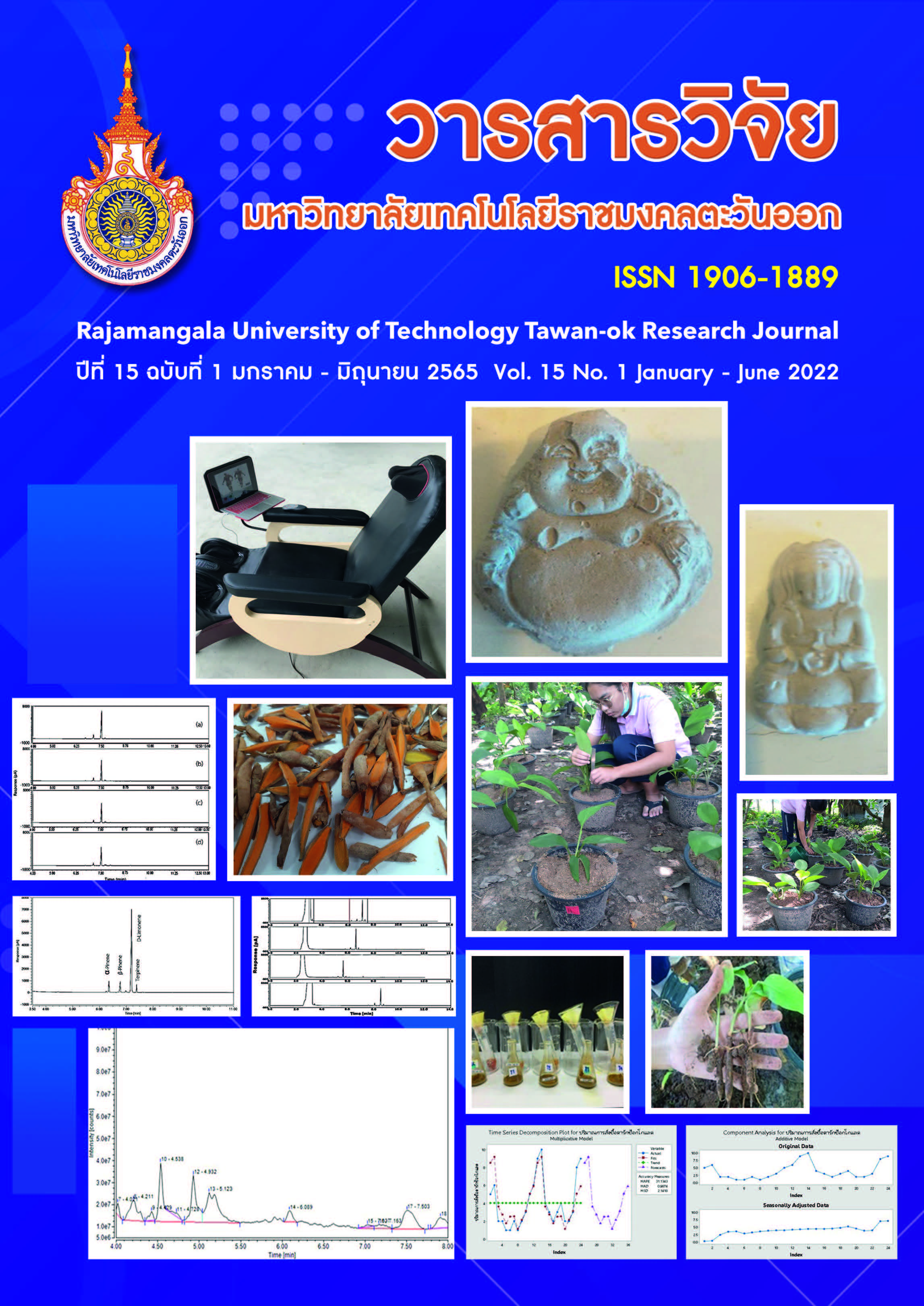
การวิจัยนี้มีวัตถุประสงค์เพื่อศึกษาการเจริญเติบโต ปริมาณสารฟีนอลิก และฤทธิ์ต้านอนุมูลอิสระ ของกระชายแดงที่ปลูกในวัสดุอินทรีย์ต่างกัน วางแผนการทดลองแบบสุ่มสมบูรณ์ ประกอบด้วย กรรมวิธีที่ 1 ดินร่วนปนทราย : มูลไก่ : แกลบ อัตรา 2:1:1 โดยปริมาตร กรรมวิธีที่ 2 ดินร่วนปนทราย : มูลวัว : แกลบ อัตรา 2:1:1 โดยปริมาตร กรรมวิธีที่ 3 ดินร่วนปนทราย : มูลสุกร : แกลบ อัตรา 2:1:1 โดยปริมาตร กรรมวิธีที่ 4 ดินร่วนปนทราย : ปุ๋ยอินทรีย์อัดเม็ด อัตรา 2:1 โดยปริมาตร กรรมวิธีที่ 5 ดินร่วนปนทราย : แกลบ อัตรา 2:1 โดยปริมาตร และกรรมวิธีที่ 6 ดินร่วนปนทราย (ชุดควบคุม) ผลการศึกษาพบว่า กระชายแดงมีความสูงเพิ่มขึ้นตามระยะเวลา ความสูงของกระชายระยะ 15 วัน และ 30 วัน ไม่มีความแตกต่างกันทางสถิติ (p > 0.05) แต่เมื่อระยะเวลา 90 วัน มีความแตกต่างกันทางสถิติ (p < 0.05) โดยกรรมวิธีที่ปลูกในมูลสุกรผสมแกลบอัตราส่วน 1:1 จะมีความสูงเฉลี่ย เท่ากับ 17.50 ซม. ส่วนกรรมวิธีที่ปลูกในดินร่วนปนทรายมีความสูงเฉลี่ยเท่ากับ 12.66 ซม. จำนวนหน่อต่อกอไม่มีความแตกต่างกันทางสถิติ (p > 0.05) กรรมวิธีที่ปลูก ดินร่วนปนทราย มูลวัวและแกลบ อัตรา 2:1:1 มีจำนวนหน่อมากที่สุดเท่ากับ 3.66 หน่อและมีน้ำหนักหลังปลูกเฉลี่ยมากที่สุดเท่ากับ 49.03 กรัมต่อกระถาง ส่วนปริมาณสารประกอบฟีนอลิกทั้งหมด และความสามารถในการต้านอนุมูลอิสระ พบว่ามีความแตกต่างกันทางสถิติ (p < 0.05) โดยกรรมวิธีที่ปลูกในมูลไก่ผสมแกลบอัตราส่วน 1:1 มีปริมาณสารประกอบฟีนอลิกทั้งหมดสูงที่สุดเท่ากับ 8,749.00 มิลลิกรัมสมมูลกรดแกลลิกต่อกรัมสารสกัด และมีความสามารถในการต้านอนุมูลอิสระดีที่สุด 82% ส่วนกรรมวิธีที่ปลูกในดินร่วนปนทรายผสมแกลบอัตรา 1:1 มีปริมาณสารประกอบฟีนอลิกทั้งหมดน้อยที่สุดเท่ากับ 5,599.07 มิลลิกรัมสมมูลกรดแกลลิกต่อกรัมสารสกัด และเมื่อปลูกในดินร่วนปนทราย ทำให้พืชมีความสามารถในการต้านอนุมูลอิสระน้อยที่สุดเท่ากับ 71.73% ถ้าต้องการปลูกเพื่อใช้ประโยชน์นั้นควรใช้วัสดุปลูกจากมูลไก่ผสมดินร่วนปนทราย อัตราส่วน 2:1:1 มีปริมาณสารประกอบฟีนอลิกทั้งหมดสูงที่สุด และมีความสามารถในการต้านอนุมูลอิสระดีที่สุด
Article Details

อนุญาตภายใต้เงื่อนไข Creative Commons Attribution-NonCommercial-NoDerivatives 4.0 International License.
เอกสารอ้างอิง
Bray, R. H. and L.T, Kurtz. 1945 Determination of total organic and available forms of phosphorus in soil. Soil Science. 9 : 39-45.
Chahyadi, A., R. Hartati, K. R. Wirasutisna, and Elfahmi 2014. Boesenbergia pandurata Roxb.,An Indonesian Medicinal Plant : Phytochemistry, Biological Activity, Plant Biotechnology. Procendia Chem. 13: 13-37.
Chattrakul, A. 2012. Research report of development of compost products from Tamarind waste. Faculty of Agricultural Technology. Petchabun Rajabhat University, Petchabun.
Cheenpracha, S., C. Kararai, C. Ponglimanont, S. Subhadhirasakul, and S. Tewtrakul. 2006. Anti-HIV-1 protease activity of comounds from Boesenbergia pandurata. Bioorganic and Medicinal Chemistry. 14(6): 1710-1714.
Chiang, M., Y. Kurmoo, and T. J. Khoo, 2017. Chemical and Cell Based Antioxidant Capacity of Methanolic Extracts of Three Commonly Edibla Plants from Zingiberaceas Family, Free Radic, Antioxidant. 7(1): 57-62.
Cordovil, C. M. D. S., J. Coutinho, M. Goss, and F. Cabral 2005. Potentially mineralizable nitrogen from organic materials applied to a sandy soil: fitting the one pool exponential model. Soil Use Manage. 21: 65-72.
Dayegamiye, A., A. Drapeau, and C. Nduwamungu. 2010. Fresh and composted paper sludges sustain soil productivity. International Journal Agronomy. 2010: 1-10.
El-Moniem, A., M. Naguib, F. K. El-Baz, Z. A. Salama, H. A. E. B. Hanaa, H. F. Ali, and A. A. Gaafar, 2012. Enhancement of phenolics, flavonoids and glucosinolates of Broccoli (Brassica olaracea, var.Italica) as antioxidants in response to organic and bio-organic fertilizers, Journal Saudi Soc. Agricultural Science, 11: 135-142.
Eng-Chong, T., L. Yean-Kee, C, Chin-Fei, H, Choon-Han, W. Sher-Ming, C. T. Li-Ping, F. Gen-Teck, N. Khalid, N. A. Rahman, S. A. Karsani, S. Othman, R. Othman and R. Yusof. 2012. Review Article Boesenbergia rotunda : From Ethnomedicine to Drug Discovery. Evidence- Based Complementary and Alternative Medicine. 25p. Hindawi Publishing Corporation.
Hemwong, S. and P. Vityakon. 2019. Effects of Organic Materials Managements on Soil Fertility, Growth and Yield of Sugarcane. Prawarun Agriculture Journal. 16(2) : 361 – 373
Ibrahim M.H., H. Z. Jaafar. A. Rahmat. and Z. A. Rahman. 2011. Effects of nitrogen fertilization on synthesis of primary and secondary metabolites in three varieties of Kacip Fatimah (Labisia pumila Blume). International .Journal Molecules Science, 12: 52-54.
Jackson, M. L. 1958. Soil chemical analysis. Prentice Halloflnc, New Jersy.
Jones, J. B. Jr., 2001. Laboratory Guide for Conducting Soil tests and Plant Analysis. Boca Raton : CRC Press.
Kesan, J. P. 2007. Agricultural Biotechnology and Intellectual Property Seeds of Change . CAB International, Wallingford.
Kiat, S., P. Richad, Y. Rohana, I. Halijah, K. Norzulaani. and A. Noorsaadah, 2006. Inhibitory activity of Cyclo hexrnyl Chacone derivatives and flavonoids of fingerroot, Boesenbergia rotunda (L.) towards dengue-2 virus NS3 protease, Bioorganic Medical Chemistry Letters, 16: 3337-3340.
Kim, J. H., F, Chen. X, Wang. H. Y., Chung. and Z, Jan. 2005. Evaluation of antioxidant activity of vetiver (Vetiveria zizaniodes L.) oil and identification of its antioxidant constituents, Journal of Agricultural and Food Chemistry, 53(20) :7691-7695.
Kowwilaisang, N. and C. Aninbon, 2018. Influence of Organic Fertilizer Types on Yield Components and Total Phenolic Compounds in Peanut. Thai Science and Technology Journal (TSTJ). 28(2) : 265-273.
Lesing, S. 2015. Effect of Organic Fertilizer on Growth and Yield Quality of White Mugwort. Master of Science, Thammasat University.
Li, J., Z. Zhu, and J. Gerendas, 2008. Effects of nitrogen and sulfur on total phenolics and antioxidant activity in two genotypes of leaf mustard, Journal Plant Nutrition. 31: 1642-1655.
Loypimai, P., A, Moongngam. and P, Chottanom. 2009. Effects of Ohmic Heating on Lipase Activity, Bioactive Compounds and Antioxidant Activity of Rice Bran. Australian Journal of Basic and Applied Sciences, 3(4): 3642-3652.
Nurrachma, M. Y., H, Fadliyah. and E, Meiyanto. 2018. Fingerroot Boesenbergia pandurata : A Prospective Anticancer Therapy. Indonesia Journal Cancer Chemoprevent. 9(2): 102-109.
Phongpaichit, S., S, Subhadhirassakul. and C, Wattanapiromsakul. 2005. Antifungal activities of extracts from Thai medicinal plants against opportunistic fulgal pathogens associated with AIDS patients. Mycoses 48(5): 333-338.
Pojangaroon, S. 2006. Possibility for Krachai-Dam (Kaempferia paruiflora W. ex Baker) Commercial Production. Thai Agricultural Research Journal. 24(3): 263-287.
Ratneetoo, B. 2009. Organic Fertilizer Improves Deteriorated Soil. Princces of Naradhivas University Journal 1(2): 1-15.
Shindo, K., M, Kato. A, Kinoshita. A, Kobayashi. and Y, Koike. 2006. Analysis of antioxidant activities contained in the Boesenbergia rotunda. Schult. Rhizome. Bioscince Biotechnol Biochem. 70(9): 2281-2284.
Srihabun, P., S, Saelim. P, Potinam. and S, Teamthaisong. 2013. High quality organic fertilizer for vegetable growing on Chum Phuang soil series, case study of Chinese kale. Available : http://www. r05.ldd.go.th.Accessed March 28, 2013
Sereme, A., C. Dabire, M. Koala, M. K. Somda and A. S. Raore, 2016. Influence of organic and mineral fertilizers on the antioxidants and total phenolic compounds level in tomato (Solanum lycopersicum) var. mongal F1, Journal Experimental Biology Agricultural Science. 4: 414-420.
Sudwan, P., Saenpet, K., Aritajat, S., Sitasuwan, N. 2007. Effect of Boesenbergia rotunda (L.) Mansf. On sexual behavior of male rats. Asian Journal Androl. 9(6): 849-855.
Supinrach,S., I, Supinrach. and R, Sriwanchai. 2016. Effect of Media on Growth and Flowering of China Pink (Dianthus chinensis) Songklanakarin journal. 3 (Suppl.II): 77- 82.
Taokaenchan, N., P. Areesrisom, W. Suthon. and. W. Manoonya. 2018. Effect of organic fertilizers on growth and total phenolic content of Artermisia lactiflora, Agricultural Science Journal, 49: 132-138. (in Thai)
Tewtrakul, S., S, Sana., K, Chatchanok., P, Chanita. and C, Sarot. 2009. Anti-flammatory effects of compounds from Kaempferia parviora and Boesenbergia pandurata, Food Chemistry. 115: 534-538.
Theunissen, P., A. Ndakidemi. and C. P. Laubscher. 2010. Potential of vermicompost produced from plant waste on the growth and nutrient status in vegetable production International Journal of Physical Science, 5(13): 1964-1973
Walkley, A. J. and I. A. Black. 1937. Estimation of soil organic carbon by the chromic acid titration method. Soil Science. 37, 29-38.
