
Innovation performance factors of the internet of things for environmental management in oyster mushroom production
Article Sidebar
Main Article Content
Abstract
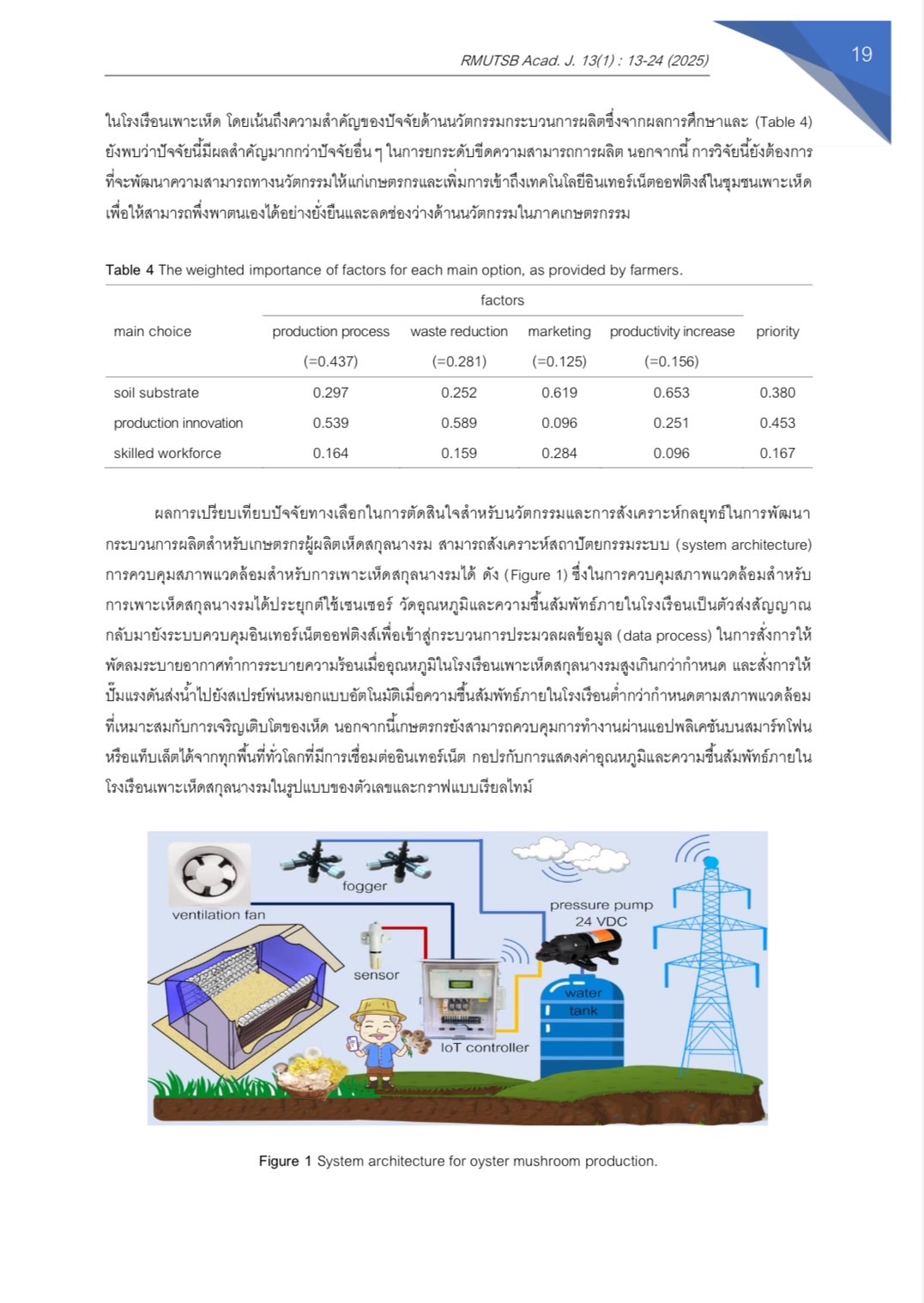
This research aims to study and analyze the factors influencing process innovation and the application of the Internet of Things (IoT) in environmental management for oyster mushroom cultivation. Additionally, it evaluates the performance of IoT innovations. The study begins by analyzing data based on the demand levels for innovation among a sample of oyster mushroom production experts using the analytica hierarchy process (AHP). AHP is an engineering management method that aids in selecting suitable innovations for community contexts, targeting three main objectives: production innovation, skilled labor, and high-quality plant-growing materials. Data were collected from 300 expert mushroom farmers located in Pathum Thani and Sa Kaeo provinces. The findings revealed comparisons of factors in each decision-making option to enhance the competitiveness of the production process and create value from agricultural waste materials suitable for oyster mushroom farmers within a community context. The importance weights of four factors were evaluated: production process innovation, waste reduction innovation, market management innovation and productivity enhancement innovation. The results indicated that the optimal technology choice was production innovation through IoT, with a significant weight of 0.453 or 45.30%. The next most important factor was high-quality plant-growing materials, with a weight of 0.380 or 38%. Moreover, the yield from June-August 2023, the period with the highest productivity for oyster mushrooms, demonstrated that IoT-based production innovations could effectively control the environmental conditions for oyster mushroom growth, resulting in higher production levels than traditional methods. The average yield from IoT implementation in oyster mushroom production reached 712.72 kilograms, compared to the traditional method’s average yield of 523.46 kilograms, representing an increase of 189.26 kilograms.
Article Details

This work is licensed under a Creative Commons Attribution-NonCommercial-NoDerivatives 4.0 International License.
Published manuscript are the rights of their original owners and RMUTSB Academic Journal. The manuscript content belongs to the authors' idea, it is not the opinion of the journal's committee and not the responsibility of Rajamangala University of Technology Suvarnabhumi
References
Aguaron, J., Escobar, M. T., & Moreno-Jimenez, J. M. (2003). Consistency stability intervals for a judgement in AHP decision support systems. European Journal of Operational Research, 145(2), 382-393. https://doi.org/10.1016/S0377-2217(02)00544-1
Branco, F., Moreira, F., Martins, J., Au-Yong-Oliveira, M., & Goncalves, R. (2019). Conceptual approach for an extension to a mushroom farm distributed process control system: IoT and blockchain. The 2019 World Conference on Information Systems and Technologies (pp. 738-747). Spain. https://link.springer.com/chapter/10.1007/978-3-030-16181-1_69
Darko, A., Chan, A. P. C., Ameyaw, E. E., Owusu, E. K., Parn, E., & Edwards, D. J. (2019). Review of application of analytic hierarchy process (AHP) in construction. International Journal of Construction Management, 19(5), 436-452. https://www.tandfonline.com/doi/full/10.1080/15623599.2018.1452098
Fauzi, R. M., Waranti, F. S., Rais, I. K., & Somantri, Y. (2020). Oyster mushroom cultivation solution based IoT for nova farmers. IOP Conference Series: Materials Science and Engineering, 850, 012044. https://iopscience.iop.org/article/10.1088/1757-899X/850/1/012044
Kazakis, N., Kougias, I., & Patsialis, T. (2015). Assessment of flood hazard areas at a regional scale using an index-based approach and analytical hierarchy process: application in Rhodope–Evros region, Greece. Science of the Total Environment, 538, 555-563. https://doi.org/10.1016/j.scitotenv.2015.08.055
Laowatthanarassamee, N., Heepkaew, P., Jainam, W., Chulee, N., & Chompuchan, Ch. (2023). Laboratory performance evaluation of a low-cost capacitive soil moisture sensor for fine-and medium-textured soils. RMUTSB Academic Journal, 11(2), 254-264. https://li01.tci-thaijo.org/index.php/rmutsb-sci/article/view/258687/177326 (in Thai)
Mastuwach, T., Dumrongwattana, J., Khaenamkaew, D., & Dechochai, U. (2021). Guidelines for promoting mushroom farming in communities. A case study of mushroom farm, police sergeant major Wichian Kongjui, village No. 9, Rommueang subdistrict, Mueang district, Phatthalung, Thailand. Journal of MCU Phetchaburi Review, 4(2), 1-16. https://so03.tci-thaijo.org/index.php/JPR/article/view/256180/171405 (in Thai)
National accounts division state–owned enterprises investment division logistics development strategy division. (September 2022). Thailand’s logistics report 2021 (research report). Office of the national economic and social development council. from https://www.nesdc.go.th/nesdb_en/ewt_dl_link.php?nid=4485.%20https://www.nesdc.go.th/nesdb_en/ewt_dl_link.php?nid=4485
Pankratova, N., & Nedashkovskaya, N., (2015). Methods of evaluation and improvement of consistency of expert pairwise comparison judgements. International Journal of Information Theories and Applications, 22(3), 203-223. http://www.foibg.com/ijita/vol22/ijita22-03-p01.pdf
Pennate, T., Yowaphui, K., Charangab, C., Boonrom, B., Tarahom, U., & Voraboot, P. (2023). Develop an environment control system for the Bhutan oyster mushroom cultivation house by using the IoT embedded system. Agriculture and Technology Journal, 4(1), 43-56. https://li01.tci-thaijo.org/index.php/atj/article/view/257095/177913 (in Thai)
Poolwan, J., Sripan, B., & Kingthong, S. (2021). Development of automatic temperature and humidity control systems for eggs incubators with internet of thing technology. RMUTSB Academic Journal, 9(2), 225-236. https://li01.tci-thaijo.org/index.php/rmutsb-sci/article/view/249695 (in Thai)
Riskiono, S. D., Prasetyawan, P., Mulyanto, A., Iqbal, M., & Prabowo, R. (2020). Control and real-time monitoring system for mushroom cultivation fields based on WSN and IoT. Journal of Physics: Conference Series, 1655, 012003. https://iopscience.iop.org/article/10.1088/1742-6596/1655/1/012003/pdf
Saaty, T. L. (2008). Decision making with the analytic hierarchy process. International Journal of Services Sciences, 1(1), 83-98. https://doi.org/10.1504/IJSSCI.2008.017590
Srilert, N. (2022, November 13). Thailand's path to survival post-COVID crisis: developing a grassroots and rural economy. https://www.bangkokbiznews.com/business/economic/1037004 (in Thai)
Srilert, N. (2023, October 29). Viewing the economy through the perspective of the 'TDRI chairman': how to help Thailand escape the middle-income trap. https://www.bangkokbiznews.com/business/economic/1095405 (in Thai)
Suksai, L., Phanak, R., & Lamaisri, S. (2022). Product development of medicinal mushroom processing according to local wisdom based on sufficiency economy and creative economy in Lahan subdistrict, Square district, Chaiyaphum province. Journal of MCU Ubon Review, 7(2), 103-114. https://so06.tci-thaijo.org/index.php/mcjou/article/view/255668/172230 (in Thai)
Tepping, B. J., (2014). Elementary Sampling Theory, Taro Yamane. Englewood Cliffs, New Jersey: Prentice-Hall, Inc., 1967. Pp. x–405. Journal of the American Statistical Association, 63(322), 728-730. https://doi.org/10.1080/01621459.1968.11009297
