In vitro test of fungicide resistance on Colletotrichum spp. causing anthracnose disease in mango
Article Sidebar
Main Article Content
Abstract
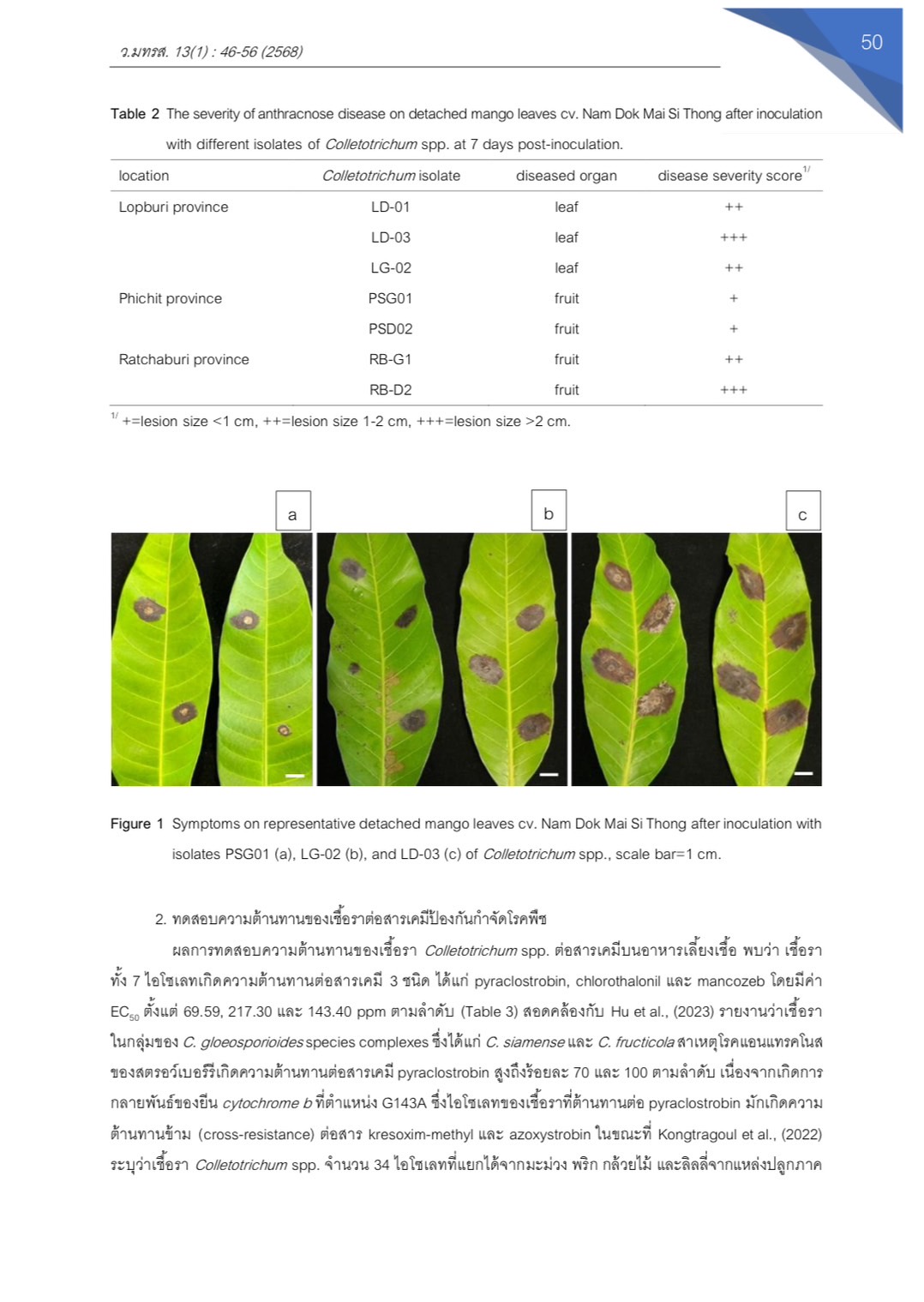
Mango is one of the economically important fruits for Thailand's exports. Anthracnose is indeed a significant threat to mango crops, caused by the fungus Colletotrichum spp. This disease can lead to severe losses in both the quantity and quality of mango yields. Disease control using fungicides is a common practice, but it’s mainly ineffective because the fungus has developed fungicide resistance. This research aimed to assess the pathogenicity of fungal isolates and evaluate the resistance of pathogenic fungi to fungicides under laboratory conditions. Seven isolates of Colletotrichum were collected from 3 Nam Dok Mai Si Thong mango plantation areas including Lopburi, Phichit, and Ratchaburi provinces. The results revealed that all fungal isolates caused disease symptoms on Nam Dok Mai Si Thong mango leaves. Two isolates, LD-03 (Lopburi isolate) and RB-D2 (Ratchaburi isolate), were the most aggressive, producing lesions larger than 2 cm. Regarding the fungicide resistance test, all isolates were resistant (R) to 3 fungicides, pyraclostrobin, chlorothalonil, and mancozeb with EC50 values of 69.59, 217.30, and 143.40 µg/ml, respectively. Moreover, 3 isolates, LD-03 (Lopburi isolate), PSG01 (Phichit isolate), and RB-G1 (Ratchaburi isolate) were moderately resistant (MR) to difenoconazole with EC50 values of 16.72 to 34.14 µg/ml. Furthermore, an isolate of PSD02 (Phichit isolate) was resistant (R) to 2 fungicides, difenoconazole and prochloraz with EC50 values of >1000 and 155.20 µg/ml, respectively. Fortunately, almost all isolates had the susceptibility (S) to prochloraz with EC50 values of 0.28 to 5.37 µg/ml. Thus, the data obtained from this study should be further tested on mango trees in a greenhouse or experimental plot to confirm the effectiveness of prochloraz before recommending its use in the cultivation areas of the three provinces.
Article Details

This work is licensed under a Creative Commons Attribution-NonCommercial-NoDerivatives 4.0 International License.
Published manuscript are the rights of their original owners and RMUTSB Academic Journal. The manuscript content belongs to the authors' idea, it is not the opinion of the journal's committee and not the responsibility of Rajamangala University of Technology Suvarnabhumi
References
Batista, D. D. C., Alves-Júnior, M., Barbosa, M. A. G., Peruch, L. A. M., & Barbosa, M. A. G. (2023). Effects of agricultural practices and fungicides on the management postharvest anthracnose and stem-end rot of mango. Australian Journal of Crop Science, 17(9), 677-683. https://doi.org/10.21475/ajcs.23.17.09.p3910
Cao, X., Xu, X., Che, H., West, J. S., & Luo, D. (2017). Distribution and fungicide sensitivity of Colletotrichum species complexes from rubber tree in Hainan, China. Plant Disease, 101(10), 1774-1780. https://doi.org/10.1016/j.cropro.2024.107034
Chen, S. N., Luo, C. X., Hu, M. J., & Schnabel, G. (2016). Sensitivity of Colletotrichum species, including C. fioriniae and C. nymphaeae, from peach to demethylation inhibitor fungicides. Plant Disease, 100(12), 2435-2441. https://doi.org/10.1016/j.pestbp.2022.105049
Department of Agricultural Extension. (2022). Guideline document No. 3/2022: Quality mango production for export. https://mediatank.doae.go.th/medias/file_upload/12-2022/3-1751705114510091.pdf (in Thai)
Dethoup, T., Kaewkrajay, C., & Nujthet, Y. (2024). Field efficacy in controlling mango diseases of antagonist Talaromyces tratensis KUFA 0091 in fresh and dry formulations. European Journal of Plant Pathology, https://doi.org/10.1007/s10658-024-02853-w
Dofuor, A. K., Quartey, N. K. A., Osabutey, A. F., Antwi-Agyakwa, A. K., Asante, K., Boateng, B. O., Ablormeti, F. K., Lutuf, H., Osei-Owusu, J., Osei, J. H. N., Ekloh, W., Loh, S. K., Honger, J. O., Aidoo, O. F., & Ninsin, K. D. (2023). Mango anthracnose disease: the current situation and direction for future research. Frontiers in Microbiology, 14, 1168203. https://doi.org/10.3389/fmicb.2023.1168203
FRAC. (2024, May 23). Fungicide Resistance Action Committee Code List©. https://www.frac.info/docs/default-source/publications/frac-code-list/frac-code-list-2024.pdf
Gama, A. B., Baggio, J. S., Rebello, C. S., Lourenço, S. D. A., Gasparoto, M. C. D. G., Junior, G. J. D. S., Peres, N. A., & Amorim, L. (2020). Sensitivity of Colletotrichum acutatum isolates from citrus to carbendazim, difenoconazole, tebuconazole, and trifloxystrobin. Plant Disease, 104, 1621-1628. https://doi.org/10.1094/PDIS-10-19-2195-RE
Grice, K. R. E., Bally, I. S. E., Wright, C. L., Maddox, C., Ali, A., & Dillon, N. L. (2023). Mango germplasm screening for the identification of sources of tolerance to anthracnose. Australasian Plant Pathology, 52, 27-41. https://doi.org/10.1007/s13313-022-00899-0
Hu, S., Zhang, S., Xiao, W., Liu, Y., Yu, H., & Zhang, C. (2023). Diversity and characterization of resistance to pyraclostrobin in Colletotrichum spp. from strawberry. Agronomy, 13, 2824. https://doi.org/10.3390/agronomy
Ishi, H., Bryson, P. K., Kayamori, M., Miyamoto, T., Yamaoka, Y., & Schnabel, G. (2021). Cross-resistance to the new fungicide mefentrifluconazole in DMI-resistant fungal pathogens. Pesticide Biochemistry and Physiology, 171, 104737. https://doi.org/10.1016/j.pestbp.2020.104737
Jenny, F., Sultana, N., Islam, M. M., Khandaker, M. M., & Bhuiyan, M. A. B. (2019). A review on anthracnose of mango caused by Colletotrichum gloeosporioides. Bangladesh Phytopathological Society, 35(1&2), 65-74. https://bps.net.bd/wp-content/uploads/2020/12/10.-A-REVIEW-ON-ANTHRACNOSE-OF-MANGO-CAUSED-BY-COLLETOTRICHUM-GLOEOSPORIOIDES.pdf
Jones, J. G., Korir, R. C., Walter, T. L., & Everts, K. L. (2020). Reducing chlorothalonil use in fungicide spray programs for powdery mildew, anthracnose, and gummy stem blight in melons. Plant Disease, 104, 3213-3220. https://doi.org/10.1094/PDIS-04-20-0712-RE
Kannan, R., & Dhivya, V. (2023). In-vitro effect of different abiotic stresses on the growth and sporulation of Colletotrichum gloeosporioides causing anthracnose of mango. Indian Journal of Agricultural Research, 57(2), 261-265. https://doi.org/10.18805/IJARe.A-5916
Keeratirawee, K., & Kongtragoul, P. (2023). Synergistic effect of salicylhydroxamic acid in quinone outside inhibitor fungicides and its sensitivity on fruit rot pathogens. Acta Horticulturae, 1396. https://doi.org/10.17660/ActaHortic.2024.1396.17
Kongtragoul, P., Imamoto, K., & Ishii, H. (2020). Resistance to quinone-outside inhibitor (QoI) fungicides in Colletotrichum species isolated from anthracnose disease occurring in Thailand. Current Applied Science and Technology, 20(1), 79-89. https://doi.org/10.14456/cast.1477.8
Kongtragoul, P., Somnuek, S., Udompongsuk, M., Prasom, P., & Jaenaksorn, T. (2022). Cross-resistance to benzimidazole group and mancozeb fungicides in Colletotrichum spp. causing anthracnose disease. Science and Technology Asia, 27(4), 400-408. https://doi.org/10.14456/scitechasia.2022.95
Miguez, M., Reeve, C., Wood, P. M., & Hollomon, D. W. (2004). Alternative oxidase reduces the sensitivity of Mycosphaerella graminicola to QOI fungicides. Pest Management Science, 60(1), 3-7. https://doi.org/10.1002/ps.837
Moral, J., Agustí-Brisach, C., Agalliu, G., de Oliveira, R., Pérez-Rodríguez, M., Roca, L. F., Romero, J., & Trapero, A. (2018). Preliminary selection and evaluation of fungicides and natural compounds to control olive anthracnose caused by Colletotrichum species. Crop Protection, 114, 167-176. https://doi.org/10.1016/j.cropro.2018.08.033
Nelson, S. C. (2008). Mango anthracnose (Colletotrichum gloeosporioides). Cooperative Extension Service, Plant Disease, PD-48. https://scholarspace.manoa.hawaii.edu/server/api/core/bitstreams/10b3cac5-3241-44e8-b562-d1d2df17f6a9/content
Nuchnuanrat, P., & Jitsatta, N. (2021). Evaluation of fungicide carbendazim resistance in Colletotrichum gloeosporioides causing anthracnose disease of mango cv. Aokrong in Chanthaburi province. RMUTSB Academic Journal, 9(2), 164-173. https://li01.tci-thaijo.org/index.php/rmutsb-sci/article/view/250724/173070 (in Thai)
Pate, E. (2024). Suggestions for anthracnose management in strawberries. https://onfruit.ca/wp-content/uploads/2024/05/2024-Anthracnose-Management-Suggestions.pdf
Ross, L. N., & Woodward, J. F. (2016). Koch’s postulates: An interventionist perspective. Studies in History and Philosophy of Biological and Biomedical Sciences, 59, 35-46. https://doi.org/10.1016/j.shpsc.2016.06.001
Tongsri, V., Nianwichai, P., Sichai, K., Songkumarn, P., Suttiviriya, P., & Kongtragoul, P. (2023). Sensitivity tests of dimethomorph, ethaboxam and etridiazole on Phytophthora palmivora causing stem rot and leaf blight of durian in eastern Thailand. Agriculture and Natural Resources, 57(4), 559-568. https://doi.org/10.34044/j.anres.2023.57.4.01
Usman, H. M., Tan, Q., Karim, M. M., Adnan, M., Yin, W. X., Zhu, F. X., & Luo, C. X. (2021). Sensitivity of Colletotrichum fructicola and Colletotrichum siamense of peach in China to multiple classes of fungicides and characterization of pyraclostrobin-resistant isolates. Plant Disease, 105, 3459-3465. https://doi.org/10.1094/PDIS-04-21-0693-RE
Wang, S., Wang, X., He, Q., Lin, H., Chang, H., Liu, Y., Suna, H., & Song, X. (2022). Analysis of the fungicidal efficacy, environmental fate, and safety of the application of a mefentrifluconazole and pyraclostrobin mixture to control mango anthracnose. Journal of the Science of Food and Agriculture, 103, 400-410. https://doi.org/10.1002/jsfa.12154
