Development of bio-based cooking oil-absorbing paper from rice straw fiber, kaffir lime (Citrus hystrix DC) fiber, and cassava starch (Cultivar 81)
Article Sidebar
Main Article Content
Abstract
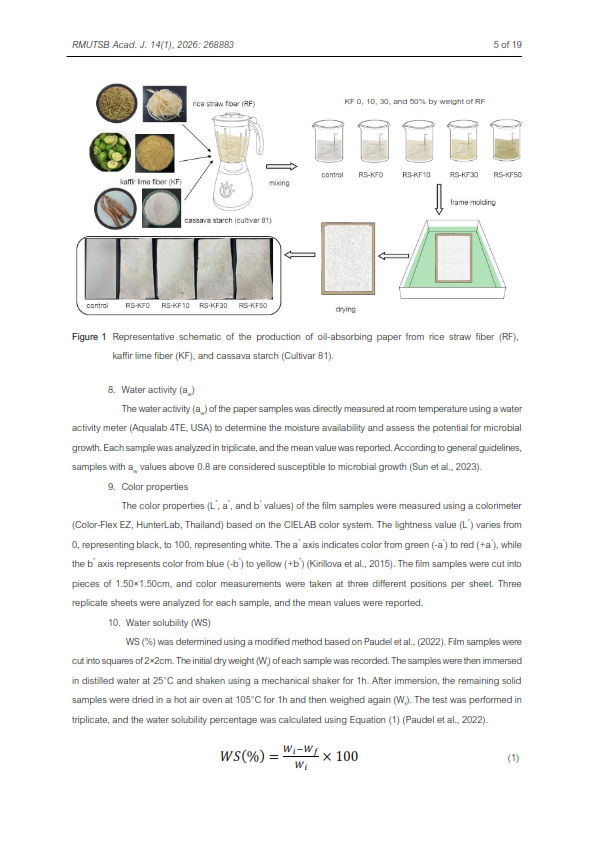
This study focused on the development of oil-absorbing paper from bio-based materials using rice straw fiber (RF), kaffir lime fiber (KF), and cassava starch (Cultivar 81) as the main components. The effects of KF incorporation at different proportions (0, 10, 30 and 50% by weight of rice straw) were investigated to evaluate the chemical, physical, mechanical, antimicrobial, and biodegradability properties. All samples were analyzed using FTIR spectroscopy to examine their chemical structures. The results showed a noticeable decrease in signals corresponding to hemicellulose and lignin after alkaline treatment, while the cellulose structure remained evident. Based on the analysis of physical and mechanical properties and oil-absorbing performance, the sample containing 30% KF exhibited the most balanced and optimal performance. This sample showed enhanced oil absorption, high porosity, suitable thickness, and a fibrous structure that facilitated efficient oil uptake, making it particularly suitable for food applications. Furthermore, the inclusion of KF effectively inhibited the growth of Escherichia coli (E. coli) and Staphylococcus aureus (S. aureus), with the inhibition zone diameter increasing proportionally with KF content. However, a higher KF content slightly reduced the biodegradation rate, likely due to its antimicrobial properties that suppressed microbial activity in the soil. Overall, incorporating KF into rice straw-based paper significantly improved its oil absorption capacity, mechanical and hydrophobic properties, and antimicrobial activity, without compromising biodegradability. These characteristics highlight its promise as an environmentally sustainable material for oil-absorbing and packaging applications.
Article Details

This work is licensed under a Creative Commons Attribution-NonCommercial-NoDerivatives 4.0 International License.
Published manuscript are the rights of their original owners and RMUTSB Academic Journal. The manuscript content belongs to the authors' idea, it is not the opinion of the journal's committee and not the responsibility of Rajamangala University of Technology Suvarnabhumi
References
Abirami, A., Nagarani, G., & Siddhuraju, P. (2014). The medicinal and nutritional role of underutilized citrus fruit Citrus hystrix (Kaffir lime): A review. Drug Invention Today, 6(1), 1-5. https://www.researchgate.net/publication/303227547_The_medicinal_and_nutritional_role_of_underutilized_citrus_fruit_Citrus_hystrix_Kaffir_lime_a_review
Bakti, N. S. H. M., Yeu, L. C., Hui, W. Q., Rahmat, A., Hashim, N. F. B. M., Zakri, T. S. A. T., & Asman, S. (2025). Sustainable paper production using treated pineapple leaf fiber and wastepaper composites. Journal of Science and Technology, 17(1), 130-142. https://doi.org/10.30880/jst.2025.17.01.013
Bamisaye, A., & Rapheal, I. A. (2023). Effect of binder type on the NaOH treated briquettes produced from banana leaves. Biomass Conversion and Biorefinery, 13(10), 8939-8947. https://doi.org/10.1007/s13399-021-01771-9
Barthlott, W., Moosmann, M., Noll, I., Akdere, M., Wagner, J., Roling, N., Koepchen Thomä, L., Azad, M. A. K., Klopp, K., Gries, T., & Mail, M. (2020). Adsorption and superficial transport of oil on biological and bionic superhydrophobic surfaces: A novel technique for oil–water separation. Philosophical Transactions of the Royal Society A, 378(2167), 20190447. https://doi.org/10.1098/rsta.2019.0447
Bhardwaj, A., Sharma, N., Alam, T., Sharma, V., Sahu, J. K., Hamid, H., Bansal, V., & Alam, M. S. (2023). Development and characterization of chitosan and beeswax–chitosan coated biodegradable corn husk and sugarcane bagasse based cellulose paper. Waste and Biomass Valorization, 14(5), 1625-1636. https://doi.org/10.1007/s12649-022-01952-1
Bharti, S. K., Pathak, V., Alam, T., Arya, A., Singh, V. K., Verma, A. K., & Rajkumar, V. (2022). Starch bio-based composite active edible film functionalized with Carum carvi L. essential oil: Antimicrobial, rheological, physic-mechanical and optical attributes. Journal of Food Science and Technology, 59(2), 456-466. https://doi.org/10.1007/s13197-021-05028-1
Boonmahitthisud, A., Booranapunpong, C., Pattaradechakul, C., & Tanpichai, S. (2023). Development of water-resistant paper using chitosan and plant-based wax extracted from banana leaves. International Journal of Biological Macromolecules, 240, 124412. https://doi.org/10.1016/j.ijbiomac.2023.124412
Budiarto, R., Wathoni, N., Mubarok, S., Hamdani, J. S., Ujilestari, T., Darsih, C., & Sholikin, M. M. (2024). Recent overview of Kaffir lime (Citrus hystrix DC) dual functionality in food and nutraceuticals. Journal of Agriculture and Food Research, 18, 101384. https://doi.org/10.1016/j.jafr.2024.101384
Chattaviriya, P., Supawantanakul, D., Sangsirimongkolying, R., & Sua, I. G. (2022). Banana fibers as a sustainable acoustic absorbing material: A review. Trends in Sciences, 19(11), 4498. https://doi.org/10.48048/tis.2022.4498
Das, S., Das, M. K., Jamatia, T., Bhattacharya, B., Mazumder, R., Yadav, P. K., & Mandal, S. (2024). Advances of cassava starch based composites in novel and conventional drug delivery systems: A state of the art review. RSC Pharmaceutics, 1(2), 182-203. https://doi.org/10.1039/d3pm00008g
Elisabeth, D. A. A., Utomo, J. S., Byju, G., & Ginting, E. (2022). Cassava flour production by small scale processors, its quality and economic feasibility. Food Science and Technology, 42, e41522. https://doi.org/10.1590/fst.41522
Ferdian, M. A., Perdana, R. G., & Rahardjo, P. P. (2023). Refinery technology of used cooking oil by utilizing coffee dregs and sugar cane bagasse as raw materials for making antiseptic transparent soap of guava leaf extract. International Journal of Agriculture Environment and Food Sciences, 7(1), 11-20. https://doi.org/10.31015/jaefs.1109072
Freitas, P. A., Santana, L. G., González Martínez, C., & Chiralt, A. (2024). Combining subcritical water extraction and bleaching with hydrogen peroxide to obtain cellulose fibres from rice straw. Carbohydrate Polymer Technologies and Applications, 7, 100491. https://doi.org/10.1016/j.carpta.2024.100491
Harun, S., & Geok, S. K. (2016). Effect of sodium hydroxide pretreatment on rice straw composition. Indian Journal of Science and Technology, 9(21), 1-9. https://doi.org/10.17485/ijst/2016/v9i21/95245
Hillscher, L. M., Höfler, M. V., Gutmann, T., Lux, C., Clerkin, K. U., Schwall, G., & Biesalski, M. (2024). Influence of TEMPO-oxidation on pulp fiber chemistry, morphology and mechanical paper sheet properties. Cellulose, 31(5), 3067-3082. https://doi.org/10.1007/s10570-024-05748-5
Hosseini, M. H., Razavi, S. H., & Mousavi, M. A. (2009). Antimicrobial, physical and mechanical properties of chitosan-based films incorporated with thyme, clove and cinnamon essential oils. Journal of Food Processing and Preservation, 33(6), 727-743. https://doi.org/10.1111/j.1745-4549.2008.00307.x
Islam, M., Sinha, A. S. K., & Prasad, K. (2024). Organosolv delignification of rice straw cellulose fiber for functional food packaging. Cellulose, 31(15), 9191-9214. https://doi.org/10.1007/s10570-024-06125-y
Ketkaew, S., Kasemsiri, P., Hiziroglu, S., Mongkolthanaruk, W., Wannasutta, R., Pongsa, U., & Chindaprasirt, P. (2018). Effect of oregano essential oil content on properties of green biocomposites based on cassava starch and sugarcane bagasse for bioactive packaging. Journal of Polymers and the Environment, 26, 311-318. https://doi.org/10.1007/s10924-017-0957-x
Kirillova, N. P., Vodyanitskii, Y. N., & Sileva, T. M. (2015). Conversion of soil color parameters from the Munsell system to the CIE Lab* system. Eurasian Soil Science, 48(5), 468-475. https://doi.org/10.1134/S1064229315050026
Liu, S., Liu, X., Wang, Q., Wang, Y., Ji, X., Yang, G., & Ni, Y. (2022). Superhydrophobic, strong and transparent paper made from cellulosic fibers. Cellulose, 29(3), 1993-2003. https://doi.org/10.1007/s10570-021-04393-6
Maimaiti, H., Arken, K., Wumaier, M., & Wushuer, L. (2014). Oil absorbency of cellulose/butylmethacrylate graft polymer fibers. Iranian Polymer Journal, 23(9), 671-678. https://doi.org/10.1007/s13726-014-0261-8
Malik, K., Sharma, A., Harikarthik, D., Rani, V., Arya, N., Malik, A., Rani, S., Sangwan, P., & Bhatia, T. (2023). Deciphering the biochemical and functional characterization of rice straw cultivars for industrial applications. Heliyon, 9(6), e16339. https://doi.org/10.1016/j.heliyon.2023.e16339
Malikhah, H., & Herdyastuti, N. (2023). Effect of kaffir lime (Citrus hystrix) leaf extract on xanthine oxidase inhibition. World Journal of Advanced Research and Reviews, 17(1), 1069-1078. https://doi.org/10.30574/wjarr.2023.17.1.0100
Mazega, A., Tarrés, Q., Aguado, R., Pèlach, M. À., Mutjé, P., Ferreira, P. J., & Delgado Aguilar, M. (2022). Improving the barrier properties of paper to moisture, air, and grease with nanocellulose-based coating suspensions. Nanomaterials, 12(20), 3675. https://doi.org/10.3390/nano12203675
Nagpal, R., Bhardwaj, N. K., Mishra, O. P., & Mahajan, R. (2021). Cleaner bio pulping approach for the production of better strength rice straw paper. Journal of Cleaner Production, 318, 128539. https://doi.org/10.1016/j.jclepro.2021.128539
Paudel, B., Basak, J. K., Madhavi, B. G. K., Kim, N. E., Lee, G. H., Choi, G. M., & Kim, H. T. (2022). Properties of paper-based biodegradable pots for growing seedlings. Horticulture, Environment, and Biotechnology, 63(6), 793-807. https://doi.org/10.1007/s13580-022-00457-z
Qi, J., Wang, X., Wang, X., Akoh, C. C., & Jin, Q. (2019). Effect of oil type and emulsifier on oil absorption of steam and fried instant noodles. Journal of Oleo Science, 68(6), 559-566. https://doi.org/10.5650/jos.ess18217
Rahaman, A., Kumari, A., Zeng, X. A., Farooq, M. A., Siddique, R., Khalifa, I., Siddeeg, M. A., Ali, M., & Manzoor, M. F. (2021). Ultrasound-based modification and structural-functional analysis of corn and cassava starch. Ultrasonics Sonochemistry, 80, 105795. https://doi.org/10.1016/j.ultsonch.2021.105795
Rahayu, M. S., Mellaratna, W. P., & Najah, N. (2024). The preliminary study on the antifungal effect of Kaffir lime (Citrus hystrix DC) peel extract against Malassezia furfur. International Journal of Secondary Metabolite, 11(3), 486-493. https://doi.org/10.21448/ijsm.1395562
Ramadhan, D. S., Warsito & Iftitah, E. D. (2018). Microwave-assisted synthesis of benzimidazole derivatives from citronellal in kaffir lime (Citrus hystrix DC.) oil. IOP Conference Series: Materials Science and Engineering, 299, 012048. https://doi.org/10.1088/1757-899X/299/1/012076
Rangappa, S. M., Siengchin, S., Parameswaranpillai, J., Jawaid, M., & Ozbakkaloglu, T. (2022). Lignocellulosic fiber reinforced composites: Progress, performance, properties, applications, and future perspectives. Polymer Composites, 43(2), 645-691. https://doi.org/10.1002/pc.26413
Ray, A., Mohanty, S., Jena, S., Sahoo, A., Acharya, L., Panda, P. C., Sial, P., Duraisamy, P., & Nayak, S. (2022). Drying methods affect physicochemical characteristics, essential oil yield and volatile composition of turmeric (Curcuma longa L.). Journal of Applied Research on Medicinal and Aromatic Plants, 26, 100357. https://doi.org/10.1016/j.jarmap.2021.100357
Risa, A. G., & Wolla, D. W. (2025). Characterization and finite element analysis of hybrid glass–maize stalk fibers–epoxy composite for bone plate application. Fibers and Polymers, 26, 2543. https://doi.org/10.1007/s12221-025-00964-7
Rosdi, M. H. H. M., Ahad, N. A., & Shahdan, D. (2022). Comparison on oil and water absorption ability of various natural fiber. Journal of Physics: Conference Series, 2169(1), 012021. https://doi.org/10.1088/1742-6596/2169/1/012021
Sahu, O. (2021). Characterisation and utilization of heterogeneous catalyst from waste rice straw for biodiesel conversion. Fuel, 287, 119543. https://doi.org/10.1016/j.fuel.2020.119543
Serrano-Martínez, V. M., Pérez-Aguilar, H., Carbonell-Blasco, M. P., Arán-Ais, F., & Orgilés-Calpena, E. (2024). Steam explosion based method for the extraction of cellulose and lignin from rice straw waste. Applied Sciences, 14(5), 2059. https://doi.org/10.3390/app14052059
Sun, S., Xie, Y., Yang, R. J., Zhu, M. J., Sablani, S., & Tang, J. (2023). The influence of temperature and water activity on thermal resistance of Salmonella in milk chocolate. Food Control, 143, 109292. https://doi.org/10.1016/j.foodcont.2022.109292
Todorova, D., Yavorov, N., Lasheva, V., Damyanova, S., & Kostova, I. (2022). Lavender essential oil as antibacterial treatment for packaging paper. Coatings, 13(1), 32. https://doi.org/10.3390/coatings13010032
Toro, R. G., Diab, M., de Caro, T., Al Shemy, M., Adel, A., & Caschera, D. (2020). Study of the effect of titanium dioxide hydrosol on the photocatalytic and mechanical properties of paper sheets. Materials, 13(6), 1326. https://doi.org/10.3390/ma13061326
Wang, F. J., Wang, L. Q., Zhang, X. C., Ma, S. F., & Zhao, Z. C. (2022). Study on the barrier properties and antibacterial properties of cellulose-based multilayer coated paperboard used for fast food packaging. Food Bioscience, 46, 101398. https://doi.org/10.1016/j.fbio.2021.101398
Wembe, B. D., Djomi, R., Konai, N., Ntamack, G. E., Tsopmo, F. A., Olubusoye, O. E., & Mevaa, L. (2023). Investigation on the mechanical properties of paper water hyacinth (Eichhornia crassipes). European Journal of Engineering and Technology Research, 8(1), 54-58. https://doi.org/10.24018/ejeng.2023.8.1.2965
Wichianphong, N., & Maison, W. (2020). Preparation of biofuel pellets from water hyacinth and waste coffee grounds. RMUTSB Academic Journal, 8(2), 140-152. https://li01.tci-thaijo.org/index.php/rmutsb-sci/article/view/247484
Wu, T., Wang, X., & Inada, T. (2025). Research on hydroponic cultivation substrates made from rice straw. Sustainability, 17, 772. https://doi.org/10.3390/su17020772
Xing, T., Dong, C., Hu, X., Zheng, Q., Zhang, J., Zhao, Y., & Wang, X. (2024). Cellulose membranes via a top-down approach from loofah for oil/water separation. Biomass Conversion and Biorefinery, 14(15), 17167-17175. https://doi.org/10.1007/s13399-023-03766-0
Xu, L. P., Dai, B., Fan, J., Wen, Y., Zhang, X., & Wang, S. (2015). Capillary-driven spontaneous oil/water separation by superwettable twines. Nanoscale, 7(31), 13164-13167. https://doi.org/10.1039/C5NR03670D
Yang, Q., Ruan, F., Wu, H., Kan, C., Wang, G., Wang, Z., & Wang, H. (2023). Effect of chemical treatment on rice straw fiber surface and properties of straw/polylactic acid composites. Journal of Natural Fibers, 20(2), 2228486. https://doi.org/10.1080/15440478.2023.2228486
Yimlamai, P., Chitbanyong, K., Wanitpinyo, K., Puangsin, B., Nanta, K., Khantayanuwong, S., Pisutpiched, S., Chaisan, T., Fei, B., & Hiziroglu, S. (2024). Properties of mixture of hemp bast and softwood pulp for filter paper manufacture. Heliyon, 10(3), e24125. https://doi.org/10.1016/j.heliyon.2024.e25353
Ying, N. H., Min, G. S., & Asman, S. (2023). Extraction of essential oil Citrus hystrix by using ultrasound assisted extraction. Malaysian Journal of Analytical Sciences, 27(6), 1236-1248. https://mjas.analis.com.my/mjas/v27_n6/pdf/Ying_27_6_6.pdf
Zaafarani, N. N., Nour, M., El Kassas, A. M., & Elsheikh, A. (2024). A new recycled high impact polystyrene rice straw composite: Eco-friendly fabrication and characterization. International Journal of Environmental Science and Technology, 21(2), 1193-1202. https://doi.org/10.1007/s13762-023-05039-9
Zhang, Y., Sam, E. K., Liu, J., & Lv, X. (2023). Biomass based/derived value added porous absorbents for oil/water separation. Waste and Biomass Valorization, 14(10), 3147-3168. https://doi.org/10.1007/s12649-023-02112-9
