
Effect of high-temperature curing duration on the compressive strength of concrete
Article Sidebar
Main Article Content
Abstract
Concrete is an important construction material in civil engineering due to its strength and durability. However, its mechanical properties may be altered when exposed to high temperatures, particularly those related to coarse aggregates. The use of limestone aggregate could result in a reduction in compressive strength and the formation of cracks, whereas basalt aggregate with its high density and superior heat resistance, has the potential to enhance concrete strength. This research investigated the effect of high-temperature curing duration on the compressive strength of concrete using basalt as coarse aggregate. Cube-shaped concrete specimens (15×15×15cm) were tested at ages of 1, 3, 7, 14, 28, and 56 days under curing at ambient temperature (25°C) and high-temperature curing at 100°C for 3 and 6 hours, with a controlled water-to-cement ratio of 0.45 and coarse aggregate sizes of 3/4, 1/2, and 3/8 inch. The results showed that basalt aggregate consistently provided higher compressive strength than limestone aggregate under all curing conditions, especially at ages of 7 and 28 days with the compressive strength increased 10-22%, which an increasing of 10-18% and 15-22%, respectively. This enhancement was attributed to accelerated cement hydration at elevated temperatures and the superior strength and thermal resistance of basalt aggregate. The findings indicated that basalt aggregate is suitable for the design of early-age high-strength concrete in high-temperature environments.
Article Details

This work is licensed under a Creative Commons Attribution-NonCommercial-NoDerivatives 4.0 International License.
Published manuscript are the rights of their original owners and RMUTSB Academic Journal. The manuscript content belongs to the authors' idea, it is not the opinion of the journal's committee and not the responsibility of Rajamangala University of Technology Suvarnabhumi
References
Al-Baijat, H. M. (2008). The use of basalt aggregates in concrete mixes in Jordan. Jordan Journal of Civil Engineering, 2(1), 63-70. https://files01.core.ac.uk/download/pdf/234698246.pdf
ASTM International. (2014a). ASTM C131/C131M-14: Standard test method for resistance to degradation of small-size coarse aggregate by abrasion and impact in the Los Angeles Machine. ASTM International. https://www.astm.org/c0131_C0131M-14.html
ASTM International. (2014b). ASTM C136/C136M-14: Standard test method for sieve analysis of fine and coarse aggregates. ASTM International. https://www.astm.org/c0136_C0136M-14.html
ASTM International. (2015a). ASTM C127/C127M-15: Standard test method for relative density (specific gravity) and absorption of coarse aggregate. West Conshohocken, PA: ASTM International. https://www.astm.org/c0127-15.html
ASTM International. (2015b). ASTM C128/C128M-15: Standard test method for relative density (specific gravity) and absorption of fine aggregate. ASTM International. https://www.astm.org/c0128-15.html
ASTM International. (2017). ASTM C29/C29M-17: Standard test method for bulk density (“unit weight”) and voids in aggregate. ASTM International. https://www.astm.org/c0029_C0029M-17.html
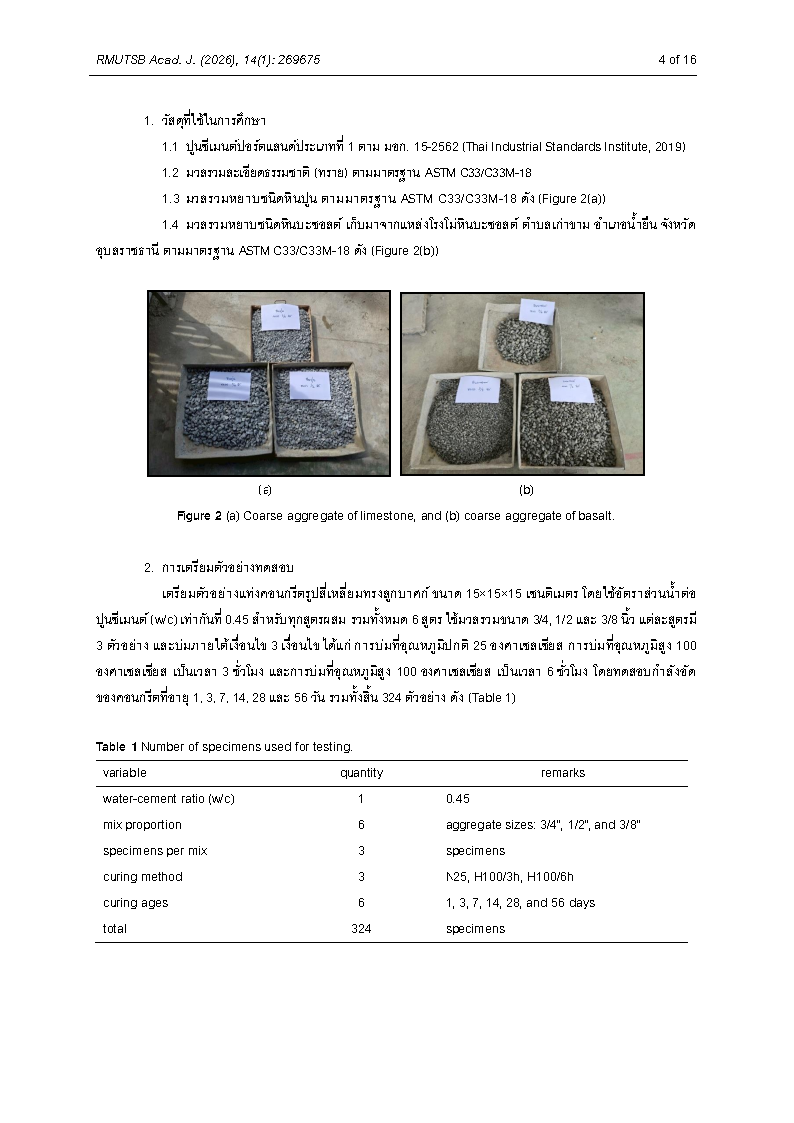
ASTM International. (2018). ASTM C33/C33M-18: Standard specification for concrete aggregates. ASTM International. https://store.astm.org/c0033_c0033m-18.html
ASTM International. (2020a). ASTM C39/C39M-20: Standard test method for compressive strength of cylindrical concrete specimens. ASTM International. https://www.astm.org/c0039_c0039m-20.html
ASTM International. (2020b). ASTM C143/C143M-20: Standard test method for slump of hydraulic-cement concrete. ASTM International. https://www.astm.org/c0143_C0143M-20.html
ASTM International. (2020c). ASTM C171/C171M 20: Standard specification for sheet materials for curing concrete. ASTM International. https://www.astm.org/c0171-20.html
Google Earth. (2026). Satellite image of basalt quarry area in Kao Kham Subdistrict, Nam Yuen District, Ubon Ratchathani Province. from https://earth.google.com/
Jha, S., Duggal, P., & Agarwal, C. (2016). To study the durability aspects of concrete using basalt aggregate. Indian Journal of Science and Technology, 9(30), 23-37. https://doi.org/10.17485/ijst/2016/v9i30/99203
Kishore, I. S., Mounika, L., Prasad, C. M., & Krishna, B. H. (2015). Experimental study on the use of basalt aggregate in concrete mixes. International Journal of Civil Engineering, 2(4), 37-40. https://doi.org/10.14445/23488352/IJCE-V2I4P107
Masood, A., Shariq, M., Alam, M. M., Ahmad, T., & Beg, A. (2018). Effect of elevated temperature on the residual properties of quartzite, granite and basalt aggregate concrete. Journal of the Institution of Engineers (India): Series A, 99(3), 485-494. https://doi.org/10.1007/s40030-018-0307-6
Rahmouni, Z. E. A., & Tebbal, N. (2020). Mechanical behavior of high-performance concrete under thermal effect. In Compressive Strength of Concrete. IntechOpen. https://doi.org/10.5772/intechopen.89916
Sethabut, C. (2003). Concrete technology (12th eds.). Product and Construction Materials. (in Thai)
Tang, Y., Su, H., Huang, S., Qu, C., & Yang, J. (2017). Effect of curing temperature on the durability of concrete under highly geothermal environment. Advances in Materials Science and Engineering, 2017(1), 7587853. https://doi.org/10.1155/2017/7587853
Thai Industrial Standards Institute. (2019). Thai Industrial Standard TIS 15: Portland cement industrial product. Thai Industrial Standards Institute, Ministry of Industry. (in Thai)
Tufail, M., Shahzada, K., Gencturk, B., & Wei, J. (2017). Effect of elevated temperature on mechanical properties of limestone, quartzite and granite concrete. International Journal of Concrete Structures and Materials, 11(1), 17-28. https://doi.org/10.1007/s40069-016-0175-2
Ubi, S. E., Nkra, P. O., Agbor, R. B., Ewa, D. E., & Nuchal, M. (2020). Efficacy of basalt and granite as coarse aggregate in concrete mixture. International Journal of Engineering Technologies and Management Research, 7(9), 1-9. https://doi.org/10.29121/ijetmr.v7.i9.2020.769
Yazıcıoglu, S., Tugla, R., Ay, S., & Demirel, B. (2018). Effect of high temperature on compressive strength of concrete prepared using different types of aggregates. In International Sustainable Buildings Symposium (pp. 425-434). Cham: Springer International Publishing. https://doi.org/10.1007/978-3-319-63709-9_34
Yenprasert, N., & Duangchan, A. (2021). The study of properties of lightweight concrete containing aluminum powder. RMUTSB Academic Journal, 9(1), 83-91. https://li01.tci-thaijo.org/index.php/rmutsb-sci/article/view/248711 (in Thai)
Zeyad, A. M., Tayeh, B. A., Adesina, A., de Azevedo, A. R., Amin, M., Hadzima-Nyarko, M., & Agwa, I. S. (2022). Review on effect of steam curing on behavior of concrete. Cleaner Materials, 3, 100042. https://doi.org/10.1016/j.clema.2022.100042
