
Effects of fermented growing media mixed with durian leaves, chicken manure, and vermicompost on growth and yield of red oak lettuce
Article Sidebar
Main Article Content
Abstract
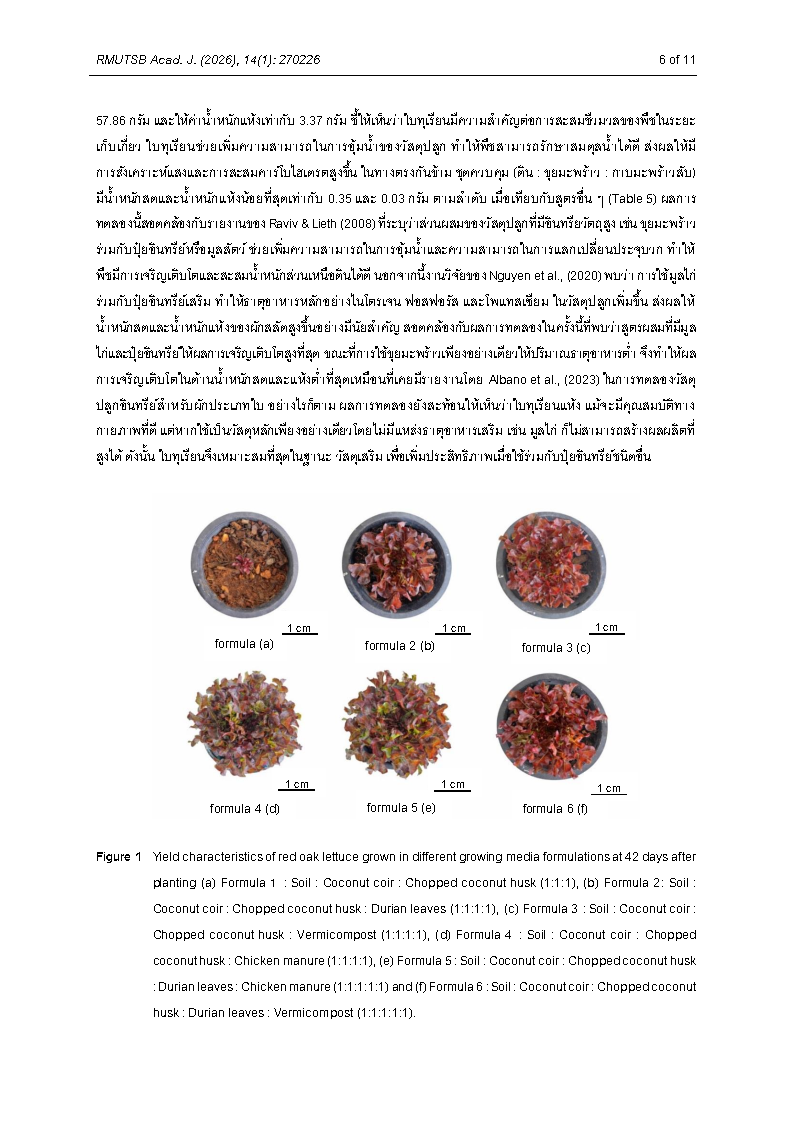
This research aimed to study the potential of local agricultural wastes, namely coconut coir, chopped coconut husks, durian leaves, vermicompost, and chicken manure, to develop suitable planting media for the growth and yield of red oak lettuce. The experiment was conducted using a Completely Randomized Design (CRD) with 6 treatments and 5 replications. The control treatment (T1) consisted of a basal mixture of soil, coconut coir, and chopped coconut husks. The subsequent treatments were supplemented with durian leaves (T2), vermicompost (T3), chicken manure (T4), a combination of chicken manure and durian leaves (T5), and a combination of vermicompost and durian leaves (T6). All planting media were composted for 60 days prior to planting, and the data of plant growth were collected at 42 days after transplanting. The chemical property analysis after composting revealed that the media containing chicken manure exhibited significantly higher electrical conductivity and primary macronutrient contents compared to other treatments, influencing the growth of red oak lettuce under a chemical-free production system. Treatment 5 yielded the highest of plant height, number of leaves, stem diameter, leaf greenness, fresh weight, and dry weight, followed by Treatment 4, which showed no significant statistical difference. Conversely, the control treatment produced the lowest yield. In conclusion, planting media developed from agricultural wastes, particularly the combination of chicken manure and durian leaves, demonstrating at high potential as an efficient alternative. This approach can effectively reduce reliance on chemical fertilizers while promoting cost-effective and sustainable resource utilization.
Article Details

This work is licensed under a Creative Commons Attribution-NonCommercial-NoDerivatives 4.0 International License.
Published manuscript are the rights of their original owners and RMUTSB Academic Journal. The manuscript content belongs to the authors' idea, it is not the opinion of the journal's committee and not the responsibility of Rajamangala University of Technology Suvarnabhumi
References
Albano, X., Whitmore, A. P., Sakrabani, R., Thomas, C. L., Sizmur, T., Ritz, K., Harris, J., Pawlett, M., Watts, C., & Haefele, S. M. (2023). Effect of different organic amendments on actual and achievable yields in a cereal-based cropping system. Journal of Soil Science and Plant Nutrition, 23(1), 45-62. https://doi.org/10.1007/s42729-023-01167-w
Altuntasş, Ö., Küçük, R., & Ersoy, L. (2019). The effect of chicken manure on plant growth, nutrient content and yield of lettuce. Biological and Chemical Research, 9, 9-18. https://www.ss-pub.org/wp-content/uploads/2022/04/BCR2022013101.pdf
Bahrun, A., Nur, R. Y., Santoso, E., Afa, L. O., Safuan, L. O., & Muhidin. (2020). Effect of durian shell (DS) biochar on growth and yield of field grown chilli (Capsicum annuum L.). Asian Journal of Crop Science, 12(1), 43-50. https://doi.org/10.3923/ajcs.2020.43.50
Bernal, M. P., Alburquerque, J. A., & Moral, R. (2009). Composting animal manures and chemical criteria for compost maturity assessment: A review. Bioresource Technology, 100, 5444-5453. https://doi.org/10.1016/j.biortech.2008.11.027
Department of Soil Science. (2022). Organic matter test kit for soil quality assessment. Kasetsart University, Thailand. https://www.soilscience.ku.ac.th
Edwards, C. A., Arancon, N. Q., & Sherman, R. (2011). Vermiculture technology: Earthworms, organic wastes, and environmental management. CRC Press. https://doi.org/10.1201/b10453
Edwards, C. A., & Bohlen, P. J. (1996). Biology and ecology of earthworms (3rd eds.). Chapman & Hall.
Havlin, J. L., Tisdale, S. L., Nelson, W. L., & Beaton, J. D. (2014). Soil fertility and fertilizers: An introduction to nutrient management (8th eds.). Pearson Education.
Kim, M. J., Moon, Y., Tou, J. C., Mou, B., & Waterland, N. L. (2016). Nutritional value, bioactive compounds and health benefits of lettuce (Lactuca sativa L.). Journal of Food Composition and Analysis, 49, 19-34. https://doi.org/10.1016/j.jfca.2016.03.004
Li, X., Zhang, Q., Li, L., & Chen, X. (2013). Interactions between compost, vermicompost and earthworms influence plant growth and yield: A one-year greenhouse experiment. Scientia Horticulturae, 160, 148-154. https://doi.org/10.1016/j.scienta.2013.05.042
Li, Q., Fu, C., Liang, C., Ni, X., Zhao, X., Chen, M., & Ou, L. (2022). Crop lodging and the roles of lignin, cellulose, and hemicellulose in lodging resistance. Agronomy, 12(8), 1795. https://doi.org/10.3390/agronomy12081795
Mahathaninwong, N., Wandee, S., Totwaree, N., & Romyen, P. (2022). Aerobic composting and vermicomposting of durian shell and citrus peel wastes. BioResources, 17(1), 1144-1160. https://doi.org/10.15376/biores.17.2.2345-2358
Marschner, P. (2012). Marschner's mineral nutrition of higher plants (3rd eds.). Academic Press.
Nguyen, T. T., Ngo, H. H., Guo, W., Chang, S. W., Nguyen, D. D., & Zhang, X. (2020). Effects of chicken manure and organic amendments on nutrient availability and growth performance of lettuce (Lactuca sativa L.). Journal of Cleaner Production, 256, 120406. https://doi.org/10.1016/j.jclepro.2020.120406
Priyadarshini, D., Priya, G., Kannan, A., Rani, B., Nair, R. V. R., Soumya, V. I., & Raj, A. (2025). Management of lignin-rich crop residue for soil health and sustainability. Journal of Advances in Biology & Biotechnology, 28(10), 1059-1077. https://doi.org/10.9734/jabb/2025/v28i103126
Raviv, M., & Lieth, J. H. (2008). Soilless culture: Theory and practice. Elsevier. https://doi.org/10.1016/B978-0-444-52975-6.X0001-5
Shah, S. H., Houborg, R., & McCabe, M. F. (2017). Response of chlorophyll, carotenoid and SPAD-502 measurement to salinity and nutrient stress in wheat (Triticum aestivum L.). Agronomy, 7, 1-21. https://doi.org/10.3390/agronomy7030061
Suriya-Arunroj, D., Chaiyawat, P., Fukai, S., & Blamey, P. (2000). Identification of nutrients limiting rice seedling growth in soils of northeast Thailand under water-limiting and non-limiting conditions. Kasetsart Journal: Natural Science (Thailand), 34(3), 323-331. https://doi.org/10.1626/pps.3.417
