
Application of augmented reality with building information modeling for as-built verification: A new project handover process proposal
Article Sidebar
Main Article Content
Abstract
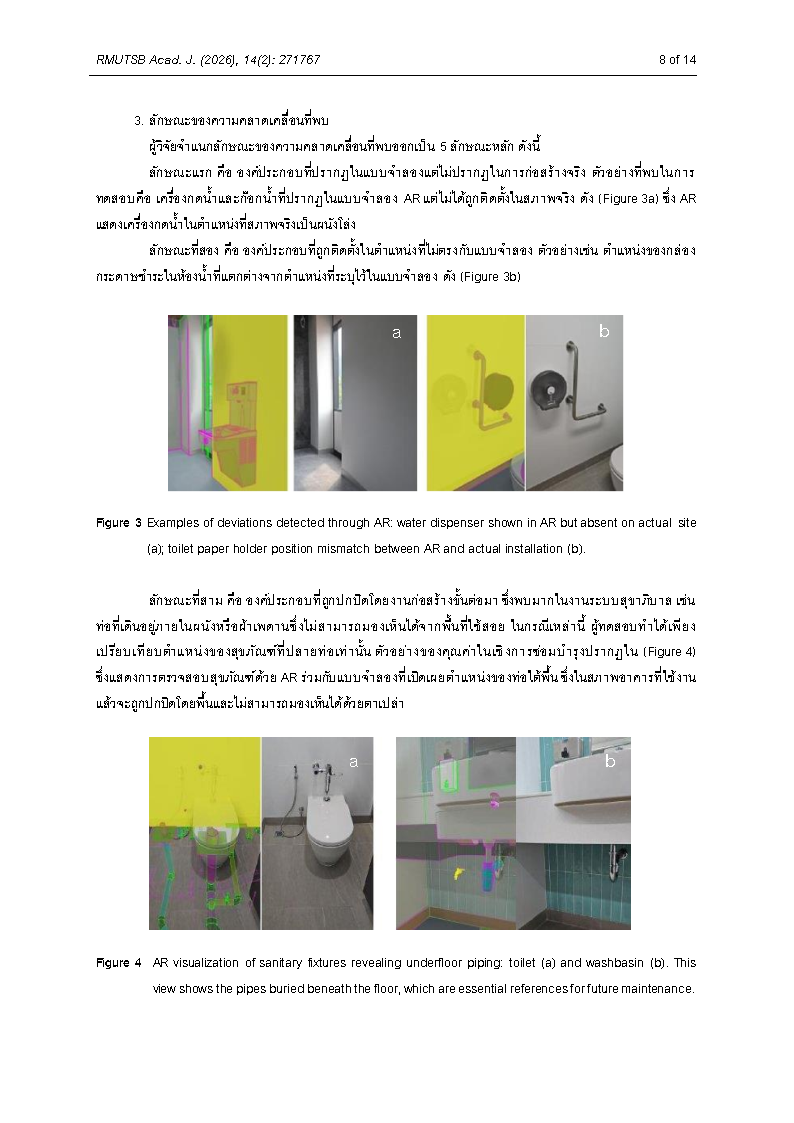
Project handover is a critical activity in construction that requires verification of consistency between digital models and actual construction. Although Building Information Modeling (BIM) is widely adopted in the Thai construction industry, handover verification still relies primarily on screen-based comparison and practitioner expertise, lacking a systematic process that integrates 1:1 on-site verification into the handover workflow. This research proposes a new project handover process integrating Augmented Reality (AR) with BIM to support verification of BIM models against actual construction in preparation for LOD 500 handover, analyzes its practical implications for building owners, and suggests implementation conditions for the Thai construction industry. Conducted as a Proof-of-Concept and Process Proposal on a case study building under construction, BIM models were developed in Autodesk Revit at LOD 400 and above, converted to IFC, and displayed through the Gamma AR application on mobile devices. Testing was conducted at 48 inspection points covering architectural and sanitary works. The qualitative findings revealed five main deviation types: elements shown in the model but absent on site, position mismatches, hidden elements, pipe alignment deviations, and discrepancies in size and shape compared with actual products. Of the 48 inspection points, 32 (66.70%) were found consistent with the model and 16 (33.30%) exhibited deviations, with missing elements being the most prevalent issue (5 points, 31.25%). Based on these findings, the research proposes four roles for AR: a stage-based verification tool during construction, a mechanism for confirming readiness for LOD 500 handover, a support tool for facility management, and a model reconciliation mechanism. Sustainable implementation requires three structural conditions: contractual commitment, enforcement throughout construction, and dedicated budget allocation. The findings suggest that AR does not replace human expertise but has the potential to enhance the efficiency and reliability of handover verification and to support the use of BIM as a living documentation system usable throughout a building's lifecycle.
Article Details

This work is licensed under a Creative Commons Attribution-NonCommercial-NoDerivatives 4.0 International License.
Published manuscript are the rights of their original owners and RMUTSB Academic Journal. The manuscript content belongs to the authors' idea, it is not the opinion of the journal's committee and not the responsibility of Rajamangala University of Technology Suvarnabhumi
References
Azuma, R. T. (1997). A survey of augmented reality. Presence: Teleoperators and Virtual Environments, 6(4), 355-385. https://doi.org/10.1162/pres.1997.6.4.355
BIMForum. (2019). Level of development (LOD) specification part I & commentary: For building information models and data. BIMForum. https://bimforum.org/lod
Carozza, L., Tingdahl, D., Bosché, F., & van Gool, L. (2014). Markerless vision-based augmented reality for urban planning. Computer-Aided Civil and Infrastructure Engineering, 29(1), 2-17. https://doi.org/10.1111/mice.12029
Chalhoub, J., Ayer, S. K., & McCord, K. H. (2021). Augmented reality to enable users to identify deviations for model reconciliation. Buildings, 11(2), 77. https://doi.org/10.3390/buildings11020077
Chung, S. W., Kwon, S. W., Moon, D. Y., & Ko, T. K. (2018). Smart facility management systems utilizing open BIM and augmented/virtual reality (pp. 1252-1257). Proceedings of the 35th International Symposium on Automation and Robotics in Construction. https://doi.org/10.22260/ISARC2018/0181
Eastman, C. M., Teicholz, P. M., Sacks, R., & Lee, G. (2018). BIM handbook: A guide to building information modeling for owners, designers, engineers, contractors, and facility managers (3rd ed.). John Wiley & Sons.
El Jazzar, M., Piskernik, M., & Nassereddine, H. (2021). A framework for construction 4.0 based on reflections from US construction organizations. Sustainability, 13(24), 13774. https://doi.org/10.3390/su132413774
Fan, S. L., Lee, C. Y., Chong, H. Y., & Skibniewski, M. J. (2023). A critical review of augmented reality applications for building life-cycle management. Automation in Construction, 145, 104644. https://doi.org/10.1016/j.autcon.2022.104644
Gallaher, M. P., O'Connor, A. C., Dettbarn, J. L., & Gilday, L. T. (2004). Cost analysis of inadequate interoperability in the U.S. capital facilities industry (NIST GCR 04-867). National Institute of Standards and Technology. https://doi.org/10.6028/NIST.GCR.04-867
Kwon, O. S., Park, C. S., & Lim, C. R. (2014). A defect management system for reinforced concrete work utilizing BIM, image-matching and augmented reality. Automation in Construction, 46, 74-81. https://doi.org/10.1016/j.autcon.2014.05.015
Lin, Y. C., Chen, Y. P., Yien, H. W., Huang, C. Y., & Su, Y. C. (2018). Integrated BIM, game engine and VR technologies for healthcare design: A case study in cancer hospital. Advanced Engineering Informatics, 36, 130-145. https://doi.org/10.1016/j.aei.2018.03.005
McGraw-Hill Construction. (2014). The business value of BIM for construction in major global markets: How contractors around the world are driving innovation with building information modeling (SmartMarket Report). McGraw-Hill Construction.
Messi, L., Spegni, F., Vaccarini, M., Corneli, A., & Binni, L. (2024). Seamless augmented reality registration supporting facility management operations in unprepared environments. Journal of Information Technology in Construction, 29, 1156-1180. https://doi.org/10.36680/j.itcon.2024.051
Ngowtanasawan, G. (2017). A causal model of BIM adoption in the Thai architectural and engineering design industry. Procedia Engineering, 180, 793-803. https://doi.org/10.1016/j.proeng.2017.04.240
Ngowtanasuwan, G., & Hadikusumo, B. H. W. (2017). System dynamics modelling for BIM adoption in Thai architectural and engineering design industry. Construction Innovation, 17(3), 301-322. https://doi.org/10.1108/CI-03-2016-0018
Pan, N. H., & Isnaeni, N. N. (2024). Integration of augmented reality and building information modeling for enhanced construction inspection: A case study. Buildings, 14(3), 612. https://doi.org/10.3390/buildings14030612
Rawdin, A., Khudhair, A., & Li, H. (2026). BIM and ISO 19650 implementation in the Welsh construction industry: A case study of bottom-up governance in a non-mandated region. Journal of Information Technology in Construction, 31, 461-476. https://doi.org/10.36680/j.itcon.2026.021
Schranz, C., Urban, H., & Gerger, A. (2021). Potentials of augmented reality in a BIM based building submission process. Journal of Information Technology in Construction, 26, 441-457. https://doi.org/10.36680/j.itcon.2021.024
Sidani, A., Dinis, F. M., Duarte, J., Sanhudo, L., Calvetti, D., Baptista, J. S., Poças Martins, J., & Soeiro, A. (2021). Recent tools and techniques of BIM-based augmented reality: A systematic review. Journal of Building Engineering, 42, 102500. https://doi.org/10.1016/j.jobe.2021.102500
Song, J., Park, S., Lee, K., Bae, J., Kwon, S., Cho, C.-S., & Chung, S. (2023). Augmented reality-based BIM data compatibility verification method for FAB digital twin implementation. Buildings, 13(11), 2683. https://doi.org/10.3390/buildings13112683
Zollmann, S., Hoppe, C., Kluckner, S., Poglitsch, C., Bischof, H., & Reitmayr, G. (2014). Augmented reality for construction site monitoring and documentation. Proceedings of the IEEE, 102(2), 137-154. https://doi.org/10.1109/JPROC.2013.2294314
