
ผลของการจัดการธาตุอาหารร่วมกับการฉีดพ่นไคโตซานต่อผลผลิตและคุณค่าทางโภชนาการของต้นอ่อนทานตะวัน
Article Sidebar
Main Article Content
บทคัดย่อ
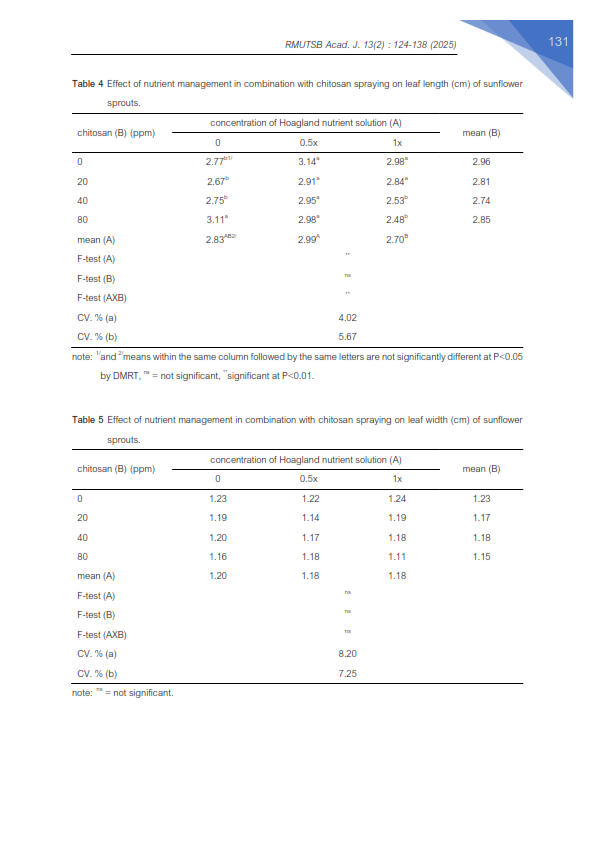
การผลิตต้นอ่อนทานตะวันแบบไฮโดรโพนิกส์ด้วยการจัดการธาตุอาหารส่งผลให้ผลผลิตและคุณค่าทางโภชนาการเพิ่มขึ้น งานวิจัยนี้มีวัตถุประสงค์เพื่อศึกษาความเข้มข้นที่เหมาะสมของสารละลายธาตุอาหาร Hoagland ร่วมกับการฉีดพ่นไคโตซานเพื่อกระตุ้นความงอก เพิ่มผลผลิตและคุณค่าทางโภชนาการ ต้นอ่อนทานตะวันโดยวางแผนการทดลองแบบ split plot in RCBD จำนวน 4 ซ้ำ ปัจจัยหลัก คือความเข้มข้นของสารละลายธาตุอาหารสูตร Hoagland 3 ระดับ คือ 0, 0.5x และ 1x ปัจจัยรอง คือไคโตซาน 4 ระดับ คือ 0, 20, 40 และ 80 ppm ผลการทดลองพบว่า ความเข้มข้นของสารละลายธาตุอาหาร Hoagland ไม่มีผลต่อความงอก ความเร็วในการงอกของเมล็ด ความกว้างใบ น้ำหนักสด และปริมาณแคโรทีนอยด์ แต่ส่งผลทำให้ความยาวต้น ความยาวใบ ปริมาณสารประกอบฟีโนลิก และความสามารถในการยับยั้งอนุมูลอิสระแตกต่างกันทางสถิติ โดยสารละลายธาตุอาหาร Hoagland ความเข้มข้น 1x มีความยาวต้น และความสามารถในการยับยั้งอนุมูลอิสระสูงกว่าความเข้มข้นอื่น ๆ ขณะที่การฉีดพ่นสารไคโตซานความเข้มข้นต่างกันไม่มีผลต่อความงอกและความเร็วในการงอก ความยาวต้น ความยาวและกว้างใบ รวมทั้งความสามารถในการยับยั้งอนุมูลอิสระ แต่ส่งผลให้น้ำหนักสด ปริมาณสารประกอบฟีโนลิก และแคโรทีนอยด์แตกต่างกันทางสถิติ ซึ่งการฉีดพ่นไคโตซาน 80 ppm ทำให้น้ำหนักสด และสารประกอบฟีโนลิกสูงกว่าความเข้มข้นอื่น ดังนั้นการปลูกต้นอ่อนทานตะวันในสารละลายธาตุอาหาร Hoagland 1x ร่วมกับการฉีดพ่นสารไคโตซาน 80 ppm ช่วยเพิ่มความเร็วในการงอก ผลผลิต ปริมาณสารประกอบฟีโนลิก และความสามารถในการยับยั้งอนุมูลอิสระให้สูงขึ้น
Article Details

อนุญาตภายใต้เงื่อนไข Creative Commons Attribution-NonCommercial-NoDerivatives 4.0 International License.
ต้นฉบับที่ได้รับการตีพิมพ์ถือเป็นสิทธิของเจ้าของต้นฉบับและของวารสารวิชาการ มทร.สุวรรณภูมิ เนื้อหาบทความในวารสารเป็นแนวคิดของผู้แต่ง มิใช่เป็นความคิดเห็นของคณะกรรมการการจัดทำวารสาร และมิใช่ความรับผิดชอบของมหาวิทยาลัยเทคโนโลยีราชมงคลสุวรรณภูมิ
เอกสารอ้างอิง
Baker, K. F., & Cook, R. J. (1974). Biological control of plant pathogens. San Francisco, CA: W.H. Freeman and Company.
Boonlertnirun, S., Suvannasara, R., Boonlertnirun, K., & Promsomboon, P. (2013). Effect of chitosan spraying on rice yield potential under drought stress at various growth stages. RMUTSB Academic Journal, 1(1), 30-40. https://li01.tci-thaijo.org/index.php/rmutsb-sci/article/view/98182 (in Thai)
Chainan, C., & Wongruang, S. (2009). Effect of chitosan on seed germination of rice (cv. Luang San Pah-Tawng) and inhibition of some rice seed fungi. Thai Science and Technology Journal, 17(1), 78-84. https://li01.tci-thaijo.org/index.php/tstj/article/view/15042/13798 (in Thai)
Fayezizadeh, M. R., Ansari, N. A., Sourestani, M. M., & Hasanuzzaman, M. (2023). Balancing yield and antioxidant capacity in basil microgreens: An exploration of nutrient solution concentrations in a floating system. Agriculture, 13, 1691. https://doi.org/10.3390/agriculture13091691
Ganesh, K. A., Randeep, R., Shigeru, T., Masami, Y., Akihiro, K., & Hikaru, S. (2002). Chitosan activates defense/stress response(s) in the leaves of Oryza sativa seedling. Plant Physiology and Biochemistry, 40(12), 1061-1069. https://doi.org/10.1016/S0981-9428(02)01471-7
Harakotr, B., Suriharn, B., Tangwongchai, R., Scott, M. P., & Lertrat, K. (2014). Anthocyanin, phenolics and antioxidant activity changes in purple waxy corn as affected by traditional cooking. Food Chemistry, 164, 510-517. https://doi.org/10.1016/j.foodchem.2014.05.069
Harakotr, B., Jirakiattikul, Y., & Rittichai, P. (2019). Effect of biostimulants on antioxidant content and free radical scavenging capacity in microgreens of native Brassicaceae vegetables. Thai Science and Technology Journal, 27(1), 109-123. https://li01.tci-thaijo.org/index.php/tstj/article/view/172553/123818 (in Thai)
International Seed Testing Association (ISTA). (2008). International rules for seed testing. International Seed Testing Association, Bassersdorf, Switzerland.
Jirakiattikul, Y., Rittichai, P., & Jetsadakarun, K. (2013). Effect of chitosan on the proliferation of Oryza rufipogon in aseptic conditions. Thai Science and Technology Journal, 21(1), 11-18. https://li01.tci-thaijo.org/index.php/tstj/article/view/12745/11445 (in Thai)
Khanam, U. K. S., Oba, S., Yanase, E., & Murakami, Y. (2012). Phenolic acids, flavonoids, and total antioxidant capacity of selected leaf vegetables. Journal of Functional Foods, 4(4), 979-987. https://doi.org/10.1016/j.jff.2012.07.006
Kiba, A., & Sakakibara, M. (2021). Nutritional deficiencies in plant using Hoagland solution. Frontiers in Plant Science, Switzerland. 12 pp.
Knott, J. E., & Deanon, J. R. (1980). Knott’s handbook for vegetable growers (2nd ed.). Wiley.
Lizarraga-Paulin, E. G., Torres-Pacheco, L., Moreno-Martinez, E., & Miranda-Castro, S. P. (2011). Chitosan application in maize (Zea mays) to counteract the effects of abiotic stress at the seedling level. Journal of Biotechnology, 10(34), 6439-6446. https://academicjournals.org/journal/AJB/article-abstract/CC3402A34556
Lueangthanawat, S., Amkha, S., Mala, T., & Teeranitayatarn, K. (2017). The utilization of chitosan on growth and flower quality of marigold. Khon Kaen Agriculture Journal, 45(S1), 411-418. https://ag2.kku.ac.th/kaj/PDF.cfm?filename=O069%20Soi06.pdf&id=2678&keeptrack=2 (in Thai)
Misra, G., & Gibson, K. E. (2021). Characterization of microgreen growing operations and associated food safety practices. Food Protection Trends, 41(1), 56-69. https://www.foodprotection.org/members/fpt-archive-articles/2021-01-characterization-of-microgreen-growing-operations-and-associated-food-safety-practices
Munpattanakarn, A. (2024, August 25). Study of phytotoxicity of neem extract on seed germination and seedling growth. https://www.scimath.org/project-mathematics/item/5807-phytotoxicity
Nagata, M., & Yamashita, I. (1992). Simple method for simultaneous determinations of chlorophyll and carotenoids in tomato fruit. Nippon Shokuhin Kogyo Gakkaish, 39(10), 925-928. https://www.jstage.jst.go.jp/article/nskkk1962/39/10/39_10_925/_article
Phinyosri, J. (2024, August 25). The benefits of sunflower sprouts. https://news.msu.ac.th/msumagaz/smain/readpost.php?mid=547
Resh, H. M. (2013). Hydroponic food production: A definitive guidebook for the advanced home gardener and the commercial hydroponic grower. CRC Press.
Salimgandomi, S., & Shabrangi, A. (2016). The effect of chitosan on antioxidant activity and some secondary metabolites of Mentha piperita L. Journal of Pharmaceutical and Health Sciences, 4, 135-142. https://journals.iau.ir/article_527130_b3a8d1d741cc86a99277adcff5501fee.pdf
Somsamran, S. (2018). Effect of sodium chloride and chitosan on growth and antioxidant activity in sunflower sprouts (Master’s thesis). Srinakharinwirot University, Bangkok. http://ir-ithesis.swu.ac.th/dspace/bitstream/123456789/1151/1/gs582110002.pdf
Sreenualpan, S., & Aswatreerattanakul, P. (2016). Effect of chitosan on antioxidant content and resistance to blast disease in Sangyod Phatthalung rice. RMUTP Research Journal Sciences and Technology, 10(2), 114-124. https://doi.org/10.14456/jrmutp.2016.27 (in Thai)
Salachna, P., & Zawadzinska, A. (2014). Effect of chitosan on plant growth, flowering and corms yield of potted freesia. Journal of Ecological Engineering, 15(3), 97-102. https://doi.org/10.12911/22998993.1110223
Sellappan, S., Akoh, C. C., & Krewer G. (2002). Phenolic compounds and antioxidant capacity of Georgia-grown blueberries and blackberries. Journal of Agricultural and Food Chemistry, 50(8), 2432-2438. https://doi.org/10.1021/jf011097r
Sittikijyothin, W., & Cherdwongcharoensuk, D. (2011). Free radical scavenging activity of seed coat extracts of sweet and sour tamarinds. Burapha Science Journal, 16(1), 47-55. https://ojs.lib.buu.ac.th/index.php/science/article/view/7344 (in Thai)
Sun, Z., Chwen, J., Ma, J., Jiang, Y., Wang, M., Ren, G., & Chen, F. (2012). Cynarin-rich sunflower (Helianthus annuus) sprouts possess both antiglycative and antioxidant activities. Journal of Agricultural and Food Chemistry, 60(12), 3260-3265. https://doi.org/10.1021/jf300737y
Taghavi, S., Barac, T., Greenberg, B., Borremans, B., Vangronsveld, J., & Lelie, D. (2005). Horizontal gene transfer to endogenous endophytic bacteria from poplar improves phytoremediation of toluene. Applied and Environmental Microbiology, 71(12), 8500-8505. https://doi.org/10.1128/AEM.71.12.8500-8505.2005
Tandavanit, O. (2024, February 24). Sprouted sunflower seeds: High nutritional value. https://soclaimon.wordpress.com (in Thai)
Xiao, Z. G., Lester, E., Luo, Y., & Wang, Q. (2012). Assessment of vitamin and carotenoid concentrations of emerging food products: Edible microgreens. Journal of Agricultural and Food Chemistry, 60(31), 7644-7651. https://doi.org/10.1021/jf300459b
