
ศักยภาพการกักเก็บคาร์บอนในรูปมวลชีวภาพของพืชพุทราที่แพร่กระจายในพื้นที่โบราณสถาน อำเภอพระนครศรีอยุธยา จังหวัดพระนครศรีอยุธยา
Article Sidebar
Main Article Content
บทคัดย่อ
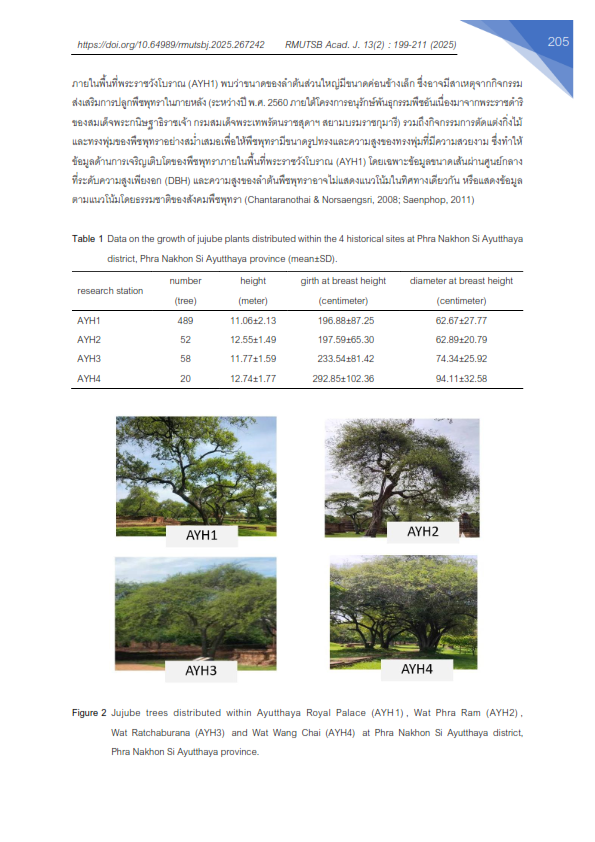
ต้นไม้มีบทบาทสำคัญในการดูดซับและตรึงก๊าซคาร์บอนไดออกไซด์จากบรรยากาศด้วยกระบวนการสังเคราะห์ด้วยแสงและกักเก็บคาร์บอนให้อยู่ในรูปของมวลชีวภาพ งานวิจัยนี้จึงมีวัตถุประสงค์เพื่อประเมินปริมาณมวลชีวภาพและศักยภาพการกักเก็บคาร์บอนของพืชพุทรา ที่แพร่กระจายภายในโบราณสถานทั้ง 4 แห่ง คือ พระราชวังโบราณ (AYH1) วัดพระราม (AYH2) วัดราชบูรณะ (AYH3) และวัดวังชัย (AYH4) อำเภอพระนครศรีอยุธยา จังหวัดพระนครศรีอยุธยา การสำรวจข้อมูลการเจริญเติบโตด้านความสูงและขนาดเส้นผ่านศูนย์กลางที่ระดับความสูงเพียงอกมากกว่า 4.50 เซนติเมตรขึ้นไป เพื่อประเมินปริมาณมวลชีวภาพเหนือพื้นดิน มวลชีวภาพใต้พื้นดิน และปริมาณคาร์บอนที่ถูกกักเก็บโดยประยุกต์ใช้สมการแอลโลเมตรี ผลการศึกษาพบการแพร่กระจายของพืชพุทราทั้งสิ้น 619 ต้น โดยมีการแพร่กระจายสูงสุดในพื้นที่พระราชวังโบราณ (489 ต้น) และจำนวนน้อยที่สุด ณ พื้นที่วัดวังชัย (20 ต้น) เมื่อพิจารณาข้อมูลการเจริญเติบโตของพืชพุทราที่แพร่กระจายในพื้นที่วัดวังชัยยังแสดงค่าเฉลี่ยของความสูง (12.74 เมตร) ขนาดเส้นรอบลำต้น (292.85 เซนติเมตร) และเส้นผ่านศูนย์กลางที่ระดับความสูงเพียงอกโดยเฉลี่ยสูงสุดเท่ากับ 94.11 เซนติเมตร ปริมาณมวลชีวภาพรวมทั้งหมด 9,294.77 กิโลกรัม แบ่งเป็นปริมาณมวลชีวภาพเหนือพื้นดิน เท่ากับ 7,376.80 กิโลกรัม และปริมาณมวลชีวภาพใต้พื้นดิน เท่ากับ 1,917.97 กิโลกรัม รวมทั้งยังแสดงปริมาณการกักเก็บคาร์บอนรวมทั้งหมด 4,368.54 กิโลกรัม จากพืชพุทราทั้งสิ้น 619 ต้น นอกจากนี้ผลการศึกษายังพบว่าพื้นที่วัดวังชัย (AYH4) แสดงค่าเฉลี่ยสูงสุดทั้งปริมาณมวลชีวภาพเหนือพื้นดิน (2,973.84 กิโลกรัม) มวลชีวภาพใต้พื้นดิน (773.20 กิโลกรัม) และการกักเก็บคาร์บอน (1,761.11 กิโลกรัม) อาจเนื่องจากลำต้นที่มีขนาดใหญ่ ขนาดเส้นรอบลำต้น และขนาดเส้นผ่านศูนย์กลางที่ระดับความสูงเพียงอกที่แสดงค่าเฉลี่ยสูงสุด
Article Details

อนุญาตภายใต้เงื่อนไข Creative Commons Attribution-NonCommercial-NoDerivatives 4.0 International License.
ต้นฉบับที่ได้รับการตีพิมพ์ถือเป็นสิทธิของเจ้าของต้นฉบับและของวารสารวิชาการ มทร.สุวรรณภูมิ เนื้อหาบทความในวารสารเป็นแนวคิดของผู้แต่ง มิใช่เป็นความคิดเห็นของคณะกรรมการการจัดทำวารสาร และมิใช่ความรับผิดชอบของมหาวิทยาลัยเทคโนโลยีราชมงคลสุวรรณภูมิ
เอกสารอ้างอิง
Cairns, M. A., Brown, S., Helmer, E. H., & Baumgardner, G. A. (1997). Root biomass allocation in the World’s upland forests. Oecologia, 111(1), 1-11. https://link.springer.com/content/pdf/10.1007/s004420050201.pdf
Chaiwong, C., Khamyong, S., Anongrak, N., Wangpakapattanawong, P., & Paramee, S. (2020). Soil characteristics and carbon storages of the soils derived from different soil parent rocks in mixed deciduous forest ecology at Huai Hong Khrai Royal Development Study Center, Chiang Mai province. PSRU Journal of Science and Technology, 5(1), 41-51. https://ph01.tci-thaijo.org/index.php/Scipsru/article/view/221544/163861 (in Thai)
Chantaranothai, P., & Norsaengsri, M. (2008, May 1). Plant taxonomy of the Jujube Family (Rhamnaceae) in Thailand. Final research report in Knowledge Development and Policy Study Project for Biological Resource Management in Thailand. National Center for Genetic Engineering and Biotechnology. https://www.nstda.or.th/brt/images/book/R147006.pdf (in Thai)
Deb, R. A., Bernardus, H. J. D. J., Ochoa-Gaona, S., Esparza-Olguin, L., & Mendoza-Vega, J. (2014). Carbon stocks and changes in tropical secondary forests of southern Mexico. Agriculture, Ecosystems & Environment, 195, 220-230. https://doi.org/10.1016/j.agee.2014.06.005
Djomoa, A. N., Ibrahimab, A., Saborowskic, J., & Gravenhorsta, J. (2010). Allometric equations for biomass estimations in Cameroon and pan moist tropical equations including biomass data from Africa. Forest Ecology and Management, 260, 1873-1885. https://doi.org/10.1016/j.foreco.2010.08.034
Intergovernmental Panel on Climate Change. (2006). IPCC guidelines for national greenhouse gas inventories: Chapter 4 forest land. National Greenhouse Gas Inventories Programme. IGES, Japan. https://www.ipcc-nggip.iges.or.jp/public/2006gl/pdf/4_Volume4/V4_04_Ch4_Forest_Land.pdf
Jundang, W., Puangchit, L., & Diloksumpun, S. (2010). Carbon storage of dry dipterocarp forest and Eucalypt plantation at Mancha Khiri plantation, Khon Kaen province. Thai Journal of Forestry, 29(3), 36-44. https://li01.tci-thaijo.org/index.php/tjf/article/view/255736 (in Thai)
Jundang, W., Puangchit, L., Junkerd, N., & Jumwong, N. (2020). Carbon stock of different forest communities at Wang Nam Khiao Forestry Research and Student Training Station, Nakhon Ratchasima province. Thai Journal of Forestry, 39(1), 57-70. https://li01.tci-thaijo.org/index.php/tjf/article/view/245961/168134 (in Thai)
Kabir, M., Habiba, U., Iqbal, M. Z., Shafiq, M., Farooqi, Z. R., Shah, A., & Khan, W. (2023). Impacts of anthropogenic activities & climate change resulting from increasing concentration of carbon dioxide on environment in 21st Century: A critical review. IOP Conference Series: Earth and Environmental Science, 1194(1), 012010. https://doi.org/10.1088/1755-1315/1194/1/012010
Kachina, P., Yimyam. N., Soawapak, T., & Mathawang, N. (2021). Impact of sky openness and tree diversity on growth of coffee under shade in Khun Chang Khian Highland Agricultural Research and Training Station and Nong Hoi Highland Agricultural Station, Chiangmai province. Thai Forest Ecological Research Journal, 5(1), 105-121. https://kuojs.lib.ku.ac.th/index.php/tferj/article/view/6152 (in Thai)
Kaewkrom, P., Kaewkla, N., Thummikkapong, S., & Punsang, S. (2019). Evaluation of carbon storage in soil and plant biomass of primary and secondary mixed deciduous forests in the lower northern part of Thailand. African Journal of Wood Science and Forestry, 7(1), 001-007. https://www.internationalscholarsjournals.com/articles/evaluation-of-carbon-storage-in-soil-and-plant-biomass-of-primary-and-secondary-mixed-deciduous-forests-in-the-lower-nor.pdf
Kanhom, B., Moungsrimuangdee, B., Waiboonya, P., Yodsa-nga, P., & Larpkern, P. (2019). Plant diversity and biomass carbon stocks of Nong Mek Community Forest, Khok Sung District, Sa Kaeo province. Thai Journal of Forestry, 38(2), 41-55. https://li01.tci-thaijo.org/index.php/tjf/article/view/245915 (in Thai)
Kiriratnikom, A., & Sumpunthamit, T. (2013). Carbon storage of Ban Nong-Tin Community Forest, Ko-Tao Sub-district, Phapayom District, Phatthalung province. Journal Thaksin University, 16(1), 34-40. https://ph02.tci-thaijo.org/index.php/tsujournal/article/view/42927/35514 (in Thai)
NOAA. (2023). What is the carbon cycle? https://oceanservice.noaa.gov/facts/carbon-cycle.html#transcript
Markphan, W., Rabsaithong, J., & Sae-ar Lee, S. (2018). Carbon stock of trees in Nakhon Si Thammarat Rajabhat University. Srinakharinwirot University (Journal of Science and Technology), 10(20), 119-128. https://ph02.tci-thaijo.org/index.php/swujournal/article/view/170515/122560 (in Thai)
Nongnuang, S., Khamyong, S., Sri-ngernyuang, K., & Anongrak, N. (2012). Biomass carbon stocks of trees in pine plantations at Boa Kaew Watershed Management Station, Chiang Mai province. Thai Journal of Forestry, 31(2), 1-15. https://li01.tci-thaijo.org/index.php/tjf/article/view/255633 (in Thai)
Ogawa, H., Yoda, K., Ogino, K., & Kira, T. (1965). Comparative ecological studies on three main types of forest vegetation in Thailand II. Plant biomass. Nature and Life in Southeast Asia, 4, 49-80. https://drive.google.com/file/d/1bpkZs2fSVFFWiNbDKIToV4HMjEOIxmuX/view?fbclid=IwY2xjawNSFCZleHRuA2FlbQIxMABicmlkETFyR2xTbGFjbzB0UXRPTm9SAR6biHi0jxmmdUCLLKm8aGNedGslQGdFlEaUabZjn9w9hhbWXrPqv3poV7RmyQ_aem_siyjkg5mzny4Ui10In-LGA
Pechrsan, S., Siriwattanaphaiboon, S., Luanwiset, D., Charoonphong, W., & Intasin, S. (2023). Carbon sink capacity and carbon credit of Huay Hin Khao Community Forests at Dan Sri Suk Sub-district, Photak District, Nongkhai province. Udon Thani Rajabhat University Journal of Sciences and Technology, 11(1), 109-125. https://ph01.tci-thaijo.org/index.php/scudru/article/view/250767/170583 (in Thai)
Pimsawan, A., Insamran, Y., & Uttaruk, Y. (2019). Community structure, diversity and carbon sequestration in biomass of community forests; Ban Hinlad and Ban Hinlad-Kao Noi, Wang Nang Subdistrict, Mueang District, Maha Sarakham province. King Mongkut's Agricultural Journal, 37(1), 88-96. https://li01.tci-thaijo.org/index.php/agritechjournal/article/view/179924/127755 (in Thai)
Piyaphongkul, J., Gajaseni, N., & Na-Thalang, A. (2011). A comparative study of carbon sequestration potential in aboveground biomass in primary forest and secondary forest, Khao Yai National Park. In Atazadeh, I. (Ed.). Biomass and remote sensing of biomass (pp. 199-212). InTech. https://doi.org/10.5772/16552
Prasertpong, P. (2006). Techniques for investigating biomass in forests. https://op.mahidol.ac.th/pe/wp-content/uploads/2018/08/sus-meeting-%E0%B8%A7%E0%B8%B4%E0%B8%98%E0%B8%B5%E0%B8%81%E0%B8%B2%E0%B8%A3%E0%B8%A8%E0%B8%B6%E0%B8%81%E0%B8%A9%E0%B8%B2%E0%B8%A1%E0%B8%A7%E0%B8%A5%E0%B8%8A%E0%B8%B5%E0%B8%A7%E0%B8%A0%E0%B8%B2%E0%B8%9E%E0%B9%83%E0%B8%99%E0%B8%9B%E0%B9%88%E0%B8%B2%E0%B9%84%E0%B8%A1%E0%B9%89.pdf (in Thai)
Rungjaeng, W., Pattanasak, P., & Phumkokrux, N. (2024). Estimation of above ground carbon sequestration in urban public park: A case study of Nakhon Pathom Municipality Youth Center, Nakorn Pathom province. The Journal of Spatial Innovation Development, 5(1), 19-23. https://ph01.tci-thaijo.org/index.php/jsid/article/view/254369/171739 (in Thai)
Saengsawang, M., Thongsuk, P., Jaikaew, P., Hengsawang, D., Vanmanee, S., Deekaew, P., Jitra, N., Matphang, P., Wanasuth, N., Thongkerd, T., Pula, N., Khamkran, S., & Buasri, C. (2017). A preliminary report on a long-term permanent sample plot in the lower dry evergreen forest in Kuiburi National Park. Journal of Thailand National Parks Research, 6, 66-77. https://www.nprcenter.com/nprc1/downloads/A%20Preliminary%20report%20on%20a%20long-term%20permanent%20sample%20plot%20in%20the%20lower%20dry%20evergreen%20forest%20in%20Kuiburi%20national%20park.pdf (in Thai)
Saenphop, C. (2011). Carbon storage in biomass of trees planted in Santiphap Park, Bangkok (Master of Science). Kasetsart University, Bangkok. https://doi.nrct.go.th/ListDoi/listDetail?Resolve_DOI=10.14457/KU.the.2011.29 (in Thai)
Senpaseuth, P., Navanugraha, C., & Pattanakiat, S. (2009). The estimation of carbon storage in dry evergreen and dry dipterocarp forests in Sang Khom District, Nong Khai province, Thailand. Environment and Natural Resources Journal, 7(2), 1-11. https://ph02.tci-thaijo.org/index.php/ennrj/article/view/82564/66789
Temwut, S., & Chaitieng, T. (2021). Biomass and carbon stock of trees in the Plant Genetic Conservation and Returning of Wild Animals Project in Kalasin University (Namon Area). Journal of Research Unit on Science, Technology and Environment for Learning, 12(1), 150-159. https://ejournals.swu.ac.th/index.php/JSTEL/article/view/12630/11026 (in Thai)
Terakulpisut, J., Gajaseni, N., & Ruankawe, N. (2007). Carbon sequestration potential in aboveground biomass of Thong Pha Phum National Forest, Thailand. Applied Ecology and Environmental Research, 5(2), 93-102. https://www.researchgate.net/publication/237673925_Carbon_sequestration_potential_in_aboveground_biomass_of_Thong_Pha_Phum_National_Forest_Thailand
Thailand Greenhouse Gas Management Organization (Public Organization). (2023). T-VER-S-TOOL-01-01 Version 1: Calculation of carbon sequestration in trees (1st ed.). Thailand Greenhouse Gas Management Organization (Public Organization) (TGO). https://ghgreduction.tgo.or.th/th/tver-method/tver-tool/for-agr/download/6057/3451/23.html (in Thai)
Timilsina, N., Staudhammer, L. C., Escobedo, J., Escobedo, F. J., & Lawrence, A. (2014). Tree biomass, wood waste yield, and carbon storage changes in an urban forest. Landscape and Urban Planning, 127, 18-27. https://doi.org/10.1016/j.landurbplan.2014.04.003
Unapohm, P. (2017). An interpretation of the world heritage site: Case study of historic city of Ayutthaya (Master degree). Thammasat University, Bangkok. https://ethesisarchive.library.tu.ac.th/thesis/2017/TU_2017_5423034056_8693_8139.pdf (in Thai)
Viriyabuncha, C. (2020). Guidelines for investigating carbon storage in natural forest. Forest Ecology Research Group. https://pubhtml5.com/oicx/yxdm/basic (in Thai)
Zhu, X. G., Long, S. P., & Ort, D. R. (2008). What is the maximum efficiency with which photosynthesis can convert solar energy into biomass? Current Opinion in Biotechnology, 19(2), 153-159. https://doi.org/10.1016/j.copbio.2008.02.004
