
ดัชนีการเก็บเกี่ยวฝรั่งแปรรูปลูกผสมคัดเลือกขั้นสูง P3
Article Sidebar
Main Article Content
บทคัดย่อ
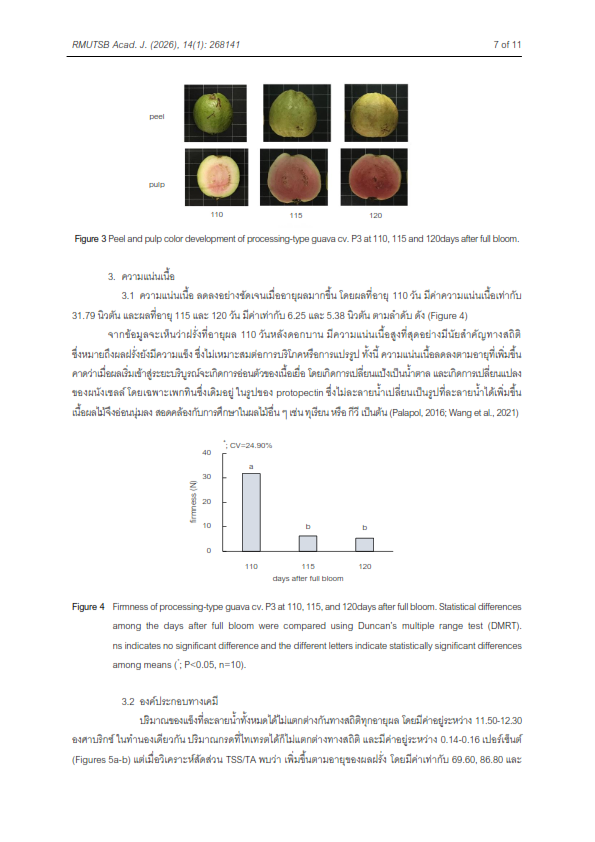
ผลิตภัณฑ์จากอุตสาหกรรมฝรั่งแปรรูปมีหลากหลายชนิด ซึ่งภาควิชาพืชสวน คณะเกษตร กำแพงแสน ม. เกษตรศาสตร์ ได้ปรับปรุงพันธุ์ฝรั่งแปรรูปเพื่อใช้เป็นฝรั่งคั้นน้ำ P3 ซึ่งเป็นลูกผสมคัดเลือกขั้นสูงที่แสดงศักยภาพเชิงพาณิชย์ แต่ยังไม่มีดัชนีการเก็บเกี่ยวที่เหมาะสม ดังนั้นการทดลองนี้จึงมีวัตถุประสงค์เพื่อศึกษาถึงดัชนีที่ใช้บ่งบอกระยะการเก็บเกี่ยวที่เหมาะสมของฝรั่งแปรรูป P3 ที่ปลูกในแปลงทดลอง ภาควิชาพืชสวน วิทยาเขตกำแพงแสน จังหวัดนครปฐม เก็บเกี่ยวที่อายุผล 110, 115 และ 120 วันหลังดอกบาน วางแผนการทดลองแบบสุ่มสมบูรณ์ (CRD) จำนวน 10 ซ้ำ พบว่า ผลที่อายุ 115 และ 120 วันหลังดอกบาน มีขนาดผลเจริญเติบโตเต็มที่มีน้ำหนักผลเฉลี่ย 374.10 และ 368.30 กรัม และความกว้างผลเฉลี่ย 8.47 และ 8.38 เซนติเมตร ซึ่งสูงกว่าผลที่ 110 วันหลังดอกบาน ในทำนองเดียวกัน ผลที่อายุ 115 และ 120 วันหลังดอกบาน มีค่าสีเปลือก (L*, a* และ b*) และค่าความเป็นสีแดง (a*) ของสีเนื้อ เพิ่มขึ้นตามอายุผลที่มากขึ้น ขณะที่ค่าความสว่างของเนื้อ (L*) และความแน่นเนื้อลดลง สำหรับองค์ประกอบทางเคมี พบว่า สัดส่วนของแข็งที่ละลายน้ำได้ (TSS) / ปริมาณกรดที่ไทเทรตได้ (TA) และปริมาณวิตามินซีเพิ่มขึ้นตามอายุผลที่มากขึ้น แต่อย่างไรก็ตาม ผลฝรั่งที่อายุ 120 วันหลังดอกบานเริ่มหลุดร่วงจากต้น จึงสรุปได้ว่า ควรเก็บเกี่ยวผลฝรั่งแปรรูป P3 เมื่อผลมีอายุ 115 วันหลังดอกบาน ซึ่งจะได้ผลฝรั่งที่มีเปลือกสีเขียวอมเหลือง เนื้อสีชมพูอมแดง และมีองค์ประกอบทางเคมีสูงสุด
Article Details

อนุญาตภายใต้เงื่อนไข Creative Commons Attribution-NonCommercial-NoDerivatives 4.0 International License.
ต้นฉบับที่ได้รับการตีพิมพ์ถือเป็นสิทธิของเจ้าของต้นฉบับและของวารสารวิชาการ มทร.สุวรรณภูมิ เนื้อหาบทความในวารสารเป็นแนวคิดของผู้แต่ง มิใช่เป็นความคิดเห็นของคณะกรรมการการจัดทำวารสาร และมิใช่ความรับผิดชอบของมหาวิทยาลัยเทคโนโลยีราชมงคลสุวรรณภูมิ
เอกสารอ้างอิง
Adsule, R. N., & Kadam, S. S. (1995). Guava. In Salunkhe, D. K., & Kadam, S. S. (Eds.). Handbook of fruit science and technology: Production composition storage and processing (pp. 419-433). Marcel Dekker, Inc. New York.
Alam, A., Biswas, M., Ahmed, T., Zahid, Md. A., Alam, M., Hasan, M. K., Biswas, B., & Zaman, R. (2023). Effect of ultrasound and thermal pasteurization on physicochemical properties and antioxidant activity of juice extracted from ripe and overripe pineapple. Food and Nutrition Sciences, 14, 300-314. https://doi.org/10.4236/fns.2023.144020
Brown, M. J. (2025, May). 8 health benefits of guava fruit and leaves. https://www.healthline.com/nutrition/8-benefits-of-guavas#blood-sugar-levels
Bureau of Nutrition, Department of Health, Ministry of Public Health, Thailand. (2010, June). Nutritional composition of fruits. https://nutrition2.anamai.moph.go.th/th/thai-food-compositiontable/download?id=39843&mid=31993&mkey=m_document&lang=th&did=13913 (in Thai)
Cavalini, F. C., Jacomino, A. P., Lochoski, M. A., Kluge, R. A., & Ortega, E. M. M. (2006). Maturity indexes for ‘Kumagai’ and ‘Paluma’ guavas. Revista Brasileira de Fruticultura, 28(2), 176-179. https://doi.org/10.1590/S0100-29452006000200005
Damkaew, J., & Jaroenkit, T. (2023). Fruit development, harvest index and growing degree day of ‘Kimju’, ‘Teangmo’ and ‘Nikro’ guavas. Journal of Agricultural Production, 5(2), 86-96. https://li01.tci-thaijo.org/index.php/japmju/article/view/254458/176744 (in Thai)
Dangpiam, N., Poonpoem, N., Tayamanon, P., & Amatrattana, D. (2004). Guava breeding for processing. The Office of Agricultural Research and Development Region 2, Phitsanulok, Department of Agriculture. (in Thai)
Department of Agricultural Extension. (2021, June). Techniques for mango cultivation and management. https://esc.doae.go.th/wp-content/uploads/2021/06/Guava.pdf (in Thai)
Duma, M., Alsina, I., Dubova, L., & Erdberga, I. (2015). Chemical composition of tomatoes depending on the stage of ripening. Chemical Technology, 66(1), 24-28. http://dx.doi.org/10.5755/j01.ct.66.1.12053
Faculty of Pharmacy, Silpakorn University. (2007, June). Guava. https://pharmacy.su.ac.th/herbmed/herb/text/herb_detail.php?herbID=265
Ishartani, D., Rahman, F. L. F., Hartanto, R., Utami, R., & Khasanah, L. U. (2017). Physical, chemical and sensory characteristics of red guava (Psidium guajava) velva at different fruit ripening time. IOP Conference Series: Earth and Environmental Science, 102, 012075. http://doi.org/10.1088/1755-1315/102/1/012075
Lueangprasert, K., Pattanayaiying R., Chuajedton, A., Choojit, S., & Saelim, K. (2023). Quality evaluation of Kaew Kamin mango with specific gravity at commercial maturity stage. RMUTSB Academic Journal, 11(2), 211-222. https://li01.tci-thaijo.org/index.php/rmutsb-sci/article/view/258683 (in Thai)
Mebratie, A. M., Woldetsadik K., Ayalew, A., & Haji, J. (2015). Comparative study of different banana ripening methods. Science, Technology and Arts Research Journal, 4(2), 32-38. https://doi.org/10.4314/STAR.V4I2.4
Menzel, C. M. (1985). Guava: An exotic fruit with potential in Queensland. Queensland Agricultural Journal, 111(2), 93-98. https://www.researchgate.net/publication/286781042
Menzel, C. M., & Paxton, B. F. (1986). The pattern of growth, flowering and fruiting of guava varieties in subtropical Queensland. Australian Journal of Experimental Agriculture, 26(1), 123-128. https://doi.org/10.1071/EA9860123
Mohapatra, A., Yuvraj, K. B., & Shanmugasundaram, S. (2016). Physicochemical change during ripening of Red banana. International Journal of Science, Environment and Technology, 5, 1340-1348. https://www.ijset.net/journal/1007.pdf
Mphahlele, R. R., Stander, M. A., Fawole, O. A., & Opara, U. L. (2014). Effect of fruit maturity and growing location on the postharvest contents of flavonoids, phenolic acids, vitamin C and antioxidant activity of pomegranate Juice (cv. Wonderful). Scientia Horticulturae, 17, 36-45. https://doi.org/10.1016/j.scienta.2014.09.007
Palapol, Y. (2016). Characterization and expression of cell wall hydrolase genes during fruit ripening of durian fruit. Research funded by the government budget on 2016, Burapha University. (in Thai)
Patterson, R. E. (1970). The role of ripening in the affairs of man. Horticultural Science, 5, 30-33. https://doi.org/10.21273/HORTSCI.5.1.30
Rathore, D. S. (1976). Effect of season on the growth and chemical composition of guava (Psidium Guajava H.) fruits. Journal of Horticultural Science, 51, 41-47. https://doi.org/10.1080/00221589.1976.11514662
Rayong Agriculture Occupation Promotion and Development Center. (2021, September). Techniques for mango cultivation and management. https://aopdh02.doae.go.th/wp-content/uploads/2021/09/Mango.pdf (in Thai)
Ryugo, K. (1988). Fruit culture: Its science and art. New York: Wiley.
Sangudom, T., Wasuri, T., Wongs-Aree, C., Srilaong, V., & Kanlayanarat, S. (2014). Maturity index and quality of ‘Kluai Khai’ as related to growing season. Acta Horticulturae, 1024, 399-405. https://doi.org/10.17660/ActaHortic.2014.1024.55
Seraglio, S. K. T., Schulz, M., Silva, B., Deolindo, C. T. P., Hoff, R. B., Gonzaga, L. V., Fett, R., & Costa, A. C. O. (2024). Chemical constituents and antioxidant potential of Red Guava (Psidium cattleianum Sabine) from Southern Brazil in different edible ripening stages. Plant Foods for Human Nutrition, 79, 166-172. https://doi.org/10.1007/s11130-024-01141-6
Siripanich, J. (1995). Physiology and technology of vegetables and fruits. National Agricultural Extension and Training Center (NAETC), Kasetsart University, Nakhon Pathom. (in Thai)
Siripanich, J., & Romphophak, T. (2006). Postharvest handling of fruits and vegetables. National Agricultural Extension and Training Center (NAETC), Kasetsart University, Nakhon Pathom. (in Thai)
Sombatpraiwan, S., Tipyavimol, T., & Treeamnuk, K. (2012). Factors related to ripening-stages of Nam Dok-mai mango after harvesting. Journal of the Thai Society of Agricultural Engineering, 18(1), 52-58. https://li01.tci-thaijo.org/index.php/TSAEJ/article/view/64147/52629 (in Thai)
Tate, D. (2000). Tropical fruit of Thailand. Asia Books Co., Ltd., Bangkok.
Wang, H., Wang, J., Mujumdar A. S., Jin, X., Liu, Z. L., Zhang, Y., & Wei, H. (2021). Effects of postharvest ripening on physicochemical properties, microstructure, cell wall polysaccharides contents (pectin, hemicellulose, cellulose) and nanostructure of kiwifruit (Actinidia deliciosa). Food Hydrocolloids, 118, 106808. https://doi.org/10.1016/j.foodhyd.2021.106808
Whangchai, K., Uthaibut, J., & Kampuan, W. (2008). Effect of maturity stages and low temperature storage on postharvest quality of ‘Mahajanaka’ mango fruit for export. Research funded by the Postharvest Technology Innovation Center year 2008, Chaingmai University. (in Thai)
Will, R. H. H., Lee, T. H., Grapham, D., Mcglasson, W. B., & Hall, E. G. (1981). Postharvest: An introduction to the physiology and handling of fruit and vegetables. New South Wales University.
