
ผลกระทบของปัจจัยในกระบวนการเชื่อมฟลักซ์คอร์ต่อโครงสร้างและความแข็งรางรถไฟเกรด 900A
Article Sidebar
Main Article Content
บทคัดย่อ
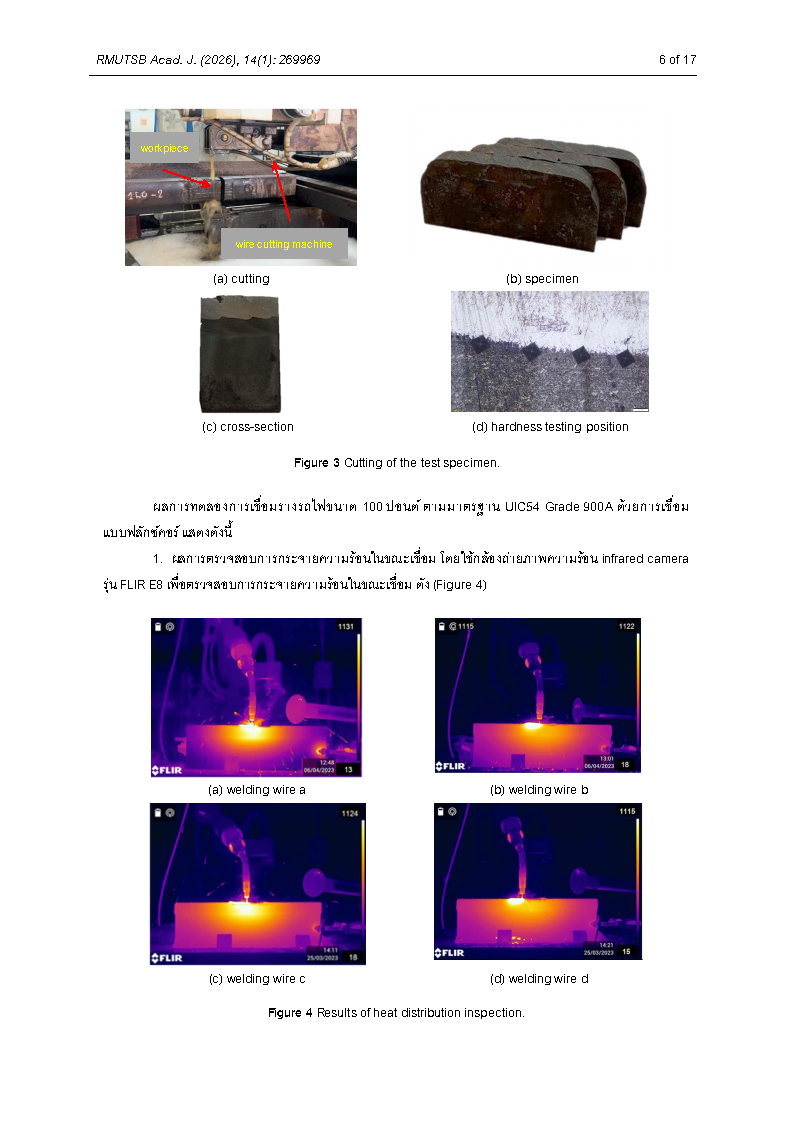
งานวิจัยนี้มีวัตถุประสงค์เพื่อศึกษาผลกระทบของปัจจัยในกระบวนการเชื่อมซ่อมรางรถไฟเกรด 900A ที่ส่งผลต่อโครงสร้างและความแข็งจากกระบวนการเชื่อมแบบฟลักซ์คอร์ (FCAW) ซึ่งลวดเชื่อมมีค่าคาร์บอนเทียบเท่าแตกต่างกัน 4 ชนิด คือ 0.684, 2.233, 4.600 และ 0.743 เปอร์เซ็นต์ ก่อนการเชื่อมทำการอุ่นรางด้วยอุณหภูมิ 150, 250 และ 350 องศาเซลเซียส และทำการเชื่อมจำนวน 1, 2 และ 3 ชั้น จากนั้นตรวจสอบการกระจายความร้อนด้วยกล้องถ่ายภาพความร้อน ผลการศึกษาแสดงถึงความร้อนแพร่กระจายตัวออกจากจุดศูนย์กลางรอยเชื่อมและกระจายตามแนวรัศมี โครงสร้างรางรถไฟภายหลังการเชื่อมซ่อมด้วยลวดเชื่อมทั้ง 4 ชนิด ประกอบด้วยเพิร์ลไลต์ (pearlite) และเฟอร์ไรต์ (ferrite) การอุ่นรางด้วยอุณหภูมิ 150 และ 350 องศาเซลเซียส ทำให้รอยต่อระหว่างรอยเชื่อมและเนื้อรางไม่สามารถกลืนกันได้เท่าที่ควร ขณะที่การอุ่นรางอุณหภูมิ 250 องศาเซลเซียส รอยเชื่อมและเนื้อรางสามารถกลืนกันได้ดี การเชื่อมซ่อมรางที่อุ่นด้วยอุณหภูมิต่ำทำให้รางมีความแข็งสูงกว่ารางที่อุ่นด้วยอุณหภูมิสูง สำหรับผลกระทบจากจำนวนชั้นในการเชื่อมส่งผลต่อความแข็งลดลงตามจำนวนชั้นที่เพิ่มขึ้นและโครงสร้างโดยรวมหยาบขึ้น ผลการวิเคราะห์ทางสถิติ บ่งชี้ว่า ปัจจัยด้านลวดเชื่อม จำนวนชั้นในการเชื่อม และอุณหภูมิการอุ่นรางก่อนการเชื่อมมีอิทธิพลต่อโครงสร้างและความแข็งอย่างมีนัยสำคัญ
Article Details

อนุญาตภายใต้เงื่อนไข Creative Commons Attribution-NonCommercial-NoDerivatives 4.0 International License.
ต้นฉบับที่ได้รับการตีพิมพ์ถือเป็นสิทธิของเจ้าของต้นฉบับและของวารสารวิชาการ มทร.สุวรรณภูมิ เนื้อหาบทความในวารสารเป็นแนวคิดของผู้แต่ง มิใช่เป็นความคิดเห็นของคณะกรรมการการจัดทำวารสาร และมิใช่ความรับผิดชอบของมหาวิทยาลัยเทคโนโลยีราชมงคลสุวรรณภูมิ
เอกสารอ้างอิง
American Welding Society. (2022). AWS D15.2/D15.2M:2022 An American National Standard, Specification for Joining Railroad Rail and Related Rail Components. American Welding Society.
Akama, M. (2025). Rolling contact Fatigue and wear of rails and wheels: A comprehensive review. Machines 2025, 13, 970. https://doi.org/10.3390/machines13100970
Ajenifuja, E., Popoola, A. P. I., & Popoola, O. (2025). Comparative analysis of structural and mechanical properties of duplex stainless steel (DSS) weldments prepared by flux core arc welding and shielded metal arc welding processes. Journal of Advanced Joining Processes, 11, 100295. https://doi.org/10.1016/j.jajp.2025.100295
Aksenova, K. V., Gromov, V. E., Ivanov, Y. F., Vashchuk, E. S., & Porfiriev, M. A. (2024). Evolution of the lamellar pearlite structure of rail steel under tension. Technical Physics, 69(1), 57-61. https://doi.org/10.1134/S1063784224700312
Andersson, B., Steyn, E., Ekh, M. & Josefson, L. (2025). Simulation-based assessment of railhead repair welding process parameters. Welding in the World, 69, 177-197. https://doi.org/10.1007/s40194-024-01837-y
Banleng, S., Lothongkham, K., & Hartung, F. (2015). Welding of rail: Technology and metallurgy. The Journal of Welding Institute of Thailand, 1(2), 37-45. https://wit.kmutnb.ac.th/myfile/Journals/journals/web-วารสารวิชาการสถาบันการเชื่อมแห่งประเทศไทย%20ปีที่%201%20ฉบับที่%202%20ปี%202558-AWT-23feb16-r2-2%20(AWT)-re.pdf
Fei, J., Zhou, G., Zhou, J., Zhou, X., Li, Z., Zuo, D., & Wu, R. (2023). Research on the effect of pearlite lamellar spacing on rolling contact wear behavior of U75V rail steel. Metals, 13(2), 237. https://doi.org/10.3390/met13020237
Fourlakidis, V., Hernando, J. C., Diószegi, A., & Holmgren, D. (2023). Relationship between thermal conductivity and tensile strength in cast irons. International Journal of Metalcasting, 17(4), 2862-2867. https://doi.org/10.1007/s40962-023-00970-6
Intawong, N., Phaoniam, R., & Wonthaisong, S. (2023). Evaluation of cold cracking susceptibility in fully pearlitic rail steel during flux cored-arc welding using implant testing. Solid State Phenomena, 378, 13-21. https://doi.org/10.4028/p-aC2Ppn
Jabtonska, M., Lewandowski, F., Chmiela, B., & Gronostajski, Z. (2023). Advanced heat treatment of pearlitic rail steel. Materials, 16(19), 6430. https://doi.org/10.3390/ma16196430
Kaewniam, W., & Kunthong, P. (2020). A study of rail weld inspection using acoustic emission (pp. 397-403). In Proceedings of the 4th KU SRC Annual Conference. Kasetsart University Si Racha Campus, Chon Buri, Thailand
Le, T. N., Vu, A. T., Le, H. C., Dong, V. H., Nguyen, V. P., & Dang, T. N. (2024). Effect of heat source on the formation of welding zone structure between carbon steel and stainless steel applied in shipbuilding. International Journal of Applied Science, Engineering and Information Technology, 14(2), 749-760. https://doi.org/10.18517/ijaseit.14.2.18828
Li, J., Hu, B., Zhao, L., Li, F., He, J., Wang, Q., & Liu, R. (2023). Influence of heat input on the microstructure and impact toughness in weld metal by high-efficiency submerged arc welding. Metals, 13(7), 1217. https://doi.org/10.3390/met13071217
Muangjunburee, P., Oo, H. Z., Abd Rahim, S. Z., & Srikarun, B. (2024). Effects of heat input and preheating temperature on the microstructure and hardness of repairing the heat-affected zone of thermite welded rail head surface. Indonesian Journal of Science & Technology, 9(2), 421-440. https://doi.org/10.17509/ijost.v9i2.71238
Poolsiri, N., Petchsang, S., Tehyo, M., Sani, S., & Muangjunburee, P. (2021). Effect of electrode selection on impact toughness in weld metal of rail steel grade 900A. Princess of Naradhiwas University Journal, 13(2), 183-198. https://li01.tci-thaijo.org/index.php/pnujr/article/view/242937
Pribadi, Y. U., Gunawan, L., & Suweca, I. W. (2024). A review of wheel wear damage in railway vehicle. Jurnal Perkeretaapian Indonesia (Indonesian Railway Journal), 8(1), 42-52. https://jurnal.ppi.ac.id/jpi/en/article/view/348
Qin, H., Tang, Y., & Liang, P. (2021). Effect of heat input on microstructure and corrosion behavior of high strength low alloy steel welds. International Journal of Electrochemical Science, 16, 210449. https://doi.org/10.20964/2021.04.07
Sangsuriya, M., & Surin, P. (2019). Study of microstructure and creep resistance of electrical welding process in spheroidal graphite cast-iron. Eau Heritage Journal Science and Technology, 13(1), 197-209. https://he01.tcithaijo.org/index.php/EAUHJSci/article/view/177206/129746
Schröpfer, D., Witte, J., Kromm, A., Barroi, A., Kannengiesser, T., & Nolze, G. (2024). Stresses in repair welding of high-strength steels Part 2: Heat control and stress optimization. Welding in the World, 68, 2537-2551. https://doi.org/10.1007/s40194-024-01731-7
Shaikh, M. S., Shajib, M. S., Kader, M. A., Mondal, D., & Islam, M. A. (2025). Effect of preheating on microstructure and mechanical properties in mild steel arc weld joints. International Journal of Automotive and Mechanical Engineering, 22(1), 12133-12145. https://doi.org/10.15282/ijame.22.1.2025.14.0931
Srijampan, W., Tongsri, R., Yotkaew, T., Torsangthum, N., Morakotjinda, M., Krataitong, R., & Wiengmoon, A. (2016). Relationship between microstructure and mechanical property of sintered Fe-Cr-Mo steels. Naresuan University Journal: Science and Technology, 24(2), 175-182. https://ph03.tci-thaijo.org/index.php/ahstr/article/view/1914
Thawatchai, P., & Anek, N. (2025). Factors that cause Rail Broken or Cracked with standard rail defect code number UIC712R. In Proceedings of the 28th National Convention on Civil Engineering. Phuket, Thailand.
Tressia, G., Alves, L. H. D., Goldenstein, H., Grandini, C. R., Mohtadi-Bonab, M. A., & Masoumi, M. (2024). Enhancing wear resistance and mechanical properties of eutectoid pearlitic steel through low-temperature annealing: Microstructural transformations and performance implications in railway applications. Materials Research, 27, e20240295. https://doi.org/10.1590/1980-5373-MR-2024-0295
Wang, S., Wen, B., Ren, D., Ding, Y., Wen, Z., Dong, D., & Tao, G. (2023). Analysis of the causes of severe side wear of the high rail on metro curves by numerical simulation and field investigation. Proceedings of the Institution of Mechanical Engineers, Part F: Journal of Rail and Rapid Transit, 238(4), 381-393. https://doi.org/10.1177/09544097231193274
Wang, L., Jiang, Y., Hu, C., Wan, X., & Li, G. (2025). Effect of heat input on microstructure evolution and fracture toughness of interlayer heat affected zone in ultra-high strength steel. Journal of Materials Research and Technology, 39, 5189-5198. https://doi.org/10.1016/j.jmrt.2025.10.201
Zani, N., Mazzù, A., Solazzi, L., & Petrogalli, C. (2024). Examining wear mechanisms in railway wheel steels: Experimental insights and predictive mapping. Lubricants, 12(3), 93. https://doi.org/10.3390/lubricants12030093
Zaw O, H., & Muangjunburee, P. (2023). Improving microstructure and hardness of softening area at HAZ of thermite welding on rail running surface. Materials Today Communications, 34, 105485. https://doi.org/10.1016/j.mtcomm.2023.105485
