
การประยุกต์ใช้โปรแกรม Arena บนพื้นฐานทฤษฎีแถวคอยเพื่อปรับปรุงกระบวนการส่งมอบบ้านในโครงการบ้านจัดสรร
Article Sidebar
Main Article Content
บทคัดย่อ
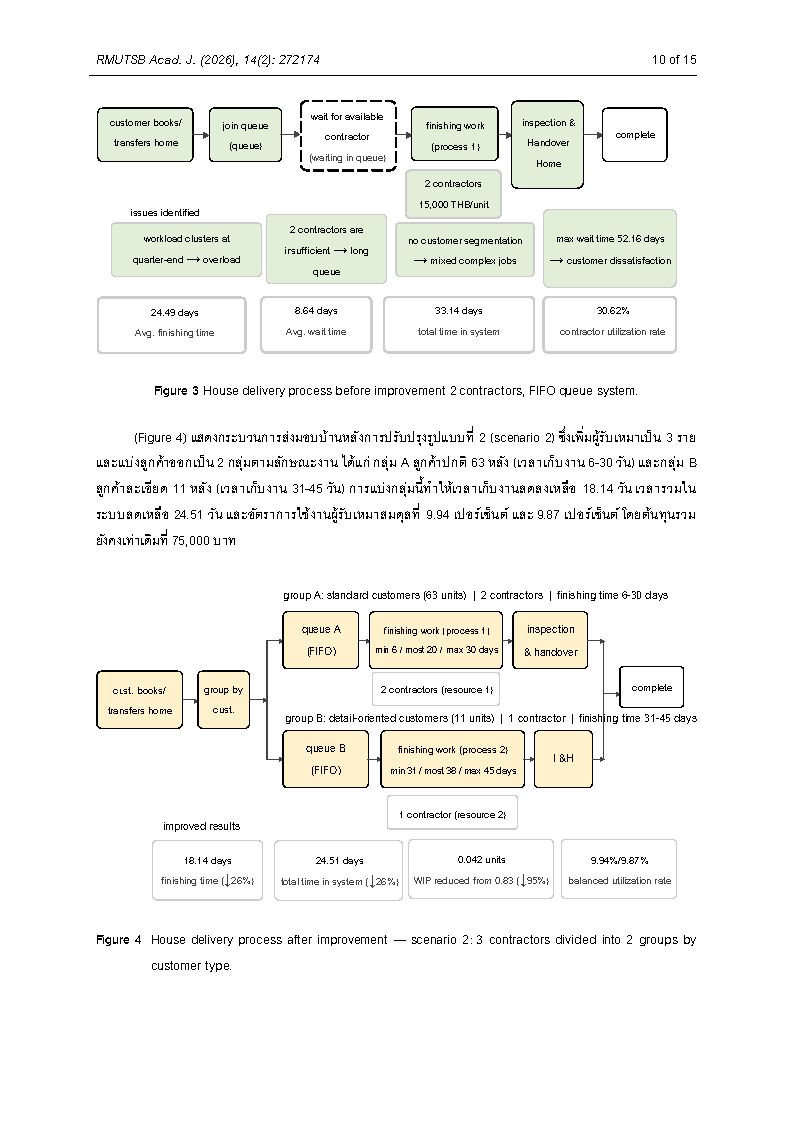
กระบวนการส่งมอบบ้านในโครงการบ้านจัดสรรมีลักษณะของระบบแถวคอย ซึ่งความล่าช้าในกระบวนการส่งผลโดยตรงต่อความพึงพอใจของลูกค้า งานวิจัยนี้มุ่งศึกษาและวิเคราะห์กระบวนการจัดการส่งมอบบ้านใน 4 โครงการบ้านจัดสรรในเขตกรุงเทพมหานครและปริมณฑล โดยเก็บข้อมูลจริงจากบ้านจำนวน 74 หลัง ครอบคลุมระยะเวลา 12 เดือน ตั้งแต่เดือนมกราคม-ธันวาคม 2565 วัตถุประสงค์หลักคือระบุปัญหาและปัจจัยที่ส่งผลต่อความล่าช้าในระบบ รวมถึงทดสอบแนวทางปรับปรุงด้วยการจำลองสถานการณ์บนพื้นฐานทฤษฎีแถวคอย จากการวิเคราะห์ข้อมูลพบว่าปัญหาสำคัญเกิดจากการกระจุกตัวของการจองและโอนกรรมสิทธิ์ในช่วงปลายไตรมาส ประกอบกับจำนวนผู้รับเหมาที่ไม่เพียงพอและการกระจายงานที่ไม่สมดุล ส่งผลให้เวลารอคอยเฉลี่ยสูงถึง 8.64 วัน และเวลารวมในระบบเฉลี่ย 33.14 วันต่อหลัง งานวิจัยนี้ใช้โปรแกรม Arena ในการจำลองสถานการณ์แบบเหตุการณ์ไม่ต่อเนื่อง (discrete-event simulation) จำนวน 500 รอบการจำลอง เพื่อทดสอบ 2 แนวทางปรับปรุง ได้แก่ รูปแบบที่ 1 การเพิ่มจำนวนผู้รับเหมาจาก 2 เป็น 3 ราย และรูปแบบที่ 2 การแบ่งกลุ่มลูกค้าและผู้รับเหมาตามลักษณะงาน ผลการจำลองพบว่ารูปแบบที่ 1 สามารถลดเวลารอคอยเหลือ 2.86 วัน และเวลารวมในระบบเหลือ 25.48 วัน ขณะที่รูปแบบที่ 2 ให้ผลดียิ่งกว่าโดยลดเวลาเก็บงานที่สร้างมูลค่าเหลือ 18.14 วัน และเวลารวมในระบบเหลือ 24.51 วัน พร้อมกระจายอัตราการใช้งานผู้รับเหมาอย่างสมดุล (9.94 และ 9.87 เปอร์เซ็นต์) โดยที่ต้นทุนรวมยังคงเท่าเดิมที่ 75,000 บาท ผลการวิจัยชี้ให้เห็นว่าการแบ่งประเภทลูกค้าและจับคู่กับผู้รับเหมาที่เชี่ยวชาญตรงกันมีประสิทธิภาพกว่าการเพิ่มทรัพยากรเพียงอย่างเดียว และกรอบแบบจำลองที่พัฒนาขึ้นสามารถนำไปประยุกต์ใช้กับโครงการอสังหาริมทรัพย์ประเภทอื่นที่มีลักษณะการดำเนินงานใกล้เคียงกัน
Article Details

อนุญาตภายใต้เงื่อนไข Creative Commons Attribution-NonCommercial-NoDerivatives 4.0 International License.
ต้นฉบับที่ได้รับการตีพิมพ์ถือเป็นสิทธิของเจ้าของต้นฉบับและของวารสารวิชาการ มทร.สุวรรณภูมิ เนื้อหาบทความในวารสารเป็นแนวคิดของผู้แต่ง มิใช่เป็นความคิดเห็นของคณะกรรมการการจัดทำวารสาร และมิใช่ความรับผิดชอบของมหาวิทยาลัยเทคโนโลยีราชมงคลสุวรรณภูมิ
เอกสารอ้างอิง
Abbaspour, S., Aghsami, A., Jolai, F., & Yazdani, M. (2022). An integrated queueing-inventory-routing problem in a green dual-channel supply chain considering pricing and delivery period: A case study of construction material supplier. Journal of Computational Design and Engineering, 9(5), 1917-1951. https://doi.org/10.1093/jcde/qwac089
Altiok, T., & Melamed, B. (2007). Simulation modeling and analysis with Arena. Academic Press.
Athikulrat, K., Praisont, C., & Jangruxsakul, S. (2023). Application of factor rating for production layout selection to improve production: Case study rail joint production. RMUTSB Academic Journal, 11(2), 223-238. https://li01.tci-thaijo.org/index.php/rmutsb-sci/article/view/258628
Chen, H. M., & Huang, P. H. (2013). 3D AR-based modeling for discrete-event simulation of transport operations in construction. Automation in Construction, 33, 123-136. https://doi.org/10.1016/j.autcon.2012.09.015
Cheung, W. M., Xiao, X., Choy, K. L., & Chiu, C. H. (2022). Managing inert construction waste through queuing theory in reverse logistics network. Advanced Engineering Informatics, 52, 101585. https://doi.org/10.1016/j.aei.2022.101585
Corrotea, H., Portales, H., Amigo, L., Gatica, G., Troncoso-Palacio, A., Mondragon, D., & Ramos, M. (2024). Maintenance process analysis in a port cargo company through discrete event simulation. Procedia Computer Science, 231, 415-420. https://doi.org/10.1016/j.procs.2023.12.227
González, V., & Echaveguren, T. (2012). Exploring the environmental modeling of road construction operations using discrete-event simulation. Automation in Construction, 24, 100-110. https://doi.org/10.1016/j.autcon.2012.02.011
Ham, N. H., & Yuh, O. K. (2023). Performance analysis and assessment of BIM-based construction support with priority queuing policy. Buildings, 13(1), 153. https://doi.org/10.3390/buildings13010153
Han, J., & Lee, S. (2024). Discrete event simulation in construction engineering and management: A scientometric review of research trends and applications. Advanced Engineering Informatics, 54, 101790. https://doi.org/10.1016/j.aei.2024.101790
Hassin, R., Haviv, M., & Oz, B. (2023). Strategic behavior in queues with arrival rate uncertainty. European Journal of Operational Research, 309(1), 217-224. https://doi.org/10.1016/j.ejor.2023.01.015
Huang, Z., & Su, X. (2024). Research on M/M/1/WV queuing system with single working vacation [Preprint]. https://doi.org/10.21203/rs.3.rs-3948469/v1
Kim, J. W., Ham, N., & Kim, J. J. (2021). Quantitative analysis of waiting length and waiting time for frame construction work activities using a queue model: Focusing on Korean apartment construction. Sustainability, 13(7), 3778. https://doi.org/10.3390/su13073778
Kim, J., Park, S., & Lee, H. (2023). Equilibrium analysis of partially observable priority queuing systems. European Journal of Operational Research, 312(2), 589-602. https://doi.org/10.1016/j.ejor.2023.06.021
Kittidecha, C., Saramath, S., & Narapinij, P. (2023). Plant layout improvement of the stainless-steel cookware manufacturing using CORELAP and graph-based method. RMUTSB Academic Journal, 11(1), 110-122. https://li01.tci-thaijo.org/index.php/rmutsb-sci/article/view/257060
Naeimi Rad, M., & Maghrebi, M. (2024). Bi-level integration of discrete-event simulation (DES) and social force modeling (SFM) for construction labor productivity. Automation in Construction, 160, 105317. https://doi.org/10.1016/j.autcon.2024.105317
Rockwell Automation. (2024). Arena simulation software (Version 24.1) [Computer software]. https://www.arenasimulation.com
Shiji, P., Rangaswamy, K., & Chandramohan, A. (2021). Resource utilization analysis of highway projects using ARENA. Malaysian Journal of Civil Engineering, 33(2), 47-55. https://doi.org/10.11113/mjce.v33.16846
Su, T. S., & Chang, L. M. (2019). Development of the construction scheduling based on fuzzy discrete event simulation for a TFT-LCD plant. Procedia Manufacturing, 38, 1130-1137. https://doi.org/10.1016/j.promfg.2020.01.201
Tao, Y., Hu, H., Xue, J., Zhang, Z., & Xu, F. (2024). Evaluation of ergonomic risks for construction workers based on multicriteria decision framework with the integration of spherical fuzzy set and alternative queuing method. Sustainability, 16(10), 3950. https://doi.org/10.3390/su16103950
Teknomo, K. (2012a). Application of queuing theory in construction management. In D. Hardjito, A. Antoni, & I. Muljati (Eds.). Developments in structural engineering and construction technology (pp. 76-88). Petra Christian University.
Teknomo, K. (2012b). Queuing rule of thumb based on M/M/s queuing theory with applications in construction management. Civil Engineering Dimension, 14(3), 139-146. https://doi.org/10.9744/ced.14.3.139-146
Usmanov, V., & Jarský, C. (2023). Application of queuing theory in construction industry. Department of Construction Technology, FCE, CTU Prague.
Wee, K., Ham, N., & Kim, J. J. (2022). Microscopical resource allocation for large-scale apartment foundation work using queuing systems. Buildings, 12(2), 89. https://doi.org/10.3390/buildings12020089
Zeng, M., Zhao, D., Yang, L., Lu, Y., Shi, L., & Zhao, H. (2021). Research on the impact of crowd queuing behavior on construction personnel evacuation. E3S Web of Conferences, 261, 03045. https://doi.org/10.1051/e3sconf/202126103045
Zhang, H., & Lin, Y. (2023). Modeling and evaluation of ergonomic risks and controlling plans through discrete-event simulation. Automation in Construction, 152, 104920. https://doi.org/10.1016/j.autcon.2023.104920
