
Effect of Biofloc Produced from Different Carbon Sources on Immune Response of Nile Tilapia (Oreochromis niloticus)
Article Sidebar
Main Article Content
Abstract
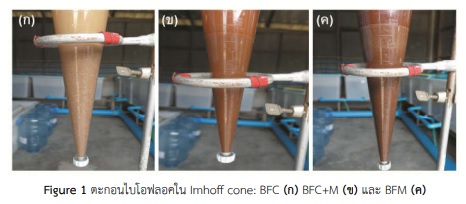
Biofloc technology (BFT) has been considered as a microorganism management technique in aquaculture. Balancing the external carbon added to the system with the proper amount can eliminate the nitrogen waste by conversing it into the microorganism mass, biofloc, consisting of heterotrophic microorganisms, protozoa, planktons, and organic particles. It can provide natural food for aquatic animals as well as function as immunostimulant enhancing the animals’ innate immunity through pathogen-associated molecular patterns (PAMPs) recognizing system. As a result, biofloc fed aquatic animals are primed and more resistant against pathogen attack. There has been reported that different carbon sources could affect the types and amounts of microbes in biofloc and its immunostimulatory efficacy. This study aimed to establish the effect of different carbon sources (100% cassava starch, 50% cassava starch+50% molasses and 100% molasses) on immune response of Nile tilapia (Oreochromis niloticus), an economically important fish of Thailand. Blood parameters, including hematocrit and humoral responses in plasma and serum, were analyzed in tilapia at 1, 2, 3 and 7 days after fed with bioflocs for 7 days. The results showed that all bioflocs produced from different carbon sources could induce immunity by significantly increased blood parameters compared to the non-biofloc fed fish. The variation of response patterns and period of induction times were observed with different carbon sources used. However, all blood parameter levels decreased to the basal level of control fish after being boosted suggesting that the tested bioflocs may not affect the fish growth. These results showed a significance of carbon sources on biofloc production for immunostimulant development and its application in aquaculture.
Article Details
บทความที่ได้รับการตีพิมพ์เป็นลิขสิทธิ์ของ วารสารวิทยาศาสตร์และเทคโนโลยี มหาวิทยาลัยอุบลราชธานี
ข้อความที่ปรากฏในบทความแต่ละเรื่องในวารสารวิชาการเล่มนี้เป็นความคิดเห็นส่วนตัวของผู้เขียนแต่ละท่านไม่เกี่ยวข้องกับมหาวิทยาลัยอุบลราชธานี และคณาจารย์ท่านอื่นๆในมหาวิทยาลัยฯ แต่อย่างใด ความรับผิดชอบองค์ประกอบทั้งหมดของบทความแต่ละเรื่องเป็นของผู้เขียนแต่ละท่าน หากมีความผิดพลาดใดๆ ผู้เขียนแต่ละท่านจะรับผิดชอบบทความของตนเองแต่ผู้เดียว
