
Influence of Temperature on Antimicrobial Activity and Mode of Action of Thymol Against Escherichia coli O157:H7
Article Sidebar
Main Article Content
Abstract
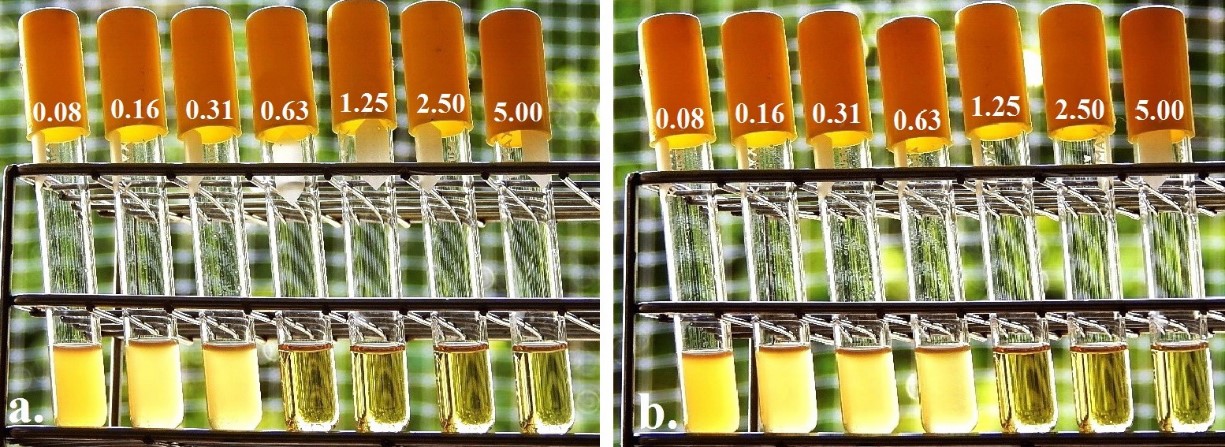
Escherichia coli O157:H7 is one of the important foodborne pathogens in Thailand. The use of chemical food preservatives to prevent the contamination of such bacterial strain in foods can pose harm to consumers. Therefore, currently there have been attempts to find safe natural products such as thymol to use as an alternative. The main objective of this study was to examine the effect of temperature on antimicrobial activity and mode of action of thymol against E. coli O157:H7. The result showed that at 37°C, thymol had ability to inhibit the bacterium with the minimal inhibitory concentration (MIC) of 0.63 mM and had bactericidal mode of action. It also showed that at 20°C, thymol had ability to inhibit the bacterium with the MIC of 1.25 mM and had bactericidal mode of action. The results from this study suggested that temperature had an effect on antimicrobial activity of thymol against E. coli O157:H7 in that the antimicrobial activity of thymol at 37°C was higher than that at 20°C. However, temperature had no effect on mode of action of thymol against E. coli O157:H7.
Article Details
บทความที่ได้รับการตีพิมพ์เป็นลิขสิทธิ์ของ วารสารวิทยาศาสตร์และเทคโนโลยี มหาวิทยาลัยอุบลราชธานี
ข้อความที่ปรากฏในบทความแต่ละเรื่องในวารสารวิชาการเล่มนี้เป็นความคิดเห็นส่วนตัวของผู้เขียนแต่ละท่านไม่เกี่ยวข้องกับมหาวิทยาลัยอุบลราชธานี และคณาจารย์ท่านอื่นๆในมหาวิทยาลัยฯ แต่อย่างใด ความรับผิดชอบองค์ประกอบทั้งหมดของบทความแต่ละเรื่องเป็นของผู้เขียนแต่ละท่าน หากมีความผิดพลาดใดๆ ผู้เขียนแต่ละท่านจะรับผิดชอบบทความของตนเองแต่ผู้เดียว
