
Relationship between Suspended Sediment Flux and Dissolved Inorganic Nutrients Flux in Water of Pak Phaying Canal during Wet Season in September 2015
Article Sidebar
Main Article Content
Abstract
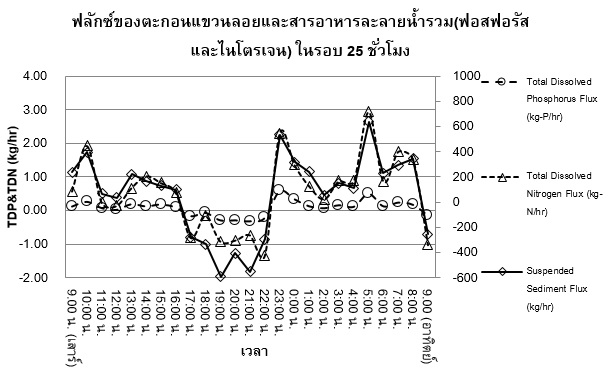
This study aims to examine the relationship between suspended sediment flux and dissolved inorganic nutrients flux in water column at Pak Phaying canal, Nakhon Si Thammarat province during wet season in September 2015. Hourly water samples were collected and determined the dissolved inorganic nutrients flux and suspended sediment flux across the canal’s mouth for a daily-cycle (25 hours period). Electromagnetic current meter was employed to measure flow speed and direction of the water movement. The results showed that the net water flux flowed toward the sea with the rate of 22,302 m3/day. Suspended sediment was found at 37.19-639.64 kg/hr (range), with 279.05±171.74 kg/hr (mean±SD). The net suspended sediment also flowed toward the sea with the rate of 1,656 kg/day. In addition, the amount of nitrite, nitrate, ammonia and total dissolved inorganic nitrogen were 11.20-35.00 (23.86±6.40), 42.00-219.80 (133.95±50.61), 0.00-134.40 (50.46±45.08) and 22.40-350.00 (204.85±93.14) µg-N/l, respectively. Dissolved inorganic phosphorous was 9.30-62.00 (38.54±13.32) µg-P/l. The inorganic dissolved nitrogen flux flowed toward the sea with the net of nitrite, nitrate, ammonia and dissolved inorganic nitrogen at the rate of 0.808, 6.700, 5.553 และ 13.670 kg-N/day, respectively. The net flux of dissolved phosphorous of 2.069 kg-P/day was also detected.
Fluxes of suspended sediment had a highly significant positive relationship with all of the water current direction and volume, the concentration of inorganic dissolved nitrogen (ammonia and nitrite), dissolved inorganic phosphorous, flux of nitrite, flux of ammonia, flux of inorganic phosphorous and flux of inorganic dissolved nitrogen (p < 0.01). Moreover, fluxes of suspended sediment had a positive relationship with the concentration of nitrate, but significant negative relationship with the time of sample collection, depth and salinity of the collection sites (p < 0.05). This indicates that most of the nutrients originating from lands is transported to the sea by tidal cycle which helps to circulate nutrients in-and-out of the canals and rivers. Flux of nutrients is at high level at low tide and low level at high tide. The amount of suspended sediment tends to increase and then decrease at the interface of tidal cycles, with the net flux of suspended sediment toward the sea.
Article Details
บทความที่ได้รับการตีพิมพ์เป็นลิขสิทธิ์ของ วารสารวิทยาศาสตร์และเทคโนโลยี มหาวิทยาลัยอุบลราชธานี
ข้อความที่ปรากฏในบทความแต่ละเรื่องในวารสารวิชาการเล่มนี้เป็นความคิดเห็นส่วนตัวของผู้เขียนแต่ละท่านไม่เกี่ยวข้องกับมหาวิทยาลัยอุบลราชธานี และคณาจารย์ท่านอื่นๆในมหาวิทยาลัยฯ แต่อย่างใด ความรับผิดชอบองค์ประกอบทั้งหมดของบทความแต่ละเรื่องเป็นของผู้เขียนแต่ละท่าน หากมีความผิดพลาดใดๆ ผู้เขียนแต่ละท่านจะรับผิดชอบบทความของตนเองแต่ผู้เดียว
