
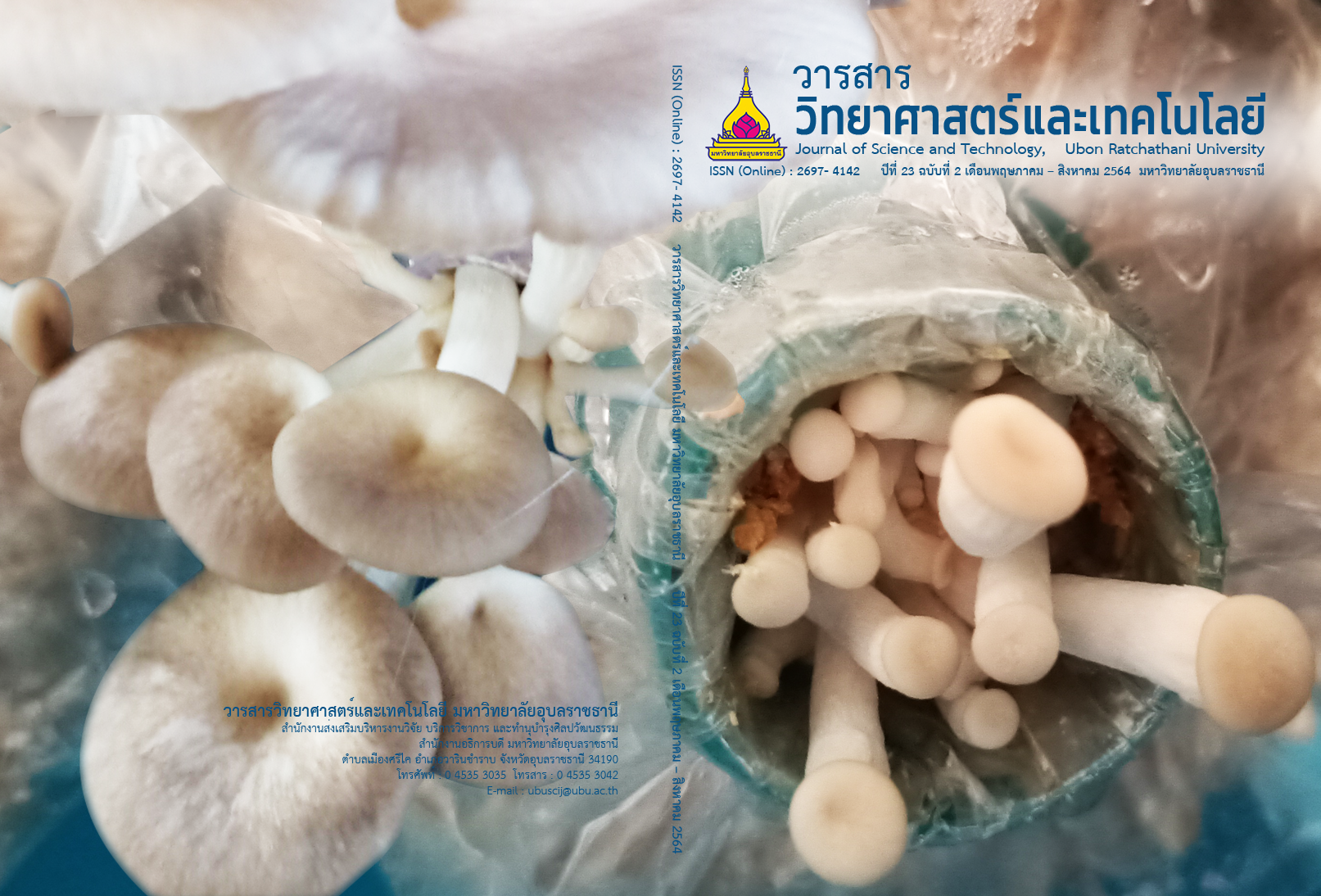
Profit Alternative Material: The Manila Grass Ratio of Oyster Mushroom (Pleurotus ostreatus) Cultivated Materials
Article Sidebar
Main Article Content
Abstract
Oyster mushroom (Pleurotus ostreatus) is an economic mushroom that is consumed in every region of Thailand and around the world. It has a high nutritional value and several medicinal properties. The cultivation is not difficult and gives a good return. Farmers prefer to use Para rubber sawdust as the main cultivated material, which is now more expensive. For this reason, we were studied alternative materials that reduced material costs and increased mushroom yields by using Para rubber sawdust mixed with Manila grass which leftover and locally available, 4 ratios of 9 repetitions as 100:0 (control), 75:25, 50:50 and 25:75 percent, Each ratio was mixed with rice bran, gypsum, lime and magnesium sulfate 6, 2, 1 and 0.2 kg/100 kg of main cultivated material, respectively. The cultivated material 700 g/block. After harvesting of 3 flushs, found that the 75:25 ratio of the Para rubber sawdust and Manila grass promoted the highest flush weight and the biological efficiency average were 48.5 g and 31.6 percent/block/flush, respectively. The average of fruiting bodies number with pileus width of 3 cm or more was 4.6 fruiting body/block/flush, less than the ratio of 25:75, but the fruiting bodies were larger and more complete. The ratio of 75:25 promoted higher mushroom weight, number of fruiting bodies and biological efficacy than the control were 5.0, 12.2 and 51.2 percent, respectively. If this research result is applied to a small mushroom farm, with 4,000 blocks, the profit from the sale of mushroom yields and blocks higher than the ratio of 100:0 amount of 8,120 baht or 16.1 percent/half crop; 3 of 6 flushs. Therefore Manila grass is an interesting alternative material for reducing costs and increasing profitability of Oyster mushroom yields of farmers during the current crisis of household debt.
Article Details
บทความที่ได้รับการตีพิมพ์เป็นลิขสิทธิ์ของ วารสารวิทยาศาสตร์และเทคโนโลยี มหาวิทยาลัยอุบลราชธานี
ข้อความที่ปรากฏในบทความแต่ละเรื่องในวารสารวิชาการเล่มนี้เป็นความคิดเห็นส่วนตัวของผู้เขียนแต่ละท่านไม่เกี่ยวข้องกับมหาวิทยาลัยอุบลราชธานี และคณาจารย์ท่านอื่นๆในมหาวิทยาลัยฯ แต่อย่างใด ความรับผิดชอบองค์ประกอบทั้งหมดของบทความแต่ละเรื่องเป็นของผู้เขียนแต่ละท่าน หากมีความผิดพลาดใดๆ ผู้เขียนแต่ละท่านจะรับผิดชอบบทความของตนเองแต่ผู้เดียว
References
[2] Adebayo, E. A. and Oloke, J. K. 2017. Oyster mushroom (Pleurotus species); a natural functional food. Journal of Microbiology, Biotechnology and Food Sciences. 7(3): 254-264.
[3] Paul, C., Roy, T. and Das, N. 2017. Potentiality of oyster mushroom (Pleurotus spp.) in medicine. Annals of Food Processing and Preservation. 2(2): 1014.
[4] Deepalakshmi, K. and Mirunalini, S. 2014. Pleurotus ostreatus: an oyster mushroom with nutritional and medicinal properties. Journal of Biochemical Technology. 5(2): 718-726.
[5] Thai market. 2021. Product Price: Oyster Mushroom. https://talaadthai.com/product/9-67-05-oyster-mushroom. Accessed 9 February 2021. (in Thai)
[6] Technologychaoban. 2017. Secrets to Buying Para Rubber Sawdust for Mushroom Cultivation. https://www.sentangsedtee.com/farming-trendy/article_40275. Accessed 9 February 2021. (in Thai)
[7] Olfati, J. A. and Peyvast, Gh. 2008. Lawn clippings for cultivation of oyster mushroom. International Journal of Vegetable Science. 14(2): 98-103.
[8] Abdul-Hadi, A. 2010. Influence of cogon grass and kind of supplementation the biological efficiency and storage of Pleurotus ostreatus. Diyala Agricultural Sciences Journal. 2(1): 208-235.
[9] Tesema, G. and Keneni, A. 2019. Nutrient compositions and optimization of elephant grass (Pennisetum purpureum) stem to cotton seed proportion for the cultivation of oyster mushroom (Pleurotus
ostreatus) at Ambo western, Ethiopia. Greener Journal of Agricultural Sciences. 9(3): 322-336.
[10] Bernardia, E. and et al. 2019. Productivity, biological efficiency and bromatological composition of Pleurotus sajor-caju growth on different substrates in Brazil. Agriculture and Natural Resources. 53: 99-105.
[11] Haastrup, N. O. and Aina oduntan, A. O. 2019. Comparative study on the growth and yield of Pleurotus sajor-caju mushroom cultivated on Pennisetum purpureum (Elephant grass) and sawdust of Triplochiton scleroxylon as an environmental control measure. International Journal of Research and Innovation in Applied Science. 4(5): 53-55.
[12] Garg, P. and et al. 2017. Conversion of urban waste into highly nutritious food by Pleurotus cultivation. IOSR Journal of Biotechnology and Biochemistry. 3(4): 15-18.
[13] Puechkaset. 2016. Benefits and Planting of Manila Grass. https://puechkaset.com. Accessed 9 February 2021. (in Thai)
[14] National bureau of agricultural commodity and food standards. 2021. Agricultural Standard: Oyster mushroom. https://www.acfs.go.th/#/ standard-commodity/search. Accessed 9 February 2021. (in Thai)
[15] Keneni, A. 2018. Yield response of oyster mushroom (Pleurotus ostreatus) cultivated on creeping bent grass (Agrostis sp.) biomass supplemented with wheat bran, cotton seed and waste paper. Journal of Natural Sciences Research. 8(21): 68-75.
[16] Tirkey, V. J., Simon, S. and Lal, A. A. 2017. Efficacy of different substrates on the growth, yield and nutritional composition of oyster mushroom Pleurotus florida (Mont.) Singer. Journal of Pharmacognosy and Phytochemistry. 6(4): 1097-1100.
[17] Masevhe, M. R., Soundy, P. and Taylor, N. J. 2016. Alternative substrates for cultivating oyster mushrooms (Pleurotus ostreatus). South African Journal of Plant and Soil. 33(2): 97-103.
[18] Vieira, F. R. and Andrade, M. C. N. 2016. Optimization of substrate preparation for oyster mushroom (Pleurotus ostreatus) cultivation by studying different raw materials and substrate preparation conditions (composting: phases I and II). World Journal of Microbiology and Biotechnology. 32(11): 190.
[19] Alia, N. and et al. 2018. Cultivation of Pleurotus ostreatus on oil palm fronds mixed with rubber tree sawdust. Chemical Engineering Transactions. 63: 547-552.
[20] Hanafi, N. D. and et al. 2018. Analysis of botanical composition and nutrient content on natural pastures in Samosir island of Samosir regency. International conference on agriculture, environment and food security. IOP Conference Series: Earth and Environmental Science. 122(1): 012131.
[21] Ritota, M. and Manzi, P. 2019. Pleurotus spp. cultivation on different agri-food by-products: example of biotechnological. Application Sustainability. 11: 1-26.
[22] Sbhatu, D. B., Abraha, H. B. and Fisseha, H. T. 2019. Grey oyster mushroom biofarm for small-scale entrepreneurship. Advances in Agriculture. 1-6.
[23] Bernardia, E. 2019. Productivity, biological efficiency and bromatological composition of Pleurotus sajor-caju growth on different substrates in Brazil. Agricultural and Nature Resources. 53: 99-105.
[24] Siqueira, F. and et al. 2012. Cultivation of Pleurotus mushrooms in substrates obtained by short composting and steam pasteurization. African Journal of Biotechnology. 11(53): 11630-11635.
[25] Fanadzo, M. and et al. 2010. Evaluation of various substrates and supplements for biological efficiency of Pleurotus sajor-caju and Pleurotus ostreatus. African Journal of Biotechnology. 9(19): 2756-2761.
[26] Ayae, A. and Suwanno, S. 2012. Utilization of lignocellulosic waste from paper cone for oyster mushroom cultivation. Proceedings of 50th Kasetsart University Annual Conference: Science, Natural Resources and Environment. 392-400.
[27] Cueva, M. B. R. , Hernández, A. and Niño-Ruiz, Z. 2017. Influence of C/N ratio on productivity and the protein contents of Pleurotus ostreatus grown in differents residue mixtures. Revista FCA UNCUYO. 49(2): 331-334.
[28] National research agency. 2019. Knowledge Guide: Knowledge Management and Technology transfer Value Added and Utilization of Microorganisms for Fermented Products and Mushroom Cultivation. 66 pp. (in Thai)
[29] Bank of Thailand. 2021. Loans to The Household Sector. https://www.bot.or.th/App/BTWS_STAT/Statistics/BOTWEBSTAT.aspx?reportID=775&Language=TH. Accessed 9 February 2021. (in Thai)
