
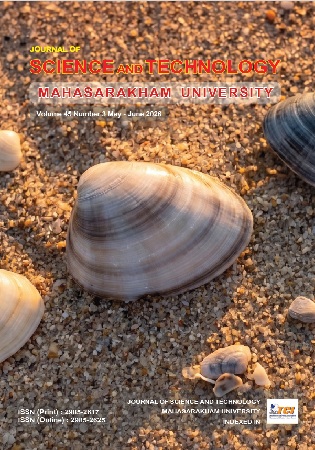
Quantity and harvesting value of wedge clams (Donax spp.) at Muang Ngam Beach, Muang Nga m Subdistrict, Singha nakhon District, Songkhla Province
Article Sidebar
Main Article Content
Abstract
Wedge clams in the genus Donax are crucial bivalves in the sandy beach ecosystem. They play a vital role in the
local food chain and provide a source of income for coastal communities. This research aimed to estimate the direct
income value and potential harvesting value of wedge clams. Economic data for direct income were collected through interviews with local harvesters, while potential value was assessed using biological surveys during spring and neap tides. The results identified three species: Donax faba, D. cuneatus, and D. incarnatus. Locals typically harvested clams based on size rather than species. The net income from harvesting amounted to 154,359.38 baht/year (averaging 9,079.96 baht/person/year). Regarding potential quantity, average densities during spring tide for D. faba and D. incarnatus were 11.6 ± 1.85 and 6.0 ± 1.21 ind/m², respectively. During neap tide, densities were 2.13 ± 0.76 for
D. cuneatus and 0.67 ± 0.28 for D. incarnatus. The estimated annual potential harvesting value for this beach area
was 716,420.94 baht/year or 247.05 baht/m²/year. These findings highlight the importance of wedge clams to coastal
communities and the necessity of their conservation for sustainable utilization.
Article Details
References
เกื้อ ฤทธิ์บูรณ์, สุภาพร ฝั่งชลจิตต์, พิมลรัตน์ ทองโรย, เชาวพจน์ ชววงศ์ษา, และ สมศักดิ์ บัวทิพย์. (2562). นิเวศวิทยาบางประการของหอยเสียบ (Donax faba Gmelin, 1791) บริเวณหาดบางหลิง อำเภอเทพา จังหวัดสงขลา. วารสารวิทยาศาสตร์บูรพา, 24(1), 395–414.
คณะกรรมการทรัพยากรทางทะเลและชายฝั่งจังหวัดสงขลา. (2560). รายงานสถานการณ์ทรัพยากรทางทะเลและชายฝั่ง และการกัดเซาะชายฝั่งจังหวัดสงขลา.
ณัฐฌาชิตา ชูเกิด, ศศิธร บุญเดช, สุธินี หีมย, และ นุชจรินทร์ เพชรเกลี้ยง. (2564). ความแปรผันทางสัณฐานวิทยาของหอยเสียบ (Donax faba Gmelin, 1791) และปัจจัยสิ่งแวดล้อมบางประการบริเวณหาดบางหอยและหาดบางเรือนาค จังหวัดสงขลา. วารสารวิทยาศาสตร์ มข., 49(4), 351–361.
แนวหน้า. (2563, 28 กรกฎาคม). ชาวบ้านหา ‘หอยเสียบ’ หาดดงตาลพัทยามาปรุงเมนูเด็ด ‘หอยเสียบผัดน้ำพริกเผา’. https://www.naewna.com/likesara/508044
บ้านเมือง. (2561, 25 สิงหาคม). “หอยเสียบ” เมนูหรอย ปีละครั้ง ต้องหน้ามรสุมเท่านั้นจึงหากินได้. https://www.banmuang.co.th/news/region/122927
ประดิษฐ์ รอดเกิด. (2562, 3 สิงหาคม). หอยเสียบโผล่ชายหาด ชาวบ้านขุดขาย หารายได้. 77 ข่าวเด็ด. https://www.77kaoded.com/news/pradit/708924
ผู้จัดการออนไลน์. (2565, 29 กันยายน). หาหอยเสียบริมทะเล. https://mgronline.com/south/detail/9650000093642
ไพฑูรย์ ศิริรักษ์. (2554). หอยเสียบ หอยสองฝา หรือหอยทราย. GotoKnow. https://www.gotoknow.org/posts/432300
สาวิกา กัลปพฤกษ์, และ สิทธิ กุหลาบทอง. (2556). การประยุกต์ใช้หอยสองฝาในการจัดการคุณภาพน้ำ. Veridian E-Journal, Silpakorn University, 6(3), 846–859.
สำนักงานแรงงานจังหวัดสงขลา. (2564). ค่าแรงขั้นต่ำจังหวัดสงขลา. https://songkhla.mol.go.th/อัตราค่าจ้างขั้นต่ำ
เสถียรพงษ์ ขาวหิต, และ เกษม จันทร์แก้ว. (2559). อิทธิพลของน้ำทิ้งที่ผ่านการบำบัดต่อมูลค่าสัตว์หน้าดินขนาดใหญ่ที่สำคัญทางเศรษฐกิจบริเวณหาดเลนงอกใหม่แหลมผักเบี้ย: โครงการศึกษาวิจัยและพัฒนาสิ่งแวดล้อมแหลมผักเบี้ยอันเนื่องมาจากพระราชดำริ จังหวัดเพชรบุรี. วารสารวิจัยเพื่อการพัฒนาเชิงพื้นที่, 8(4), 84–96.
หาดใหญ่โฟกัสดอทคอม. (2562, 19 พฤษภาคม). ชาวสงขลา งมหอยเสียบ อาชีพเสริมสร้างรายได้หลักพัน. https://www.hatyaifocus.com/ข่าว/8813-ข่าวเศรษฐกิจและการเงิน-สงขลา%2B%7C%2Bชาวสงขลา%2Bงมหอยเสียบ%2Bอาชีพเสริมสร้างรายได้หลักพัน
Basco, D. R. (2006). Seawall impacts on adjacent beaches: Separating fact from fiction. Journal of Coastal Research, 39, 741–744.
Bujan, N., Cox, R., & Masselink, G. (2019). From fine sand to boulders: Examining the relationship between beach-face slope and sediment size. Marine Geology, 417, 1–17.
Carstensen, D., Laudien, J., Leese, F., Arntz, W., & Held, C. (2009). Genetic variability, shell and sperm morphology suggest that the surf clams Donax marincovichi and D. obesulus are one species. Journal of Molluscan Studies, 75(4), 381–390. https://doi.org/10.1093/mollus/eyp036
DeLancey, L. (1999). Coquina clam. South Carolina Department of Natural Resources. http://www.dnr.sc.gov/cwcs/pdf/Coquinaclam.pdf
Manatrinon, S., Thonglor, O.-U., & Boonyapakdee, A. (2012). Genetic and morphological variation in three populations of Donax spp. in the Gulf of Thailand. Thai Journal of Genetics, 5(1), 79–88.
Nel, R., McLachlan, A., & Winter, D. P. E. (2001). The effect of grain size on the burrowing of two Donax species. Journal of Experimental Marine Biology and Ecology, 265(2), 219–238.
Özden, Ö., Erkan, N., & Ulusoy, Ş. (2009). Seasonal variations in the macronutrient, mineral and proximate composition of two clams (Chamelea gallina and Donax trunculus). International Journal of Food Sciences and Nutrition, 60(5), 402–412. https://doi.org/10.1080/09637480701772945
Signorelli, J. H., & Printrakoon, C. (2020). The family Donacidae (Bivalvia: Tellinoidea) in Thai waters. Molluscan Research, 3.
Smits, M., Enez, F., Ferraresso, S., Rovere, G. D., Vetois, E., Auvray, J. F., Genestout, L., Mahla, R., Arcangeli, G., Paillard, C., Haffray, P., & Bargelloni, L. (2020). Potential for genetic improvement of resistance to Perkinsus olseni in the Manila clam, Ruditapes philippinarum, using DNA parentage assignment and mass spawning. Frontiers in Veterinary Science, 7, 1–14.
Supmee, V., Songrak, A., Suppapan, J., & Sangthong, P. (2021). Population genetic structure of the wedge clam (Donax scortum) along the Andaman Sea coast of Thailand. Journal of Fisheries and Environment, 45(1), 85–97.
Takar, S., Jawahar, P., Gurjar, U. R., Kingston, S. D., Neethiselvan, N., Pereira, J. J., & Jagadis, I. (2021). Food and feeding habits of wedge clam (Donax cuneatus) off Thoothukudi, Gulf of Mannar, India. Indian Journal of Animal Research, 57(3), 328–333.
Tantikamton, K., Rodpai, J., Srinakorn, P., & Jitpukdee, S. (2017). Species diversity and spatial distribution of macroinvertebrates on the intertidal zone of Rajamangala Beach, Trang Province, Thailand. Environment and Natural Resources Journal, 15(1), 30–40.
Tenjing, S. Y. (2017). Biometric relationships of the edible wedge clam, Donax faba (Gmelin, 1791) of two populations from Panambur (polluted area) and Padukere (unpolluted area) with reference to environmental variables (India). Vie et Milieu, 67(3–4), 179–192.
Tinker, M. T., Yee, J. L., Laidre, K. L., Hatfield, B. B., Harris, M. D., Tomoleoni, J. A., Bell, T. W., Saarman, E., Carswell, L. P., & Miles, A. K. (2021). Habitat features predict carrying capacity of a recovering marine carnivore. Journal of Wildlife Management, 85(2), 303–323.
Turra, A., Corte, G. N., Amaral, A. C. Z., Yokoyama, L. Q., & Denadai, M. R. (2018). Non-linear curve adjustments widen biological interpretation of relative growth analyses of the clam Tivela mactroides (Bivalvia, Veneridae). PeerJ, 6, Article e5070.
Varadharajan, D., Soundarapandian, P., Gunalan, B., & Babu, R. (2009). Seasonal abundance of macrobenthic composition and diversity along the southeast coast of India. European Journal of Applied Sciences, 2(1), 1–5.
Wangkulangkul, K., Khantasimachalerm, N., Kaewutai, K., & Choosun, T. (2021). Distribution of wedge clams Donax spp. on sandy beaches of Thailand [Unpublished manuscript].
Yucharoen, M., Khantasimachalerm, N., Punritdum, N., Thawaii, S., Kaewutai, K., Choosun, T., & Wangkulangkul, K. (2020). Does coastal erosion influence dominant macrobenthic invertebrates on Songkhla sandy beaches? Proceedings of The Science Society of Thailand Under the Patronage of His Majesty the King, Faculty of Science, Ramkhamhaeng University, 721–727.
