
Changes in Clostridium Difficile Toxin A/B Detection Results Using Lateral Flow Immunochromatography
Article Sidebar
Main Article Content
Abstract
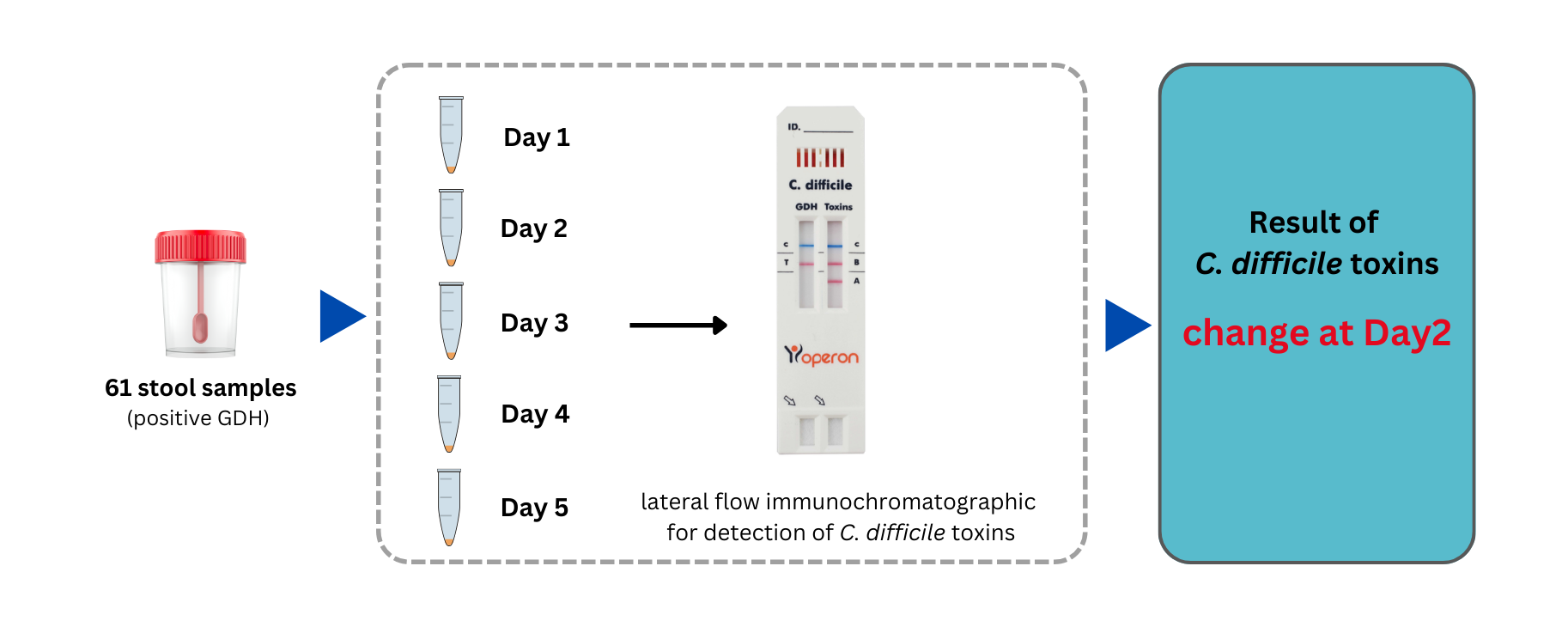
Toxin types A (TcdA) and B (TcdB) of Clostridium or Clostridiodes difficile (C. difficile) are responsible for causing severe diarrhea in patients with CDI (Clostridioides difficile infection), and can lead to fatal outcomes. Detection of glutamate dehydrogenase (GDH) and TcdA/B using lateral flow immunochromatography (IC) is crucial for CDI diagnosis. However, when immediate testing is not possible, fecal samples are typically stored at 4°C until official analysis, sometimes for up to 5 days. This study aimed to determine the critical day—the first day on which IC test results for GDH and TcdA/B begin to deviate from Day 1 results, potentially affecting clinical decision-making. A total of 61 post-analysis fecal samples from patients at Thammasat University Hospital, Pathumtani, Thailand, were divided into five aliquots per sample, stored at 4°C, and tested for GDH and TcdA/B using the IC method from Day 1 to Day 5. The agreement of test results across the 5 days was evaluated using Cohen’s Kappa coefficient. The results identified Day 2 as the critical day. Overall, IC test result patterns between Day 1 and Days 2–5 showed high agreement (almost perfect concordance). However, beginning on Day 2, a 4.90–6.60% increase in negative results was observed, which may lead to missed diagnoses and delayed treatment. In conclusion, GDH and TcdA/B detection using the IC method should be performed as soon as possible to reduce the lethal rate.
Article Details
References
Janoir, C., 2016, Virulence factors of Clostridium difficile and their role during infection, Anaerobe. 37: 13–24.
Putsathit, P., Maneerattanaporn, M., Piewngam, P., Knight, D. R. and Riley, T. V., 2017, Antimicrobial susceptibility of Clostridium difficile isolated in Thailand, Antimicrob. Resist. Infect. Control. 6: 1-6.
Imwattana, K., Putsathit, P., Leepattarakit, T., Kiratisin, P. and Riley, T. V., 2020, Mild or malign: clinical characteristics and outcomes of Clostridium difficile infection in Thailand, J. Clin. Microbiol. 58(9): 1217- 1220.
Imwattana, K., Wangroongsarb, P. and Riley, T. V., 2019, High prevalence and diversity of tcdA-negative and tcdB-positive and non-toxigenic Clostridium difficile in Thailand, Anaerobe. 57: 4–10.
Imwattana, K., Knight, D. R., Kullin, B., Collins, D. A., and Riley, T. V., 2019, Clostridium difficile ribotype 017 - characterization evolution and epidemiology of the dominant strain in Asia, Emerg. Microbes. Infect. 8: 796–807.
Sholeh, M., Kouhsari, E., Talebi, M., Hallajzadeh, M. and Amirmozafari, N., 2021, Toxin gene profiles and antimicrobial resistance of Clostridioides difficile infection: a single tertiary care center study in Iran, Iran. J. Microbiol. 13(6): 793–800.
Becker, S. L., Chatigre, J. K., Coulibaly, J. T., Mertens, P. and von Müller, L., 2015, Molecular and culture-based diagnosis of Clostridium difficile isolates from Côte d'Ivoire after prolonged storage at disrupted cold chain conditions, Trans. R. Soc. Trop. Med. Hyg. 109(10): 660–668.
Schora, D. M., Peterson, L. R. and Usacheva, E. A., 2018, Immunological stability of Clostridium difficile toxins in clinical specimens, Infect. Control. Hosp. Epidemiol. 39(4): 434–438.
Nho, S. W., Kim, M., Kim, S. J., Foley, S. L. and Cerniglia, C. E., 2021, Pragmatic strategy for fecal specimen storage and the corresponding test methods for Clostridioides difficile diagnosis, Pathogens. 10(8): 1-13.
Borriello, S. P., Vale, T., Brazier, J. S., Hyde, S. and Chippeck, E., 1992, Evaluation of a commercial enzyme immunoassay kit for the detection of Clostridium difficile toxin A, Eur. J. Clin. Microbiol. Infect. Dis. 11(4): 360–363.
Bowman, R. A. and Riley, T. V., 1986, Isolation of Clostridium difficile from stored specimens and comparative susceptibility of various tissue culture cell lines to cytotoxin, FEMS. Microbiol. Lett. 34: 31-35.
Planche, T., Aghaizu, A., Holliman, R., Riley, P. and Krishna, S., 2008, Diagnosis of Clostridium difficile infection by toxin detection kits: A systematic review, Lancet. Infect. Dis. 8(12): 777–784.
Operon immune and molecular diagnostics, 2025, Simple GDH-Toxins, Available Source: https://www.operondx.com/wpcontent/uploads/pdf/instructions/0905144_GDH-Toxins_web.pdf, February 21, 2025.
McHugh, M. L., 2012, Interrater reliability: The kappa statistic, Biochem. Med. 22(3): 276–282.
Kvach, E. J., Ferguson, D., Riska, P. F. and Landry, M. L., 2010, Comparison of BD GeneOhm C. diff real-time pcr assay with a two-step algorithm and a toxin A/B enzyme-linked immunosorbent assay for diagnosis of toxigenic Clostridium difficile infection, J. Clin. Microbiol. 48: 109–114.
Novak-Weekley, S. M., Marlowe, E. M., Miller, J. M., Cumpio, J. and Weissfeld, A., 2010, Clostridium difficile testing in the clinical laboratory by use of multiple testing algorithms, J. Clin. Microbiol. 48(3): 889–893.
Sharp, S. E., Ruden, L. O., Pohl, J. C., Hatcher, P. A. and Ivie, W. M., 2010, Evaluation of the C.Diff quik chek complete assay, a new glutamate dehydrogenase and A/B toxin combination lateral flow assay for use in rapid, simple diagnosis of Clostridium difficile disease, J. Clin. Microbiol. 48(6): 2082–2086.
Alcalá L., 2013, Laboratory tests for diagnosis of Clostridium difficile infection: past, present, and future, Enferm. Infecc. Microbiol. Clin. 31(2): 65–67.
Grześkowiak, Ł., Riedmüller, J., Vahjen, W. and Zentek, J., 2020, Storage procedures and time influence the detectability of Clostridium difficile toxin A but not toxin B in porcine fecal specimens, J. Vet. Diagn. Invest. 32(2): 222–225.
Aichinger, E., Schleck, C. D., Harmsen, W. S., Nyre, L. M. and Patel, R., 2008, Nonutility of repeat laboratory testing for detection of Clostridium difficile by use of pcr or enzyme immunoassay, J. clin. Microbiol. 46(11), 3795–3797.
Cardona, D. M. and Rand, K. H., 2008, Evaluation of repeat Clostridium difficile enzyme immunoassay testing, J. Clin. Microbiol. 46(11): 3686–3689.
Barbut, F., Surgers, L., Eckert, C., Visseaux, B. and Lalande, V., 2014, Does a rapid diagnosis of Clostridium difficile infection impact on quality of patient management?, Clin. Microbiol. Infect. 20(2): 136–144.
Freeman, J. and Wilcox, M. H., 2003, The effects of storage conditions on viability of Clostridium difficile vegetative cells and spores and toxin activity in human faeces, J. Clin. Pathol. 56(2): 126–128.
Barbut, F., Beaugerie, L., Delas, N., Fossati-Marchal, S. and Petit, J. C., 1999, Comparative value of colonic biopsy and intraluminal fluid culture for diagnosis of bacterial acute colitis in immunocompetent patients. infectious colitis study group, Clin. Microbiol. Infect. 29(2): 356–360.
Planche, T. D., Davies, K. A., Coen, P. G., Finney, J. M. and Wilcox, M. H., 2013, Differences in outcome according to Clostridium difficile testing method: a prospective multicentre diagnostic validation study of C difficile infection, Lancet. Infect. Dis. 13(11): 936–945.
