
Effect of Osil® Application on the Explant Surface Sterilization Procedure of Rosa chinensis Jacq.
Article Sidebar
Main Article Content
Abstract
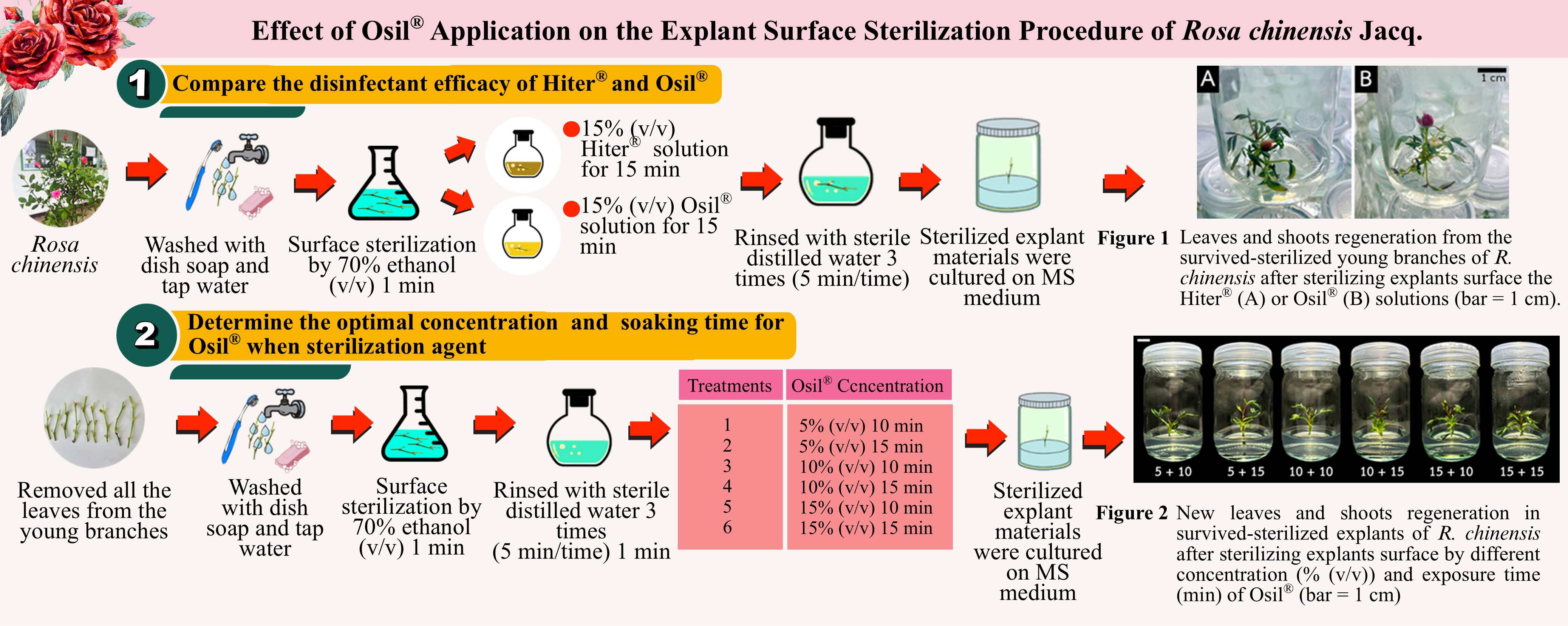
Rosa chinensis Jacq. is commonly propagated through tissue culture to meet the consistent demand in the decorative plant market. However, limited research has been conducted on the effectiveness of explant surface sterilization in initiating axenic plantlets within tissue culture systems. This study aimed to: 1) compare the disinfectant efficacy of Hiter®, a commercial bleach containing sodium hypochlorite as the active ingredient, with Osil®, an agricultural chemical containing silver nanoparticles as active substance-both at a 15% (v/v) concentration with a 15-minute exposure, and 2) determine the optimal concentration (5%, 10%, 15% v/v) and soaking time (10 and 15 minutes) for Osil® when used as a surface sterilization agent. The results showed that Hiter® and Osil® achieved similar disinfection rates for R. chinensis young branches (83.33% and 93.33%, respectively). However, the explant survival rate was significantly higher with Osil® (100%) compared to Hiter® (35.65%) after surface sterilization. The study concluded that the most effective method for sterilizing R. chinensis young branches is soaking them in a 15% (v/v) Osil® solution for 10 minutes. These findings improve the explant surface sterilization process and may enhance the efficiency of tissue culture propagation for R. chinensis.
Article Details
References
Tibkwang, A., Junkasiraporn, S. and Chotikadachanarong, K. 2018, Effects of cytokinnin and sucrose on tissue culture of Rosa chinensis Jacq.var.minima Voss. BUU. Sci. J, 23(2): 712-721. (in Thai)
Nikomtat, J., Pokeaw, S., Klinnoo, S., Raktham, R. and Faiyue, B. 2020. Tissue culture of Rosa chinensis Jacq. var. minima Voss. by simple plant Tissue culture media. Academic. J. Sci. Applied. Sci, 1: 29-39. (in Thai)
Ramasoot, S., Mahrea, N. and Bayor, A. 2017, Effect of silver nitrate on in vitro flowering induction and prolong duration of miniature Rose (Rosa chinensis Jacq). Wichchca. J, 36(1): 39-49.
Pongthai,P.and Pongswat,S.2010,Plant Tissue Culture and in vitro Flowering of Rosa chinensis Jacq.The3rd Rajamangala University of Technology Conference, 6 p.
Salehi, H. and Khish-Khui, M. 1996, Micropropagation of miniature rose cultivars. Iran. Agric. Res. 15: 51-67.
Chu, C.Y., Knight, S.L. and Smith, M.A.L. 1993, Effect of liquid culture on the growth and development of miniature rose (Rosa chinensis Jacq. ’Minima’). Plant CellTissue Organ Cult.32:329-334.
Hsia, C.N. and Korban, S.S. 1996, Factors affecting in vitro establishment and shoot proliferation of Rosa hybrida L.and Rosa chinensis minima. In Vitro Cell. Dev.Biol.-Plant. 32: 217-222.
Vaca-Suquillo, I. de los Ángeles, Acuña, J.A.A. and Cruz, M.V.P. 2022, Oxidation and contamination control inthein vitro establishment of Rosa chinensis. Stud. Environ. Anim. Sci, 3(3): 1479-1493.
de la Rosa Jr., Z.S. and Belarmino, M.M. 2007, In vitro culture of rose species (Rosa spp.) via axillary bud growth. Ann.Trop. Res, 29(1): 1-13.
Salehi, H. and Khish-Khui, M. 1997, A simple procedure for disinfection of ’Baby Masquerade’ miniature rose explants. Sci. Hortic. 68: 145-148.
Maurya,R.P.,Yadav,R.C., Godara, N.R.and Beniwal, V.S. 2013, In vitro plant regenerationof rose(Rosa hybridaL.) cv."Benjamin Paul" through various explants. J. Exp. Biol. Agric. Sci. 1: 111-119.
Shirdel, M., Motallebi-Azar, A.R., Matloob,M., Mokhtarzadeh, S. and Ozdemir. F.A. 2017, In vitro establishment procedures of Dog rose (Rosa canina). J. Appl. Biol. Sci. 11(2): 6-9.
Parzymies, M., Pudelska, K. and Poniewozik, M. 2019, The use of nano-silver for disinfection of Pennisetum alopecuroides plant material for tissue culture. Acta. Sci. Pol. Hortorum Cultus.18(3): 127-135.
Hashim, S.N., Ghazali, S.Z., Sidik, N.J., Chia-Chay,T. and Saleh, A.2021,Surface Sterilization Method for Reducing Contamination of Clinacanthus Nutans Nodal Explants Intended for In-Vitro Culture.The 1 st International Conference on Assessment and Development of Agricultural Innovation, 8 p.
Mahajan,S.,Kadam, J., Dhawal,P.,Barve, S. and Kakodkar, S. 2022, Application of silver nanoparticles in in-vitro plant growth and metabolite production: revisiting its scope and feasibility. Plant Cell Tissue Organ Cult, 150(1), 15-39.
Abdi, G. 2012, Evaluation the potential of nano silver for removal of bacterial contaminants in valerian (Valeriana officinalis L.) tissue culture. J. Bio. Env. Sci, 6(17): 199-205.
Fakhrfeshani, M., Bagheri, A. and Sharifi, A.2012, Disinfecting effects of nanosilver fluids in Gerbera (Gerbera jamesonii) capitulum tissue culture. J. Bio. Env. Sci,6(17): 121-127.
Gouran, A., Jirani, M., Mozafari, A.A.,Saba, M.K., Ghaderi, N. and Zaheri, S. 2014, Effect of Silver Nanoparticles on Grapevine Leaf Explants Sterilization at In Vitro Conditions.The 2nd National Conference on Nanotechnology from Theory to Application, 6 p.
Taghizadeh, M. and Solgi, M. 2014, The application of essential oils and silver nanoparticles for sterilization of bermudagrass explants in in vitro culture. Int. J. Hortic. Sci. Technol. 1(2): 131-140.
Shokri, S., Babaei, A., Ahmadian, M., Arab, M.M. and Hessami, S.2013.Theeffectsof different concentrations of nano-silveron elimination of bacterial contaminations and phenolic exudation of rose (Rosa hybrida L.) in vitro culture. Acta Hortic. 1083: 391-396.
Adebomojo, A.A.and Abdul-Rahaman, A.A. 2020, Surface Sterilization of Ocimum Seeds and Tissues With Biosynthesized Nanosilver and its Effects on Callus Induction. Nanotechnology Applicationsin Africa: Opportunities and Constraints,20 p.
Vatcharakajon, P., Sornsaket, A.,Choengpanya, K., Susawaengsup, C.,Sornsakdanuphap, J., Boonplod, N., Bhuyar,P.and Dangtungee,R. 2023,Silver nanochito oligomer hybrid solutionfor the treatmentof Citrus greening disease(CGD) and biostimulants in Citrus. Horticulture. 9(6): 725.
Choengpanya,K.,Susawaengsup,C.,Sornsakdanuphap, J., Dangtungee, R. and Siangsuepchart, A. 2024, Antifungal Property of Silver Nano-Chito Oligomer Hybrid Solution Against Canbendazim Resistan tFungus. Fusarium Solani.The 4 th National and The 2nd International MJU Phrae Conference,7 p.
Muiruri, S.N., Mweu, C.M. and Nyende, B.A. 2011, Micropropagation protocols using nodal explants of selected rose (Rosa hybrida) cultivars. Afr. J. Hort. Sci. 4: 60-65.
Murashige, T. and Skoog, F. 1962. A revised medium for rapid growthand bio assays with tobacco tissue cultures. Physiol. Plant. 15(3): 473-497.
Yadav, H., Banyal, N., Singh, M.K., Singh, K.P., Panwar, S., Singh, B., Kumar, S. and Mandal, B.N. 2023, Optimization of in vitro protocol for rapid mass multiplication of floribunda rose cv. ’Rose Sherbet’.AMA Agric. Meeh. Asia. Afr.Lat. AM.54(9):15781-15788.
Aung, K., Jiang, Y. and He, S.Y. 2018, The role of water in plant-microbe interactions. Plant J. 93(4): 771-780.
Fukuzaki,S.2006, Mechanisms of actions of sodium hypochlorite in cleaning and disinfection processes. Bio. Sci. 11(4):147-157.
Shields, H. J.,Traa, A.and VanRaamsdonk, J. M. 2021, Beneficial and detrimental effects of reactive oxygen species on lifespan: a comprehensive review of comparative and experimental studies. Front. Cell. Dev. Biol. 9: 181.
Estrela, C., Estrela, C.R., Barbin, E.L.,Spanó, J.C.E., Marchesan, M.A. and Pécora, J.D. 2002, Mechanism of action of sodium hypochlorite.Braz. Dent. J.13: 113-117.
Yildiz, M. 2012, The Prerequisite of the Success in Plant Tissue Culture: High FrequencyShootRegeneration, Available Source: https://www.intechopen.com/chapters/40187. August 27, 2024.
Karawak, P.K., Chiangnoon, R., Sriwiang, W., Meepean, P., Sritapanya, N., Thamrongsiripak, N., Yooyen, T. and Uttayarat, P. 2024, The release of silver nanoparticles and antibacterial properties of hydrogel sheet dressings. Thai. Sci. Technol. J, 32(5): 55-65. (in Thai)
Kim,S.W., Jung, J.H.,Lamsal,K.,Kim,Y.S., Min, J.S. and Lee, Y.S. 2012, Antifungal effects of silver nanoparticles (AgNPs) against various plant pathogenic fungi. Mycobiology. 40(1): 53-58.
Yin, I.X., Zhang, J., Zhao, I.S., Mei, M.L.,Li, Q. and Chu, C.H. 2020, The antibacterial mechanism of silver nanoparticles and its application in dentistry. Int. J. Nanomedicine, 15: 2555-2562.
Tung, H.T., Thuong, T.T., Cuong, D.M., Luan,V. Q., Hien,V.T., Hieu,T., Nam, N.B., Phuong, H.T.N, Vinh, B.V.T., Khai, H.D., Nhut, D.T., and Nhut, D.T. 2021. Silver nanoparticles improved explant disinfection, in vitro growth, runner formation and limited ethylene accumulation during micropropagation of strawberry (Fragaria × ananassa). Plant Cell Tissue Organ Cult, 145: 393-403.
Mishra, S.K., Ferreira, J.M.F. and Kannan,S.2015, Mechanically stable antimicrobial chitosan-PVA-silver nanocomposite coatings deposited ontitanium implants. Carbohydr. Polym. 121: 37-48.
Cuong, D.M., Mai, N.T.N.,Tung, H.T.,Khai,H.D., Luan, V.Q., Phong, T.H., Van The Vinh,B.,Phuong, H.T.N.,VanBinh, N. and Tan Nhut, D.2023,Positive effect of silver nanoparticles in micropropagation of Limonium sinuatum (L.) Mill.’White’. Plant CellTissue Organ Cult,155(2):417-432
