
Total Phenolic Content, Antioxidant and Antibacterial Activities of Lime, Tangerine and Kaffir Lime Peel Extracts
Article Sidebar
Main Article Content
Abstract
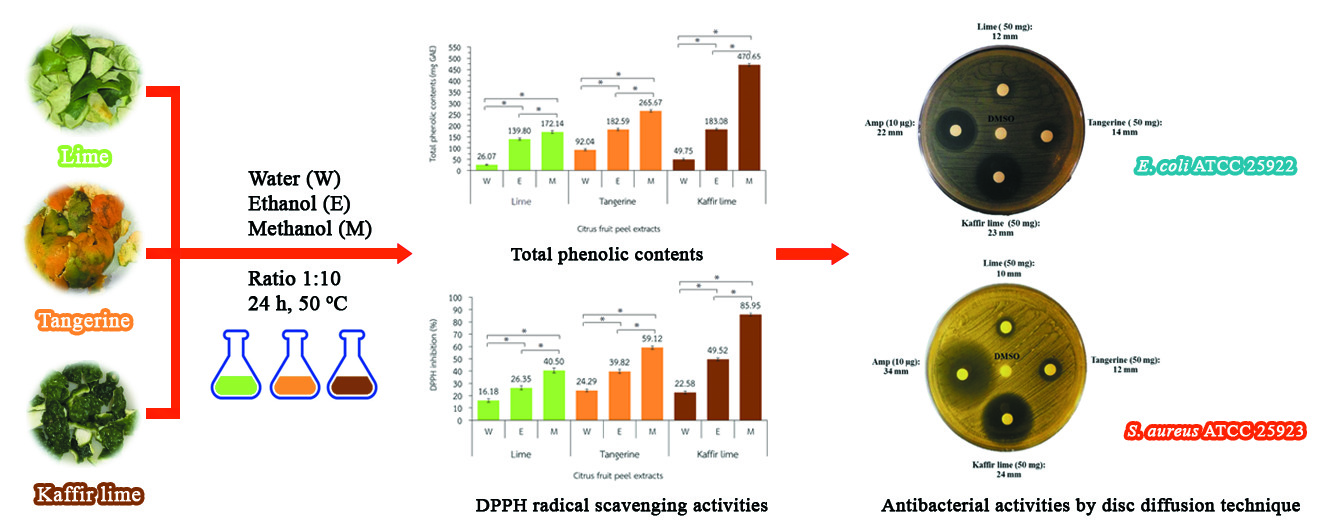
This research aimed to compare the total phenolic content (TPC), antioxidant activity, and antibacterial activity of crude extracts from the peels of three citrus fruits: lime, tangerine, and kaffir lime. Extraction was performed through maceration using three different solvents, distilled water, ethanol, and methanol, in a 1:10 solute-to solvent ratio at 50°C for 24 hours. Among the solvents tested, methanol proved to be the most effective for extracting phenolic compounds, followed by ethanol and then distilled water. The highest TPC was observed in the methanol extract of kaffir lime peel (11.76±0.15 milligrams of gallic acid equivalents per gram of dry weight), followed by the methanol extracts of tangerine and lime peels. Antioxidant activity, assessed via the DPPH radical scavenging assay, was highest in the methanol extracts for all citrus types and showed a positive correlation with TPC. For antibacterial activity, methanol extracts from lime, tangerine, and kaffir lime peels were tested using the agar disc diffusion method, producing inhibition zones of 12, 14, and 23 millimeters, respectively, against Escherichia coli, and 10, 12, and 24 millimeters, respectively, against Staphylococcus aureus. Further analysis of MIC and MBC values indicated that the methanol extract from kaffir lime peel exhibited superior antibacterial and bactericidal effects compared to the other citrus extracts. It also showed greater efficacy against S. aureus (a gram positive bacterium) than E. coli (a gram-negative bacterium). HPLC analysis identified hesperidin as the main phenolic compound in the extracts.
Article Details
References
Pizzino, G., Irrera, N., Cucinotta, M., Pallio, G., Mannino, F., Arcoraci, V., Squadrito, F., Altavilla, D. and Bitto, A., 2017, Oxidative stress: harms and benefits for human health, Oxid. Med. Cell Longev. 2017: 8416763.
Urban-Chmiel, R., Marek, A., Stepien-Pysniak, D., Wieczorek, K., Dec, M., Nowaczek, A. and Osek, J., 2022, Antibiotic resistance in bacteria-A review, Antibiotics (Basel). 11(8): 1079.
Saleem, M., Durani, A. I., Asari, A., Ahmed, M., Ahmad, M., Yousaf, N. and Muddassar, M., 2023, Investigation of antioxidant and antibacterial effects of citrus fruits peels extracts using different extracting agents: Phytochemical analysis with in silico studies, Heliyon. 9: e15433.
Chen, Y., Pan, H., Hao, S., Pan, D., Wang, G. and Yu, W., 2021, Evaluation of phenolic composition and antioxidant properties of different varieties of Chinese citrus, Food Chem. 364: 130413.
Butkhup, L., 2011, Dietary polyphenols and their biological effects, J. Sci. Technol. MSU. 31(4): 443-455.
Kometani, T., Nishimura, T., Nakae, T., Takii, H. and Okada, S., 1996, Synthesis of neohesperidin glycosides and naringin glycosides by cyclodextrin glucanotransferase from alkalophilic Bacillus sp, Biosci. Biotechnol. Biochem. 60(4): 645-649.
Kometani, T., Terada, Y., Nishimura, T., Takii, H. and Okada, S., 1994, Purification and characterization of cyclodextrin glucanotransferase from a Bacillus species and transglucosylation at alkaline pHs, Biosci. Biotechnol. Biochem. 58(3): 517-520.
Kometani, T., Terada, Y., Nishimura, T., Takii, H. and Okada, S., 1994, Transglucosylation to hesperidin by cyclodextrin glucanotransferase from Bacillus species in alkaline pH and properties of hesperidin glycosides, Biosci. Biotechnol. Biochem. 58(11): 1990-1994.
Chaisin, T., Rudeekulthamrong, P. and Kaulpiboon, J., 2021, Enzymatic synthesis, structural analysis, and evaluation of antibacterial activity and α-glucosidase inhibition of hesperidin glycosides, Catalysts. 11(5): 532.
Ganeshpurkar, A. and Saluja, A. K., 2017, The pharmacological potential of rutin, Saudi. Pharm. J. 25(2): 149-164.
Singleton, V. L., Orthofer, R. and Lamuela-Raventos, R. M., 1999, Analysis of total phenols and other oxidation substrates and antioxidants by means of Folin-Ciocalteu reagent, Methods Enzymol. 299: 152-178.
Brand-Williams, W., Cuvelier, M. E. and Berset, C., 1995, Use of a free radical method to evaluate antioxidant activity, LWT - Food Sci. Technol. 28(1): 25-30.
CLSI, 2017, Performance Standards for Antimicrobial Susceptibility Testing, 27th Ed. Clinical and Laboratory Standards Institute (CLSI) Supplement M100. Wayne, PA, Available Source: https://goums.ac.ir/files/deputy_treat/md_labs_ef39a/files/M100-S27_CLSI_2017.pdf, April 13, 2024.
Kim, H. J., Lee, M. S., Jeong, S. K. and Lee, S. J., 2023, Transcriptomic analysis of the antimicrobial activity of prodigiosin against Cutibacterium acnes, Sci. Rep. 13(1): 17412.
Awwad, A. M., Salem, N. M. and Abdeen, A. O., 2013, Green synthesis of silver nanoparticles using carob leaf extract and its antibacterial activity, Int. J. Integr. Care. 4: 29-34.
Tapouk, F. A., Nabizadeh, R., Mirzaei, N., Jazani, N. H., Yousefi, M. and Hasanloei, M. V., 2020, Comparative efficacy of hospital disinfectants against nosocomial infection pathogens, Antimicrob. Resist. Infect. Control. 9: 115.
Yan, S. W. and Asmah, R., 2010, Comparison of total phenolic contents and antioxidant activities of turmeric leaf, pandan leaf and torch ginger flower, Int. Food Res. J. 17: 417-423.
Kovács, Á., Vancsik, A., Pászti, Z. and Kiss, Á., 2010, Dielectric constant and solvent polarity of water–alcohol mixtures: Dielectric spectroscopy and thermodynamic analysis, J. Solut. Chem. 39(5): 734–748.
Ivanov, M., Novović, K., Malešević, M., Dinić, M., Stojković, D., Jovčić, B. and Soković, M., 2022, Polyphenols as inhibitors of antibiotic resistant bacteria-mechanisms underlying rutin interference with bacterial virulence, Pharmaceuticals (Basel). 15(3): 385.
