
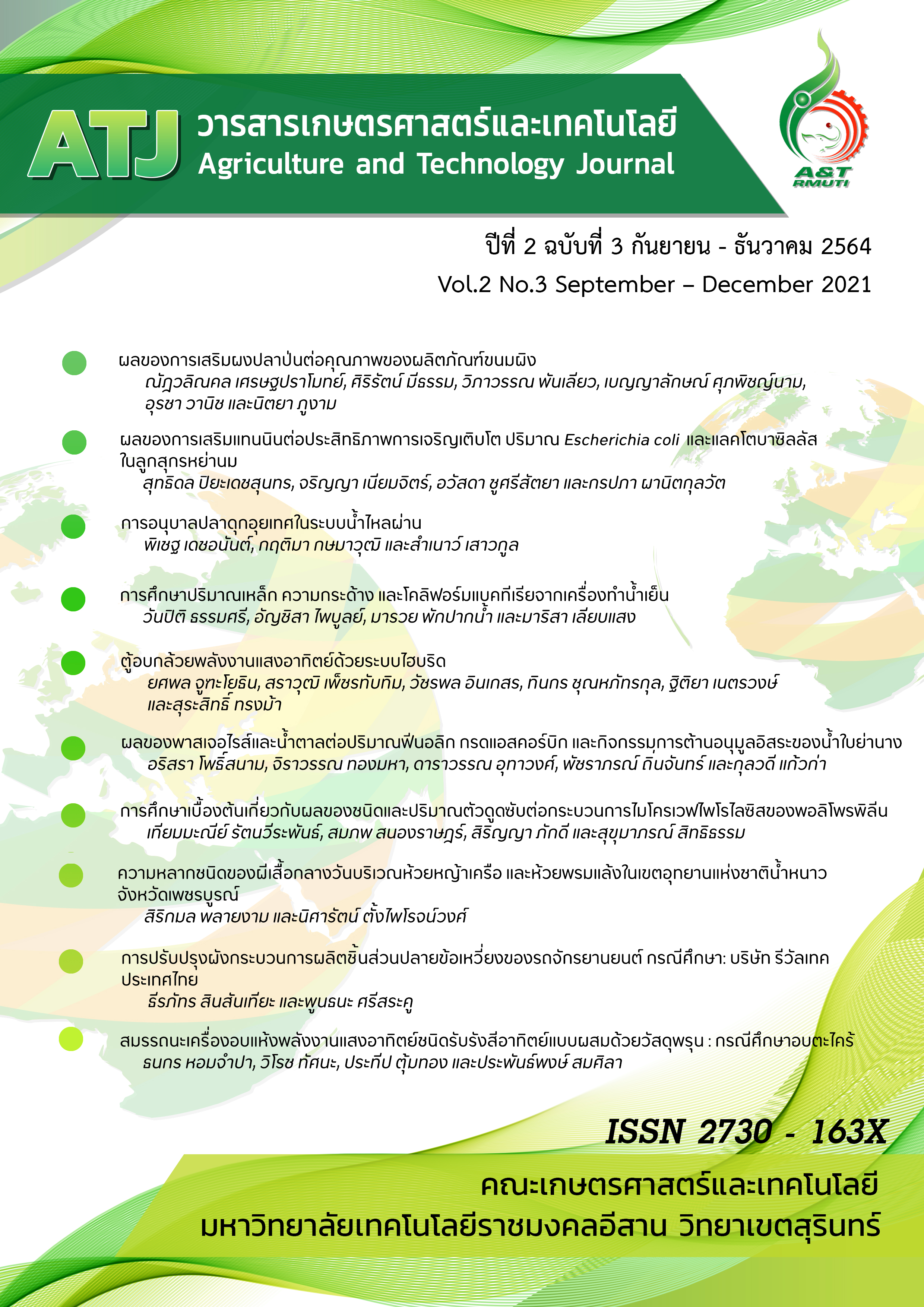
การศึกษาเบื้องต้นเกี่ยวกับผลของชนิดและปริมาณตัวดูดซับต่อกระบวนการไมโครเวฟ ไพโรไลซิสของพอลิโพรพิลีน
คำสำคัญ:
ไมโครเวฟไพโรไลซิส, ขยะพลาสติก, ตัวดูดซับคลื่นไมโครเวฟบทคัดย่อ
งานวิจัยนี้มีวัตถุประสงค์เพื่อศึกษาผลของชนิดและปริมาณตัวดูดซับคลื่นไมโครเวฟที่มีต่อกระบวนการไมโครเวฟไพโรไลซิสพลาสติกพอลิโพรพิลีนด้วยคลื่นไมโครเวฟ โดยชนิดตัวดูดซับคลื่นที่เลือกใช้คือถ่านกัมมันต์และแกรไฟต์ ปริมาณที่ใช้ได้แก่
ร้อยละ 2, 5 และ 10 โดยมวล ผลการทดลองพบว่าการใช้ถ่านกัมมันต์ให้ปริมาณผลิตภัณฑ์ของเหลวสูงกว่าแกรไฟต์ ปริมาณผลิตภัณฑ์ของเหลวที่ได้จากการใช้ถ่านกัมมันต์เป็นตัวดูดซับคลื่นมีค่าอยู่ระหว่างร้อยละ 22.20-41.60 โดยมวล ซึ่งมีแนวโน้มแปรผันตรงกับปริมาณถ่านกัมมันต์ที่ใช้ ความหนาแน่นของผลิตภัณฑ์ของเหลวมีค่าอยู่ระหว่าง 0.72-0.80 กิโลกรัม/ลิตร ความหนืดมีค่าระหว่าง 5-31 เซนติสโตก ซึ่งเมื่อเทียบกับน้ำมันเบนซินในท้องตลาดพบว่าผลิตภัณฑ์ของเหลวจากการทดลองมีความหนาแน่นใกล้เคียงกับน้ำมันเบนซินในท้องตลาดแต่ความหนืดสูงกว่า พบหมู่ฟังก์ชันที่เป็นองค์ประกอบในโครงสร้างโมเลกุลของผลิตภัณฑ์ของเหลวที่ได้สอดคล้องกับน้ำมันเบนซินในท้องตลาดซึ่งประกอบด้วยสารประกอบไฮโดรคาร์บอนชนิดอิ่มตัว
ไม่อิ่มตัวและอะโรมาติกส์ อย่างไรก็ตามควรมีการวิเคราะห์ลักษณะสมบัติอื่น ๆ เพิ่มเติม เช่น จุดวาบไฟ ค่าความร้อน และไฮโดรคาร์บอนองค์ประกอบ
เอกสารอ้างอิง
โปรดปราน สิริธีรศาสตร์, ณัฐพล ช่างการ และศรัณย์ ชโนวิทย์. (2554). การปรับปรุงคุณภาพของผสมชีวมวล และถ่านหินด้วยกระบวนการแยกสลายด้วยความร้อน (Pyrolysis) โดยใช้คลื่นไมโครเวฟ. ใน การประชุมวิชาการนานาชาติวิศวกรรมเคมีและเคมีประยุกต์ แห่งประเทศไทย ครั้งที่ 21 วันที่ 10–11 พฤศจิกายน 2554. สงขลา. T-16.
สุขสันต์ อมรรักษา และแอ๊ปเปิ้ล แจ่มจำรัส. (2556). การประยุกต์ใช้ไมโครเวฟไพโรไลซิสสำหรับอุตสาหกรรมปิโตรเคมี. วารสารวิชาการพระจอมเกล้าพระนครเหนือ. 23(2): 480-488.
Dadi V.S., Garlapati N., Attada Y. and Veluru S. (2021). Optimization of microwave power and graphite susceptor quantity for waste polypropylene microwave pyrolysis. Process Safety and Environmental Protection. 149: 234-243.
Lopez G., Artetxe M., Amutio M., Bilbao J. and Olazar M. (2017). Thermochemical routes for the valorization of waste polyolefinic plastics to produce fuels and chemicals. A review. Renewable and Sustainable Energy Reviews. 73: 346–368.
Manaeva A., Tahmasebi A., Tian, L. and Yu, J. (2016). Microwave-assisted catalytic pyrolysis of lignocellulosic biomass for production of phenolic-rich bio-oil. Bioresource Technology. 211: 382–389.
Raj M.B. and Chayan B. (2016). Study on Microwave Pyrolysis of Polypropylene. International Journal of Engineering Research and Technology (IJERT). 5: 108-116.
Samuel K.T., Enoch K.B. and Samuel D. (2019). Plastic waste to fuel via pyrolysis: A key way to solving the severe plastic waste problem in Ghana. Thermal Science and Engineering Progress. 11: 417–424.
Yaning Z., Yunlei C., Shiyu L., Liangliang F., Nan Z., Peng P., Yunpu W., Feiqiang G., Min M., Yanling C., Yuhuan L., Hanwu L., Paul C., Bingxi L. and Roger R. (2020). Fast microwave-assisted pyrolysis of wastes for biofuels production–A review. Bioresource Technology. 297: 122480.
Zhenyi D., Yecong L., Xiaoquan W., Yiqin W., Qin C., Chenguang W., Xiangyang L., Yuhuan L., Paul C. and Roger R. (2011). Microwave-assisted pyrolysis of microalgae for biofuel production. Bioresource Technology. 102: 4890–4896.
Zhifeng H., Xiaoqian M. and Chunxiang C. (2012). A study on experimental characteristic of microwave-assisted pyrolysis of microalgae. Bioresource Technology. 107: 487–493.
ดาวน์โหลด
เผยแพร่แล้ว
เวอร์ชัน
- 19-02-2024 (3)
- 31-12-2021 (2)
- 30-12-2021 (1)
รูปแบบการอ้างอิง
ฉบับ
ประเภทบทความ
สัญญาอนุญาต
ลิขสิทธิ์ (c) 2021 วารสารเกษตรศาสตร์และเทคโนโลยี

อนุญาตภายใต้เงื่อนไข Creative Commons Attribution-NonCommercial-NoDerivatives 4.0 International License.
เนื้อหาและข้อมูลในบทความที่ลงตีพิมพ์ในวารสารทดสอบระบบ ThaiJo2 ถือเป็นข้อคิดเห็นและความรับผิดชอบของผู้เขียนบทความโดยตรงซึ่งกองบรรณาธิการวารสาร ไม่จำเป็นต้องเห็นด้วย หรือร่วมรับผิดชอบใดๆ
บทความ ข้อมูล เนื่อหา รูปภาพ ฯลฯ ที่ได้รับการดีพิมพ์ในวารสารทดสอบระบบ ThaiJo2 ถือเป็นลิขสิทธิ์ของวารสารทดสอบระบบ ThaiJo2 หากบุคคลหรือหน่วยงานใดต้องการนำทั้งหมดหรือส่วนหนึ่งส่วนใดไปเผยแพร่หรือเพื่อกระทำการใดๆ จะต้องได้รับอนุญาตเป็นลายลักอักษรณ์จากวารสารทดสอบระบบ ThaiJo2 ก่อนเท่านั้น