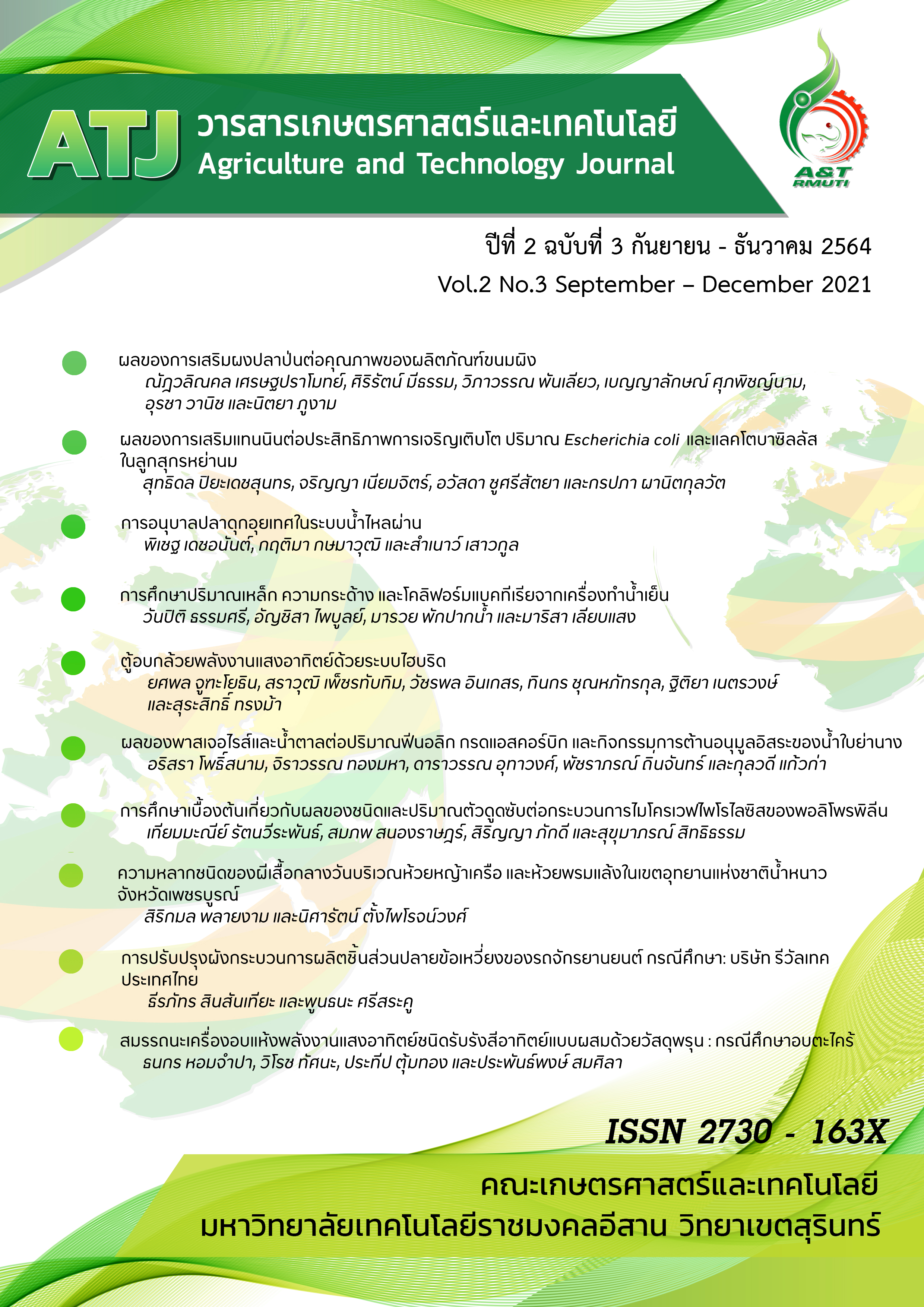
Effect of fish meal supplement on quality of Khanom ping product
Keywords:
Khanom ping product, Fish meal, QualityAbstract
Khanom ping is a Thai confectionary made from flour and sugar then bake until have light yellow colour this product providing the nutrition only carbohydrate. The aim of this research was to investigate the effect of fish meal supplement on quality of Khanom ping product. Firstly, the appropriate original recipe was selected from three original recipes. Recipe 1 was selected due to the highest overall acceptance as 7.73 ±1.03 (moderate liking). Then, fish meal with 0, 2.5, 5 and 7.5% by total weight of materials were supplemented to recipe 1. Physical, chemical and sensory properties of Khanom ping were determined. The results showed that physical, chemical and sensory properties were different among percentage of adding fish meal (p≤0.05). The optimum fish meal supplement was 5% by total weight of materials. Moisture content and water activity were 2.85 and 0.47, respectively. The physical property, colour L* a* b* were 65.50, 2.21 and 17.26, respectively. Crunchiness and hardness were 30.31±1.78 N and 34.20±3.11 N, respectively. The acceptance of colour taste and overall acceptance were 6.40± 1.13, 6.56±1.30 and
7.13 ±1.97, respectively (moderate liking). Consequently, supplement of fish meal into Khanom ping product could improve the appearance and acceptance.
References
จักรกฤษณ์ เพียรทอง, อรพินธ์ ทันเที่ยง, จิราพัทธ์ แก้วศรีทอง และอารี ธนวัฒน์ชัย. (2558). การพัฒนาผลิตภัณฑ์ขนมผิงเสริมน้ำใบบัวบก. ใน การประชุมวิชาการระดับชาติ สถาบันวิจัยและพัฒนา มหาวิทยาลัยราชภัฏกำแพงเพชร 22 ธันวาคม 2558. มหาวิทยาลัยราชภัฏกำแพงเพชร. กำแพงเพชร. 808-815.
จริยา เดชกุญชร. (2549). ขนมไทยเล่ม 1. สำนักพิมพ์เพชรการเรือน. กรุงเทพฯ.
นพวรรณ จงสันติกุล. (2539). ขนมไทย. สำนักพิมพ์แสงแดด. กรุงเทพฯ.
นรินทร์ เจริญพันธ์. (2563). การใช้ประโยชน์จากแป้งปลายข้าวในการผลิตขนมผิงสูตรสมุนไพร. วารสารวิทยาศาสตร์และเทคโนโลยี. 28(9): 1595-1607.
นิรนาม. (2564). วิธีทำขนมผิง เมนูขนมไทยโบราณ กรุบกรอบ ละลายในปาก. ค้นเมื่อ 25 กรกฎาคม 2564. https://www.wongnai.com/recipes/khanom-ping?ref=ct.
วลัย หุตะโกวิท, บุษรา สร้อยระย้า, ชญาภัทร์ สุทธิมิตร, น้อมจิตต์ สุธีบุตร, นพพร สกุลยืนยงสุข, เจตนิพัทธ์ บุณยสวัสดิ์ และธนภพ โสตรโยม. (2551). การพัฒนาผลิตภัณฑ์อาหารจากปลาน้ำจืดเพื่อเพิ่มมูลค่าทางเศรษฐกิจ. รายงานการวิจัย. คณะเทคโนโลยีคหกรรมศาสตร์ มหาวิทยาลัยเทคโนโลยีราชมงคลพระนคร. กรุงเทพฯ.
ศันสนีย์ อุตมอ่าง. (2559). การพัฒนาทองม้วนข้าวกล้องเสริมโปรตีนจากเนื้อปลาของกลุ่มวิสาหกิจชุมชนแปรรูปบ้านกุดกุ่ม ตำบลบุ่งคล้า อำเภอหล่มสัก จังหวัดเพชรบูรณ์. รายงานการวิจัย. คณะเทคโนโลยีการเกษตร มหาวิทยาลัยราชภัฏเพชรบูรณ์ เพชรบูรณ์.
ศรีสมร คงพันธุ์. (2539). ตำรับขนมไทย. สำนักพิมพ์แสงแดด. กรุงเทพฯ.
สำนักงานมาตรฐานผลิตภัณฑ์อุตสาหกรรม. (2548). มาตรฐานผลิตภัณฑ์ชุมชน เรื่อง ขนมผิง มผช. 745/2548. รายงานการประชุม. กองบริหารมาตรฐานผลิตภัณฑ์ชุมชน สำนักงานมาตรฐานผลิตภัณฑ์อุตสาหกรรม. กรุงเทพฯ.
สุมภา เทิดขวัญชัย และอมรรัตน์ เจริญชัย. (2554). การพัฒนาผลิตภัณฑ์ปลานิลหยอง. วารสารคหเศรษฐศาสตร์. 54: 5-11.
Kitts D.D., Wu C.H., Kopec A. and Nagasawa T. (2006). Chemistry and genotoxicity of caramelized sucrose. Molecular Nutrition & Food Research. 50: 1180-1190.
Khan S., Rehman A., Shah H., Aadil R.M., Ali A., Shehzad Q., Shehzada W., Ashrafa F., Yanga A., Karima A., Khaliqd A. and Xia W. (2020). Fish Protein and its derivatives: the novel applications, bioactivities, and their functional significance in food products. Food Reviews International. 23: 1-28.
Stefansson G. and Hultin H.O. (1994). On the solubility of cod muscle proteins in water. Journal of Agricultural and Food Chemistry. 42(26): 56–64.
Downloads
Published
Versions
- 2024-02-16 (3)
- 2021-12-31 (2)
- 2021-12-30 (1)
How to Cite
Issue
Section
License
Copyright (c) 2021 Agriculture and Technology Journal

This work is licensed under a Creative Commons Attribution-NonCommercial-NoDerivatives 4.0 International License.
เนื้อหาและข้อมูลในบทความที่ลงตีพิมพ์ในวารสารทดสอบระบบ ThaiJo2 ถือเป็นข้อคิดเห็นและความรับผิดชอบของผู้เขียนบทความโดยตรงซึ่งกองบรรณาธิการวารสาร ไม่จำเป็นต้องเห็นด้วย หรือร่วมรับผิดชอบใดๆ
บทความ ข้อมูล เนื่อหา รูปภาพ ฯลฯ ที่ได้รับการดีพิมพ์ในวารสารทดสอบระบบ ThaiJo2 ถือเป็นลิขสิทธิ์ของวารสารทดสอบระบบ ThaiJo2 หากบุคคลหรือหน่วยงานใดต้องการนำทั้งหมดหรือส่วนหนึ่งส่วนใดไปเผยแพร่หรือเพื่อกระทำการใดๆ จะต้องได้รับอนุญาตเป็นลายลักอักษรณ์จากวารสารทดสอบระบบ ThaiJo2 ก่อนเท่านั้น