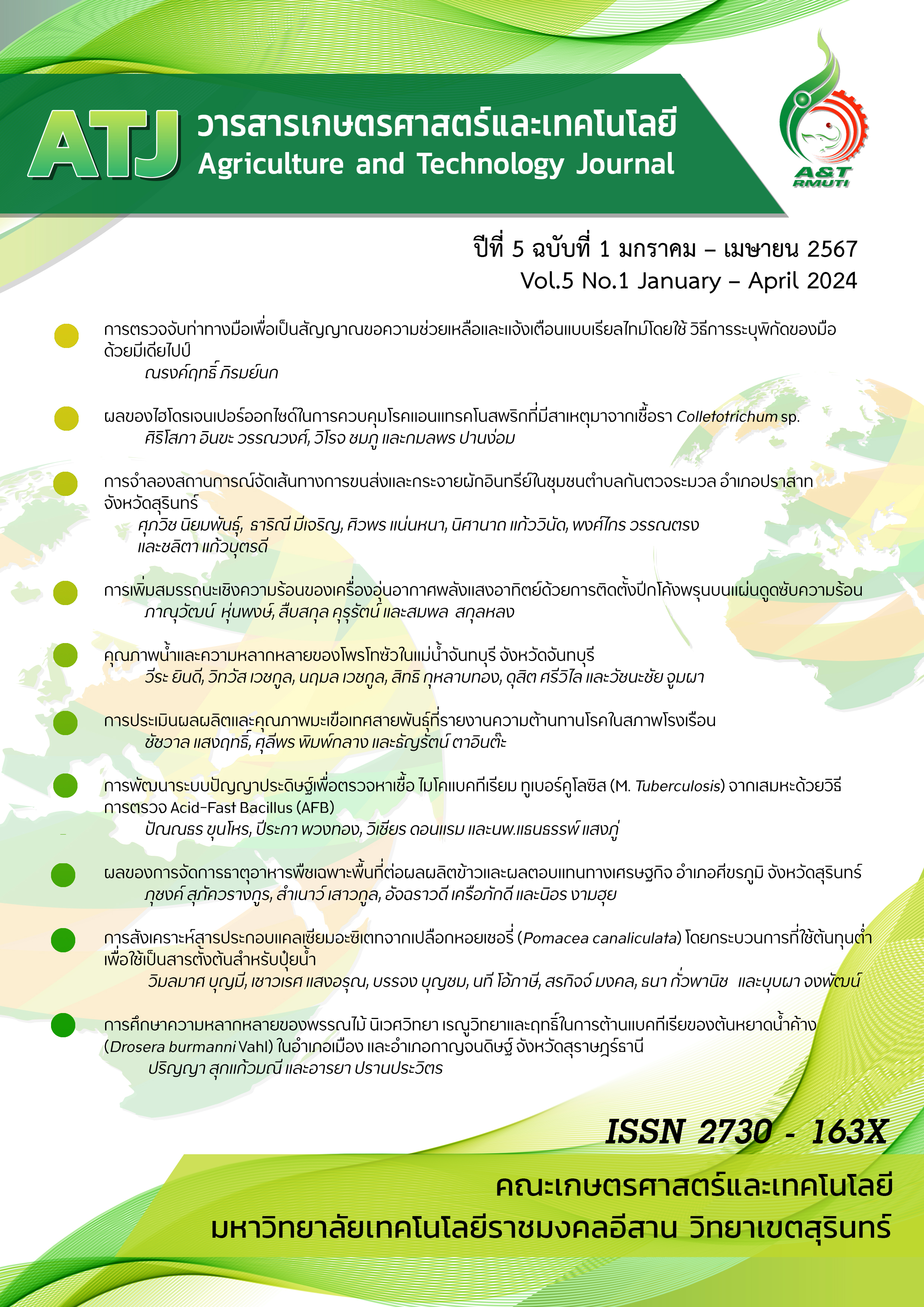
Effect of hydrogen peroxide on the control of chili anthracnose caused by Colletotrichum sp.
Keywords:
Hydrogen peroxide, Anthracnose disease, Colletotrichum sp., ChiliAbstract
The objective of this research is to study the effect of hydrogen peroxide (H2O2) solution on controlling anthracnose disease caused by Colletotrichum sp. Two experiments were set up, and a completely randomized design (CRD) was used in both studies. Experiment 1 was performed by incubating the fungal spore of isolate no. NMK-MJ101 in H2O2 solution at concentrations of 10, 20, 40, and 80 millimolar (mM) for 3 hours before artificially inoculating on chili fruits. Experiment 2 was conducted by artificially inoculating the fungal spore of isolate no. NMK-MJ01 on chili fruits for 72 hours before spraying the chili fruits with H2O2 solutions at the same concentrations as experiment 1 once a day for 4 consecutive days. Distilled water was used as a control in both experiments. The results of disease incidence and disease severity index were collected on day 7 of experiments. The H2O2 solution was able to inhibit disease incidence and disease severity in experiment 1 better than experiment 2. In experiment 1, 40 and 80 mM H2O2 solutions showed disease incidences of 26.00 and 16.00 percent, respectively, disease severity indices of 13.33 and 9.25 percent, respectively, and lesion diameters of 12.93 and 11.60 mm, respectively. In experiment 2, the percentage disease incidence and percentage disease severity were high. Therefore, H2O2 solution can be used for controlling fungal anthracnose disease to increase the quality and quantity of chili products.
References
กลุ่มส่งเสริมพืชผักและเห็ด. (2565). พริก. ค้นเมื่อ 8 มีนาคม 2566. http://www.agriman.doae.go.th/home/news/2565/22chili.pdf
ประภัสศร ศิลปะศาสตร์ดำรง. (2561). ไฮโดรเจนเปอร์ออกไซด์ในเครื่องสำอาง (สารเคมีใกล้ตัวกว่าที่คิด). ค้นเมื่อ 8 มีนาคม 2566. http://lib3.dss.go.th/fulltext/dss_knowledge/BIO_4_2561_Hydrogen_peroxide.pdf
ปิลันธนา ฐาปนพงษ์วรกุล และชนากานต์ รัตนศักดิ์ชัยชาญ. (2559). ประสิทธิภาพของน้ำสกัดชีวภาพจากเศษเหลือพริกต่อการยับยั้งชื้อรา Colletotrichum gloeosporioides ในสภาพห้องปฏิบัติการ. วารสารเกษตร. 32(1): 61-72.
ศศิลภัส เพชรชู, เฉลิมชัย ชัยกิตติภรณ์, วิชัย พฤกษ์ธาราธิกุล, พิพัฒน์ ลักษมีจรัลกุล, วชิระ สิงหะคเชนทร์ และธีระ กลลดาเกรียงไกรคเชนทร์. (2557). การศึกษาประสิทธิผลไอของไฮโดรเจนเปอร์ออกไซด์หลังจากการอบฆ่าเชื้อจุลินทรีย์ในอากาศของห้องผ่าตัด. ใน การประชุมวิชาการเสนอผลงานวิจัยระดับบัณฑิตศึกษา ครั้งที่ 15 “15th Khon Kaen University Graduate Research Conference: 50 Years of Social Devotion Khon Kaen University” 28 มีนาคม 2557. มหาวิทยาลัยขอนแก่น. ขอนแก่น. 1399-1407.
สวิตา สุวรรณรัตน์, ปัฐวิภา สงกุมาร, Siegrid Steinkellner และสมศิริ แสงโชติ. (2560). การแสดงออกของยีนที่เกี่ยวข้องกับเอนไซม์ cutinase และ endopolygalacturonase ของเชื้อรา Colletotrichum capsici ในช่วงการเข้าทำลายบนผลพริก. วารสารเกษตร. 33(3): 357-366.
สำนักงานเกษตรจังหวัดแพร่. (2563). การผลิตพริกปลอดภัย. ค้นเมื่อ 20 มีนาคม 2566. http://alc.doae.go.th/wp-content/uploads/2020/04/แพร่_ถอดบทเรียน63.pdf.
Abdel-Monaim M.F. (2013). Improvement of biocontrol of damping-off and root rot/wilt of faba bean by salicylic acid and hydrogen peroxide. Mycobiology. 41(1): 47–55.
Agrios G.N. (2005). Plant Pathology. 5th ed. Academic Press. New York. 592 p.
Ali A.A.M. (2018). Role of hydrogen peroxide in management of root rot and wilt disease of thyme plant. Journal of Phytopathology and Pest Management. 5(3): 1-13.
Angelova M.B., Pashova S.B., Spasova B., Vassilev S. and Slokoska L.S. (2005). Oxidative stress response of filamentous fungi induced by hydrogen peroxide and paraquat. Mycological Research.109(2): 150-158.
Eloy Y.R.G., Vasconcelos I.M., Barreto A.L.H., Freire-Filho F.R. and Oliveira J.T.A. (2015). H2O2 plays an Important role in the lifestyle of Colletotrichum gloeosporioides during interaction with cowpea (Vigna unguiculata (L.) Walp. Fungal Biology. 119(8): 747-757.
Gálvez-Marroquín L.A., Martínez-Bolaños M., Cruz-Chávez M.A., Ariza-Flores R., Cruz-López J.A., Magaña-Lira N., Cruz de la Cruz L.L. and Ariza-Hernández F.J. (2022). Inhibition of mycelial growth and conidium germination of Colletotrichum sp. for organic and inorganic products. Agro Productividad. 5(2): 25-32.
Ivanova A.E., Aslanidi K.B., Karpenko Y.V. and Belozerskaya T.A. (2005). The effect of hydrogen peroxide on the growth of microscopic mycelial fungi isolated from habitats with different levels of radioactive contamination. Microbiology. 74(6): 655–663.
McMaugh T. (2008). Guidelines for Surveillance for Plant Pests in Asia and the Pacific. ACIAR monograph No. 119c. Australia. 199 p.
Montri P., Taylor P.W.J. and Mongkolporn O. (2009). Pathotypes of Colletotrichum capsici, the causal agent of chili anthracnose, in Thailand. Plant Disease. 93(1):17-20.
Moreno-Hernández C.L., Zambrano-Zaragoza M.L., Velázquez-Estrada R.M., Sánchez-Burgos J.A. and Gutiérrez-Martinez P. (2022). Identification of a Colletotrichum species from mango fruit and its in vitro control by GRAS compounds. Revista Mexicana de Ingeniería Química. 21(3): Bio2777, doi: 10.24275/rmiq/Bio2777.
Nassar A.M.K. and Adss I.A.A. (2016). 2,4-Dichlorophenoxy acetic acid, abscisic acid, and hydrogen peroxide induced resistance-related components against potato early blight (Alternaria solani, Sorauer). Annals of Agricultural Science. 61(1): 15-23.
Pakdeevaraporn P., Wasee S., Taylor P.W.J. and Mongkolporn O. (2005). Inheritance of resistance to anthracnose caused by Colletotrichum capcisi in Capsicum. Plant Breeding. 124(2): 206-208.
Pring R.J., Nash C., Zakaria M. and Bailey J.A. (1995). Infection process and host range of Colletotrichum capsici. Physiological and Molecular Plant Pathology. 46(2): 137-152.
Saxena A., Raghuwanshi R., Gupta V.K. and Singh H.B. (2016). Chilli anthracnose: The epidemiology and management. Frontiers in Microbiology. 7: 1527, doi: 10.3389/fmicb.2016.01527.
Sutton B.C. (1992). The genus Glomorella and its anamorph Colletotrichum. In Bailey J.A. and Jeger M.J. Editors. Colletotrichum: Biology, Pathology and Control. CAB International, Wallingford. 1-26.
Yeimmy P.R., Chiara R., Carlos D.G.T. and Clemencia C.L. (2023). Green management of postharvest anthracnose caused by Colletotrichum gloeosporioides. Journal of fungi. 9: 623, doi: 10.3390/jof9060623.
Zhou B., Luo Y., Nou X., Mwangi E., Poverenov E., Rodov V., Demokritou P. and Fonseca J.M. (2023). Effects of a novel combination of gallic acid, hydrogen peroxide and lactic acid on pathogen inactivation and shelf-life of baby spinach. Food Control. 143: 109284, doi: 10.1016/j.foodcont.2022.109284.
Downloads
Published
How to Cite
Issue
Section
License
Copyright (c) 2024 Agriculture and Technology Journal

This work is licensed under a Creative Commons Attribution-NonCommercial-NoDerivatives 4.0 International License.
เนื้อหาและข้อมูลในบทความที่ลงตีพิมพ์ในวารสารทดสอบระบบ ThaiJo2 ถือเป็นข้อคิดเห็นและความรับผิดชอบของผู้เขียนบทความโดยตรงซึ่งกองบรรณาธิการวารสาร ไม่จำเป็นต้องเห็นด้วย หรือร่วมรับผิดชอบใดๆ
บทความ ข้อมูล เนื่อหา รูปภาพ ฯลฯ ที่ได้รับการดีพิมพ์ในวารสารทดสอบระบบ ThaiJo2 ถือเป็นลิขสิทธิ์ของวารสารทดสอบระบบ ThaiJo2 หากบุคคลหรือหน่วยงานใดต้องการนำทั้งหมดหรือส่วนหนึ่งส่วนใดไปเผยแพร่หรือเพื่อกระทำการใดๆ จะต้องได้รับอนุญาตเป็นลายลักอักษรณ์จากวารสารทดสอบระบบ ThaiJo2 ก่อนเท่านั้น