
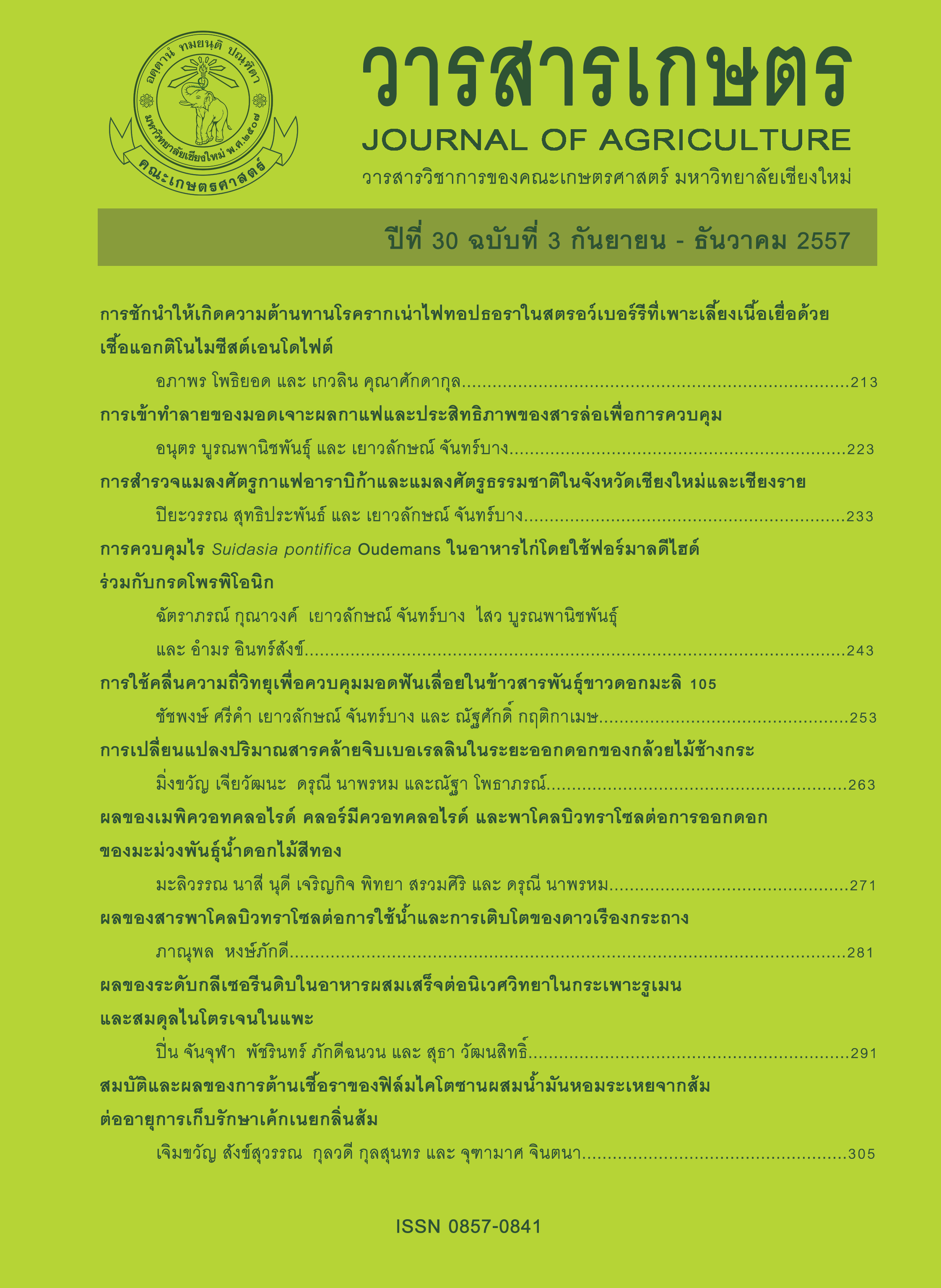
การใช้คลื่นความถี่วิทยุเพื่อควบคุมมอดฟันเลื่อยในข้าวสารพันธุ์ขาวดอกมะลิ 105
Article Sidebar
Main Article Content
บทคัดย่อ
การทดลองนี้มีวัตถุประสงค์เพื่อใช้คลื่นความถี่วิทยุในการควบคุมมอดฟันเลื่อยในข้าวสารพันธุ์ขาวดอกมะลิ 105 และศึกษาคุณภาพข้าวหลังจากไปผ่านคลื่นความถี่วิทยุในระดับที่ทำให้แมลงตายอย่างสมบูรณ์ โดยทำการทดลอง ณ สถาบันวิจัยเทคโนโลยีหลังการเก็บเกี่ยว มหาวิทยาลัยเชียงใหม่ ซึ่งการทดลองเริ่มจากการเลี้ยงมอดฟันเลื่อยในข้าวสารพันธุ์ขาวดอกมะลิ 105 ที่มีความชื้น 14 เปอร์เซ็นต์ ในสภาพห้องปฏิบัติการ การทดลองที่ 1 นำแมลงแต่ละระยะการเจริญเติบโตมาผ่านคลื่นความถี่วิทยุที่ความถี่ 27.12 MHz อุณหภูมิ 55 องศาเซลเซียส เป็นเวลา 90 วินาที พบว่าตัวเต็มวัยมีเปอร์เซ็นต์การตายน้อยที่สุด คือ 78.09 เปอร์เซ็นต์ แตกต่างอย่างมีนัยสำคัญทางสถิติ (P<0.05) ส่วนระยะดักแด้ หนอน และไข่ มีเปอร์เซ็นต์การตายอยู่ที่ 90.90, 94.34 และ 96.46 เปอร์เซ็นต์ ตามลำดับ การทดลองที่ 2 ใช้มอดฟันเลื่อยตัวเต็มวัยซึ่งเป็นระยะที่ทนทานต่อคลื่นความถี่วิทยุที่สุดมาผ่านที่คลื่นที่ระดับอุณหภูมิ 55, 60, 65 และ 70 องศาเซลเซียส เป็นเวลา 90, 120 ,150 และ 180 วินาที ในทุกระดับอุณหภูมิ พบว่าที่อุณหภูมิ 70 องศาเซลเซียส เป็นเวลา 120 วินาที เป็นการใช้คลื่นความถี่วิทยุที่เหมาะสมที่สุด เนื่องจากใช้เวลาน้อยที่สุดที่ทำให้แมลงตายอย่างสมบูรณ์ (การตาย 100 เปอร์เซ็นต์)และไม่พบแมลงรุ่นลูก (F1) โดยคุณภาพของข้าวหลังจากผ่านคลื่นความถี่วิทยุเปรียบเทียบกับชุดควบคุม พบว่า ความชื้นของข้าวลดลง ค่าสีที่วัดได้มีค่าของสีเหลืองเพิ่มขึ้น ดัชนีความขาวเพิ่มขึ้น ปริมาณอะไมโลสที่วัดได้เพิ่มขึ้น ปริมาณโปรตีนลดลง และปริมาณสารหอมที่วัดได้ลดลงจาก 2.82 ppm เป็น 2.50 ppm
Article Details
เอกสารอ้างอิง
กรมการค้าภายใน. 2550. มาตรฐานข้าวหอมมะลิบรรจุถุงจำหน่ายภายในประเทศ. (ระบบออนไลน์).แหล่งข้อมูล http://www.ratchakitcha. soc.go.th/DATA/PDF/2550/E/150/9.PDF/(18 ธันวาคม 2556).
กฤษณา สุเมธะ เยาวลักษณ์ จันทร์บาง วิเชียร เฮงสวัสดิ์ และ ณัฐศักดิ์ กฤติกาเมษ. 2552. ผลของการใช้คลื่นความถี่วิทยุต่อมอดหัวป้อมและคุณภาพของข้าวสารพันธุ์ขาวดอกมะลิ 105. หน้า 97-103. ใน: รายงานสัมมนาวิชาการ บัณฑิตศึกษาเกษตรศาสตร์ คณะเกษตรศาสตร์ มหาวิทยาลัย เชียงใหม่ ครั้งที่ 6. 12-13 มีนาคม 2552. คณะเกษตรศาสตร์ มหาวิทยาลัยเชียงใหม่, เชียงใหม่.
งามชื่น คงเสรี. 2547. คุณภาพและการตรวจสอบข้าวหอมมะลิไทย. กรมวิชาการเกษตร, กรุงเทพฯ. 133 หน้า.
ณคณิณ ลือชัย วิชชา สะอาดสุด เยาวลักษณ์ จันทร์บาง และ ณัฐศักดิ์ กฤษติกาเมษ. 2551. การใช้คลื่นความถี่วิทยุเพื่อควบคุมผีเสื้อข้าวสาร Corcyra cephalonica (Stainton) และผลต่อคุณภาพข้าวสารพันธุ์ขาวดอกมะลิ 105. วารสารวิทยาศาสตร์เกษตร 39(3) (พิเศษ): 347-350.
พลากร สำรีราษฎร์ สงวนศักดิ์ ธนาพรพูนพงษ์ และสุชาดา เวียรศิลป์. 2551. การดัดแปลงคุณภาพหุงต้มของข้าวขาวดอกมะลิ 105 ด้วยคลื่นความถี่วิทยุ. วารสารวิทยาศาสตร์เกษตร 39(3): 354-538.
พรทิพย์ วิสารทานนท์ กุสุมา นวลวัฒน์ บุษรา จันทร์-แก้วมณี ใจทิพย์ อุไรชื่น รังสิมา เก่งการพานิช กรรณิการ์ เพ็งคุ้ม จิราภรณ์ ทองพันธ์ ดวงสมร สุทธิสุทธิ์ ลักขณา ร่มเย็น และ ภาวิณี หนูชนะ-ภัย. 2548. แมลงที่พบในผลิตผลเกษตรและการป้องกันกำจัด. โรงพิมพ์ชุมนุมสหกรณ์การเกษตรแห่งประเทศไทย จำกัด. กรุงเทพฯ. 150 หน้า
รตินุช นุตพงษ์ เยาวลักษณ์ จันทร์บาง และ สุชาดา เวียรศิลป์. 2555. การใช้คลื่นความถี่วิทยุเพื่อควบคุมมอดยาสูบ. วารสารเกษตร 28(1): 75-82.
วีรยุทธ ใฝ่กระจายเพื่อน เยาวลักษณ์ จันทร์บาง และ สุชาดา เวียรศิลป์. 2554. ผลของกำลังความถี่วิทยุขนาดต่าง ๆ ต่อการตอบสนองของด้วงงวงข้าวโพด (Sitophilus zeamais Motschulsky) และคุณภาพของข้าวโพด. วารสารวิทยาศาสตร์เกษตร 42(3) (พิเศษ): 392-395.
สมพร อิศวิลานนท์. 2556. สัมมนาทิศทางข้าวไทยปี 2556: ตลาดส่งออกข้าวไทยจะก้าวไปอย่างไร. (ระบบออนไลน์). แหล่งข้อมูล: http://www. thairice.org/doc_dl/032013/ppt-a.pptx (18 ธันวาคม 2556).
สำนักงานเศรษฐกิจการเกษตร. 2556. มูลค่าการส่งออกข้าวหอมดอกมะลิ. (ระบบออนไลน์). แหล่งข้อมูล: http://www.oae.go.th/ oae_report/export_import/export_result.php (18 ธันวาคม 2556).
อัมพร บัวผุด เยาวลักษณ์ จันทร์บาง และ สุชาดา เวียร-ศิลป์. 2555. ผลของการให้ความร้อนด้วยคลื่นความถี่วิทยุต่อผีเสื้อข้าวเปลือกและคุณภาพการสีของข้าวพันธุ์ขาวดอกมะลิ 105. วารสารเกษตร 28(2): 137-144.
Abbott, W. S. 1925. Method for computing the effectiveness of an insecticide. Journal of Economic Entomology 18: 256-267.
Cwiklinski, M. and D. von Hoersten. 1999. Thermal treatment of seed using microwave or radio frequency energy for eradication seedborne fungi. Paper presented at the 1999 ASAE/CSAE-CSGR Annual International Meeting. July 18-21 1999. Ontario, Canada.
Neven, L.G. 2000. Physiological responses of insects to heat. Postharvest Biology and Technology. 21: 103-111.
Theanjumpol, P., S. Thanapornpoonpong, E. Pawelzik and S. Vearasilp. 2007. Milled rice physical properties after various radio frequency heat treatments. Paper presented at the Conference on International Agricultural Research for Development. October 9-11, 2007. University of Kassel-Witzenhausen and University of Gottingen, Germany.4 pp.
Wang, S., J. Tang, J. A. Johnson and J. D. Hansen. 2002. Thermal-death kinetics of fifth-instar Amyelois transitella(Walker) (Lepidoptera: Pyralidae) larvae. Journal of Stored Products Research 38(5): 427-440.
Wang, S., M. Monzon, J. A. Johnson, E. J. Mitcham and J. Tang. 2007. Industrial scale radio frequency treatments for insect control in walnuts: I. Heating uniformity and energy efficiency. Postharvest Biology and Technology 45: 240-246.
Wongpornchai, S., K, Dumri, S. Jongkaewwattana and B. Siri. 2004. Effects of drying methods and storage time on the aroma and milling quality of rice (Oryza sativa L.) cv. Khao Dawk Mali 105. Food Chemistry 87: 407-414.
Zhao, S., S. Xiong, C. Qiu and Y. Xu. 2007. Effect of microwaves on rice quality. Journal of Stored Products Research 43: 496-502.
