
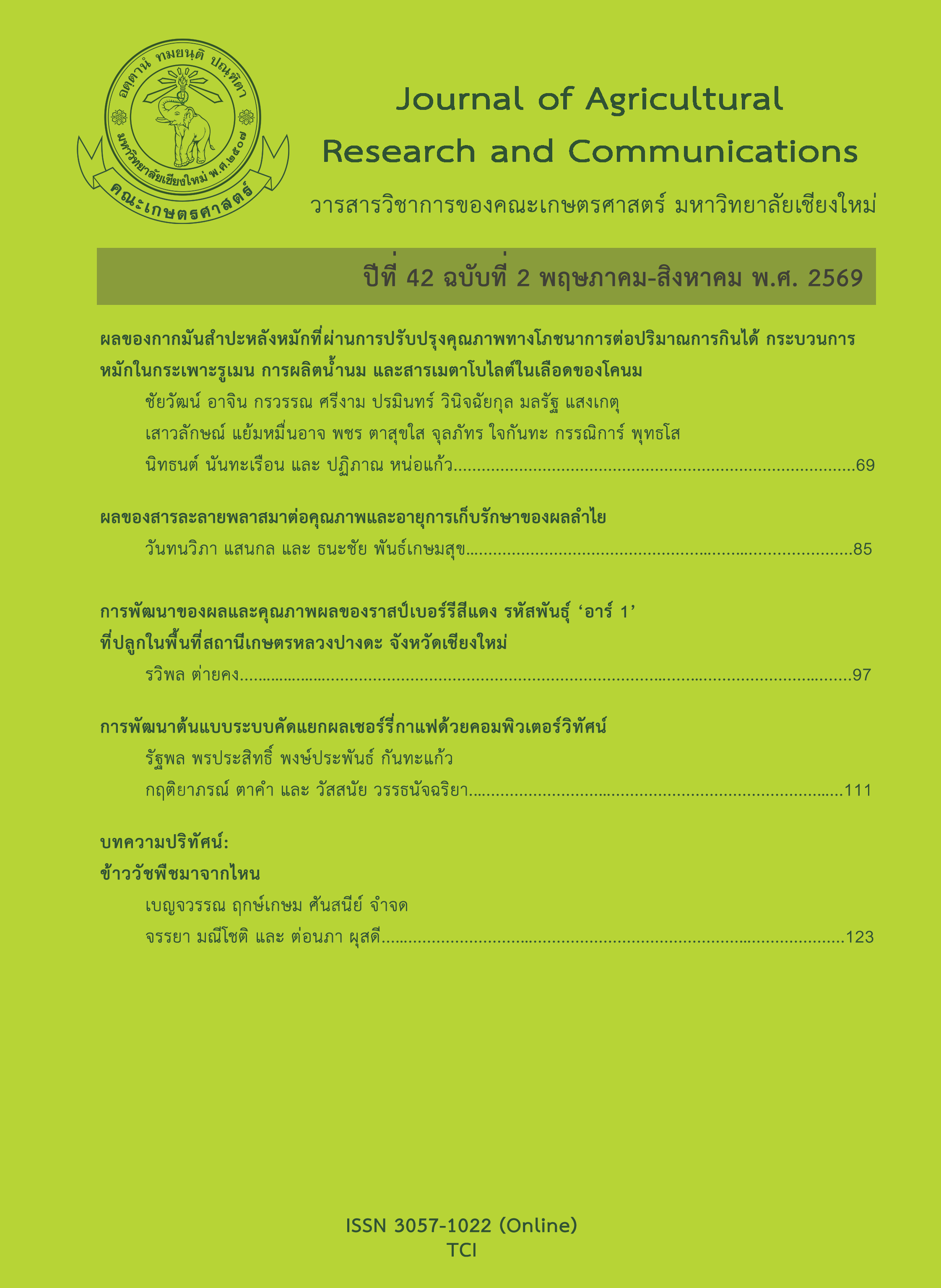
ผลของกากมันสำปะหลังหมักที่ผ่านการปรับปรุงคุณภาพทางโภชนาการต่อปริมาณการกินได้ กระบวนการหมักในกระเพาะรูเมน การผลิตน้ำนม และสารเมตาโบไลต์ในเลือดของโคนม
Article Sidebar
Main Article Content
บทคัดย่อ
การวิจัยนี้มีวัตถุประสงค์เพื่อศึกษาผลของกากมันสำปะหลังหมักที่ผ่านการปรับปรุงคุณภาพทางโภชนาการต่อปริมาณการกินได้ การหมักในกระเพาะรูเมน การผลิตน้ำนม และสารเมตาโบไลต์ในเลือดของโคนม โดยใช้โคนมสายพันธุ์ Holstein Friesian จำนวน 12 ตัว น้ำหนักตัวเฉลี่ย 450 ± 20.0 กิโลกรัม อยู่ในรอบการให้นมที่ 1 (1st lactation) มีระยะการให้น้ำนม 130 ± 30 วัน และมีปริมาณการให้น้ำนมเฉลี่ย 12.0 ± 2.0 กิโลกรัมต่อวัน โคนมได้รับอาหารผสมครบส่วน (Total mixed ration; TMR) ที่มีระดับโปรตีน 14% และให้อาหารแบบ ad libitum วางแผนการทดลองแบบ independent sample t-test แบ่งออกเป็น 2 กลุ่ม ได้แก่ กลุ่มควบคุมที่ได้รับ TMR โดยไม่มีการทดแทนกากมันสำปะหลังหมัก (CON) และกลุ่มทดลองที่ได้รับ TMR ซึ่งมีการทดแทนกากมันสำปะหลังหมัก (Fermented cassava pulp; FCP) ในสูตรอาหารที่ระดับ 20% DM basis (TREAT) ทำการทดลอง 59 วัน (ระยะปรับอาหาร 14 วัน และระยะเก็บตัวอย่าง 45 วัน) มีการบันทึกปริมาณการให้อาหารและการให้น้ำนมทุกวัน และเก็บตัวอย่างของเหลวในกระเพาะรูเมน น้ำนม และเลือดในวันที่ 0, 15, 30 และ 45 ของการทดลอง เพื่อวิเคราะห์ค่า pH ความเข้มข้นของแอมโมเนียไนโตรเจน (NH3-N) ปริมาณกรดไขมันระเหยง่าย (Volatile fatty acids; VFA) องค์ประกอบน้ำนม และสารเมตาโบไลต์ในเลือด ผลการศึกษาพบว่า ในวันที่ 45 กลุ่ม TREAT มีปริมาณการกินวัตถุแห้งต่ำกว่ากลุ่ม CON อย่างมีนัยสำคัญทางสถิติ (P < 0.05) อย่างไรก็ตาม ในวันที่ 30 และ 45 กลุ่ม TREAT มีความเข้มข้นของ NH3-N ปริมาณกรดไขมันระเหยง่ายรวม และสัดส่วนโพรพิโอเนตสูงกว่ากลุ่ม CON อย่างมีนัยสำคัญทางสถิติ (P < 0.05) ขณะที่ปริมาณน้ำนม องค์ประกอบน้ำนม และสารเมตาโบไลต์ในเลือดไม่แตกต่างกันระหว่างกลุ่มทดลอง การศึกษาครั้งนี้จึงสรุปได้ว่าการทดแทน FCP ในสูตรอาหาร TMR ที่ระดับ 20% บนพื้นฐานวัตถุแห้งสามารถช่วยเพิ่มกิจกรรมการหมักในกระเพาะรูเมนและปรับรูปแบบการหมักไปสู่การผลิตโพรพิโอเนตมากขึ้น โดยไม่ส่งผลกระทบเชิงลบต่อสมรรถนะการให้น้ำนมและสุขภาพของโคนม
Article Details

อนุญาตภายใต้เงื่อนไข Creative Commons Attribution-NonCommercial-NoDerivatives 4.0 International License.
เอกสารอ้างอิง
Allen, M.S. 2000. Effects of diet on short-term regulation of feed intake by lactating dairy cattle. Journal of Dairy Science 83(7): 1598-1624.
AOAC. 2000. Official Methods of Analysis. 17thed. The Association of Official Analytical Chemists, Gaithersburg.
Asanuma, N. and T. Hino. 2001. Molecular characterization, enzyme properties and transcriptional regulation of phosphoenolpyruvate carboxykinase and pyruvate kinase in a ruminal bacterium, Selenomonas ruminantium. Microbiology 147(3): 681-690.
Chaney, A.L. and E.P. Marbach. 1962. Modified reagents for determination of urea and ammonia. Clinical Chemistry 8: 130-132.
Counotte, G.H.M., R.A. Prins, R.H.A.M. Janssen and M.J.A. deBie. 1981. Role of Megasphaera elsdenii in the fermentation of DL-[2-13C] lactate in the rumen of dairy cattle. Applied and Environmental Microbiology 42(4): 649-655.
Dagaew, G., S. Wongtangtintharn, R. Prachumchai and A. Cherdthong. 2023. The effects of fermented cassava pulp with yeast waste and different roughage-to-concentrate ratios on ruminal fermentation, nutrient digestibility, and milk production in lactating cows. Heliyon 9(4): e14585.
Dieho, K., J. Dijkstra, J.T. Schonewille and A. Bannink. 2016. Changes in ruminal volatile fatty acid production and absorption rate during the dry period and early lactation as affected by rate of increase of concentrate allowance. Journal of Dairy Science 99(7): 5370-5384.
Hnokaew, P., K. Sringarm, P. Chuammitri, C. Arjin, C. Lumsangkul, S. Mekchay, A. Satsook, Y. Wang and P. Vinitchaikul. 2024. Influence of dietary mulberry (Morus Alba L.) leaf supplementation on production performance, blood metabolites, rumen fermentation characteristics and ruminal bacteria community in lactating dairy cows. Italian Journal of Animal Science 23(1): 1031-1043.
Hnokaew, P., C. Arjin, A. Satsook, J.N. Halder, S. Tateing, N. Potapohn and K. Sringarm. 2025. Harnessing bioactive compounds from Cannabis sativa residue to improve rumen fermentation and reduce methane production: in silico, in vitro, and in situ nylon bag studies. BMC Veterinary Research 21(1): 611.
Jouany, J.P. 2006. Optimizing rumen functions in the close-up transition period and early lactation to drive dry matter intake and energy balance in cows. Animal Reproduction Science 96(4): 250-264.
Julien, C., J.P. Marden, F. Enjalbert, C. Bayourthe and A. Troegeler-Maynadier. 2010. Live yeast as a possible modulator of polyunsaturated fatty acid biohydrogenation in the rumen. Revue de Medecine Veterinaire 161(8-9): 391-400.
Kwankaew, M., P. Lueanglawany and W. Suksombat. 2010. Utilization of cassava peel and pulp as composition of silage. Journal of Science and Technology, Ubon Ratchathani University 12(3):92-103. (in Thai)
Leduc, A., S. Souchet, M. Gele, F. Le Provost and M. Boutinaud. Effect of feed restriction on dairy cow milk production: a review. Journal of Animal Science 99(7): 1-12.
Mertens, D.R. 1994. Regulation of forage intake. In: Fahey Jr., G.C., Ed., Forage Quality, Evaluation, and Utilization. American Society of Agronomy, Madison. 450-493 p.
Norrapoke, T., M. Wanapat, A. Cherdthong, S. Kang, K. Phesatcha and T. Pongjongmit. 2018. Improvement of nutritive value of cassava pulp and in vitro fermentation and microbial population by urea and molasses supplementation. Journal of Applied Animal Research 46(1): 242-247.
Norrapoke, T., T. Phongchongmit, A. Cherdthong and N. Phakachoed. 2018. Using cassava pulp fermented with additives on feed intake and digestibility of beef cattle. Khon Kaen Agriculture Journal 46(Suppl.1): 590-596. (in Thai)
NRC. 2001. Nutrient Requirements of Dairy Cattle. 7thed. National Academies Press, Washington, DC. 381 p.
Olorunlowu, S., P. Sidoruk, J. Sznajder, J. Szczesny, D. Lechniak, P. Pawlak, M. Ryczek, H. Huang, L. Li and A.Irawan. 2025. Effects of a multi-strain lactic and propionic acid bacteria inoculant on silage quality, methane emissions, milk composition, and rumen microbiome. Animals 15: 2740.
Polyorach, S. and M. Wanapat. 2015. Potential of yeast as probiotics in ruminants. Khon Kaen Agriculture Journal 43(Suppl. 1): 191-206. (in Thai)
Ragkos, A., G. Koutouzidou and A. Theodoridis. 2021. Impact of feeding pattern on the structure and the economic performance of dairy cow sector. dairy 2: 122-134.
Rigout S, C. Hurtaud, S. Lemosquet, A. Bach and H. Rulquin. 2003. Lactational effect of propionic acid and duodenal glucose in cows. Journal of Dairy Science 86(1): 243-53.
Ramos, S.C., C.D. Jeong, L.L. Mamuad, S.H. Kim, S.H. Kang, E.T. Kim, Y.I. Cho, S.S. Lee and S.S. Lee. 2021. Diet transition from high-forage to high-concentrate alters rumen bacterial community composition, epithelial transcriptomes and ruminal fermentation parameters in dairy cows. Animals 11: 838.
Rossi, F., A.D. Luccia, D. Vincenti and P.S. Cocconcelli. 2004. Effects of peptidic fractions from Saccharomyces cerevisiae culture on growth and metabolism of the ruminal bacteria Megasphaera elsdenii. Animal Research 53(1): 177-186.
Sirisan, V. 2017. Strategies to reduce ruminal acidosis by using microorganism. Chiang Mai Veterinary Journal 15(1): 51-62. (in Thai)
Stein, D.R., D.T. Allen, E.B. Perry, J.C. Bruner, K.W. Gates, T.G. Rehberger, K. Mertz, D. Jones and L.J. Spicer. 2006. Effects of feeding propionibacteria to dairy cows on milk yield, milk components, and reproduction. Journal of Dairy Science 89(1): 111-125.
Suksombat, W., P. Lounglawan and P. Noosen. 2006. Energy and protein evaluation of five feedstuffs used in diet in which cassava pulp as main energy source for lactating dairy cows. Suranaree Journal of Science and Technology 14(1): 99-107.
Van Soest, P.J. 1994. Nutritional ecology of the ruminant. 2nd ed. Cornell University Press, Ithaca, 476 p.
Van Soest, P.J., J.B. Robertson and B.A. Lewis. 1991. Method for dietary fiber, neutral detergent fiber, and nonstarch polysaccharides in relation to animal nutrition. Journal of Dairy Science 74: 3583-3597.
Wanapat, M. 2000. Rumen manipulation to increase the efficient use of local feed resources and productivity of ruminants in the tropics. Asian-Australasian Journal of Animal Sciences 1(Suppl.): 59-67.
Wolin, M.J., T.L. Miller and C.S. Stewart. 1997. Microbe-microbe interactions. pp.467-491. In: P.N. Hobson and C.S. Stewart (eds.). The Rumen Microbial Ecosystem. Blackie Academic & Professional, London.
