
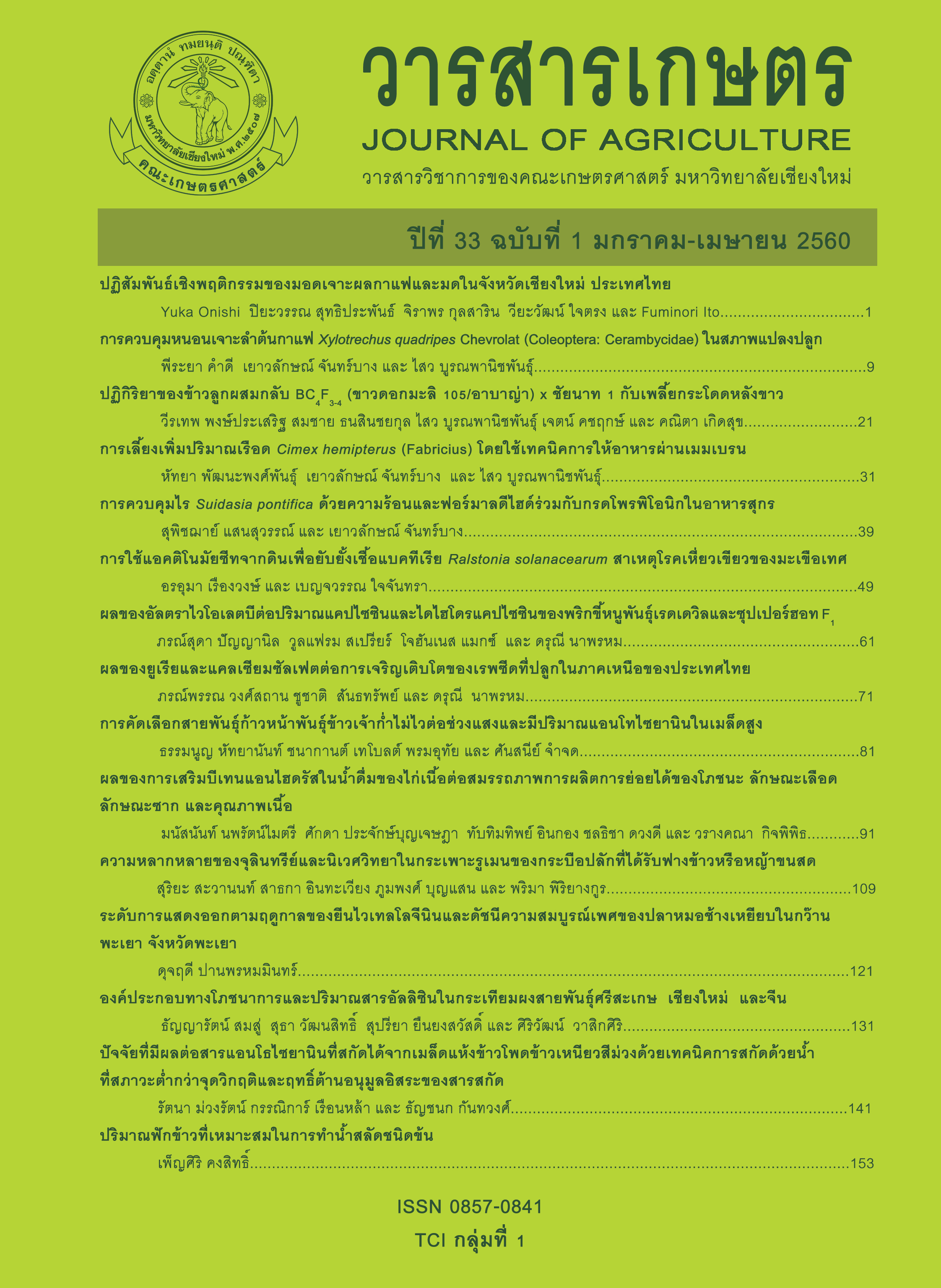
Microbial Diversity and Rumen Ecology of Swamp Buffalo Fed Rice Straw or Fresh Para Grass
Article Sidebar
Main Article Content
Abstract
The diversity and population of ruminal bacteria present in the rumen of swamp buffaloes fed rice straw or para grass (Brachiaria mutica). Total DNA were extracted from the rumen digesta of 4 swamp buffaloes fed rice straw or para grass. The diversity of bacteria was analyzed by PCR amplification and 16S rDNA clone library sequences. The bacteria population was determined by real-time PCR technique. The 16S rDNA sequences (1,500 bp) of clones were completely sequenced and subjected to a BLAST. In buffaloes fed rice straw, the 102 clones, 49.02% (50 clones) of the clone showed >97% sequence similarity with known isolates, for the remaining 50.98% (52 clones) had <97% similarity. The majority of clones fell into Low G+C Gram-Positive Bacteria (LGCGPB) and Cytophaga-Flexibacter-Bacteroides (CFB) (71.57 and 10.25%, respectively). In buffaloes fed fresh para grass, the 109 clones, 40.37% (44 clones) of the clone showed >97 % sequence similarity with known isolates, for the remaining 59.63% (65 clones) had similarity <97%. The majority of clones fell into LGCGPB and CFB (56.88 and 31.19%, respectively). The population of major groups of known bacteria in the rumina of buffalo fed rice straw or fresh para grass were similar.
Article Details
References
ปรีชา อินนุรักษ์ และ ทวีพร เรืองพริ้ม. 2551. การเพิ่มศักยภาพการใช้ฟางข้าวเป็นอาหารสัตว์เคี้ยวเอื้อง. พิมพ์ครั้งที่ 1. โรงพิมพ์สำนักส่งเสริมและฝึกอบรม กำแพงแสน มหาวิทยาลัยเกษตรศาสตร์ วิทยาเขตกำแพงแสน, นครปฐม.
ภูมพงศ์ บุญแสน สุริยะ สะวานนท์ ปรีชา อินนุรักษ์ และ พริมา พิริยางกูร. 2553. การศึกษาลักษณะบางประการของแบคทีเรียย่อยเยื่อใยที่มีศักยภาพสูงที่คัดเลือกจากกระเพาะรูเมนของกระบือปลัก. ใน: การประชุมทางวิชาการ ครั้งที่ 48 สาขา สัตว์, มหาวิทยาลัยเกษตรศาสตร์, กรุงเทพฯ.
เมธา วรรณพัฒน์. 2552. การผลิตโคเนื้อและกระบือในเขตร้อน. พิมพ์ครั้งที่ 2. คณะเกษตรศาสตร์ มหาวิทยาลัยขอนแก่น, ขอนแก่น.
วันเลิศ พงษ์โปกุล. 2549. การเพิ่มคุณค่าทางโภชนะของฟางข้าวโดยการหมักย่อยของจุลินทรีย์ในการผลิตโคเนื้อ. วิทยานิพนธ์วิทยาศาสตรมหาบัณฑิต. มหาวิทยาลัยเกษตรศาสตร์, กรุงเทพฯ.
สมพร ปุ่นโก๋. 2557. การศึกษาความหลากหลายและการคัดเลือกแบคทีเรียที่มีศักยภาพในการย่อยเยื่อใยและไม่ย่อยเยื่อใยจากกระเพาะรูเมนของกระบือปลัก. วิทยานิพนธ์วิทยาศาสตรมหาบัณฑิต. มหาวิทยาลัยเกษตรศาสตร์, กรุงเทพฯ.
สาธกา สุริยะ สะวานนท์ พริมา พิริยางกูร และสมจิตร ถนอมวงศ์วัฒนะ. 2555. การเปรียบเทียบความสามารถในการย่อยเยื่อใย กิจกรรมของเอนไซม์เซลลูเลส ปริมาณจุลินทรีย์ และสภาวะของกระเพาะรูเมนของกระบือปลักที่ ได้รับฟางข้าวกับหญ้าขนสด. ใน: การประชุมทางวิชาการ ครั้งที่ 50 สาขาสัตว์, มหาวิทยาลัยเกษตรศาสตร์, กรุงเทพฯ
สุริยะ สะวานนท์. 2551. จุลินทรีย์และเทคโนโลยีชีวภาพด้านจุลินทรีย์ในกระเพาะรุเมน. ภาควิชาสัตวบาล คณะเกษตร กำแพงแสน มหาวิทยาลัยเกษตรศาสตร์ วิทยาเขตกำแพงแสน, นครปฐม.
อังคณา หาญบรรจง และดวงสมร สินเจิมศิริ. 2532. การวิเคราะห์และประเมินคุณภาพอาหารสัตว์. ภาควิชาสัตวบาล, มหาวิทยาลัยเกษตรศาสตร์, กรุงเทพฯ.
Dengdi, A., D. Xiuzhu and D. Zhiyang. 2005. Prokaryote diversity in the rumen of yak (Bos grunniens) and Jinnan cattle (Bos taurun) estimated by 16S rDNA homology analyses. Anarobe 11: 207-215.
Fukuma, N., S. Koike and Y. Kobayashi. 2012. Involvement of recently cultured group U2 bacterium in ruminal fiber digestion revealed by coculture with Fibrobacter succinogenes S85. FEMS Microbiology Letters 336: 17-25.
Koike, S. and Y. Kobayashi. 2001. Development and use of competitive PCR assays for the rumen cellulolytic bacteria: Fibrobacter succinogenes, Ruminococcus albus and Ruminococcus flavefaciens. FEMS Microbial Ecology 204: 361-366.
Lane, D.J. 1991. 16S/23S rRNA sequencing. E. Stackebrandt and M. Goodfellow (eds.). In: pp. 115-175. E. Stackebrandt and M. Goodfellow (eds.). Nucleic Acid Techniques in Bacterial Systematics. John Wiley and Sons, New York.
Loy A., A. Lehner, N. Lee, J. Adamczyk, H. Meier, J. Ernst, K.H. Schleifer and M. Wagner. 2002. Oligonucleotide microarray for 16S rRNA gene-based detection of all recognized lineages of sulfate-reducing prokaryotes in the environment. Applied and Environmental Microbiology 68(10): 5064-5081.
Makkar, H.P.S. and C.S. McSweeney. 2010. Methods in Gut Microbial Ecology for Ruminants. Springer, Dordrecht.
Muyzer, G., E.C. Waal and A.G. Uitterlinden. 1993. Profiling of complex microbial populations by denaturing gradient gel electrophoresis analysis of polymerase chain reaction-amplified genes coding for 16S rRNA. Applied and Environmental Microbiology 59(3): 695-700.
Perriere, G. and M. Gouy. 1996. WWW-query: an on-line retrieval system for biological sequence banks. Biochimie 78: 364-369.
Tajima, K., R.I. Aminov, T. Nagamine, K. Ogata, M Nakamura, H. Matsui and Y. Benno. 1999. Rumen bacterial diversity as determined by sequence analysis of 16S rDNA libraries. FEMS Microbial Ecology 29: 159-169.
Tajima, K., R.I. Aminov, T. Nagamine, H. Matsui, M. Nakamura and Y. Benno. 2001. Diet-dependent shifts in the bacterial population of the rumen revealed with real-time PCR. Applied and Environmental Microbiology 67: 2766-2774.
Thu, N.V. and T. R. Preston. 1999. Rumen environment and feed degradability in swamp buffaloes fed different supplements. Livest. Res. Rural Dev. 11(3): 1-7.
