
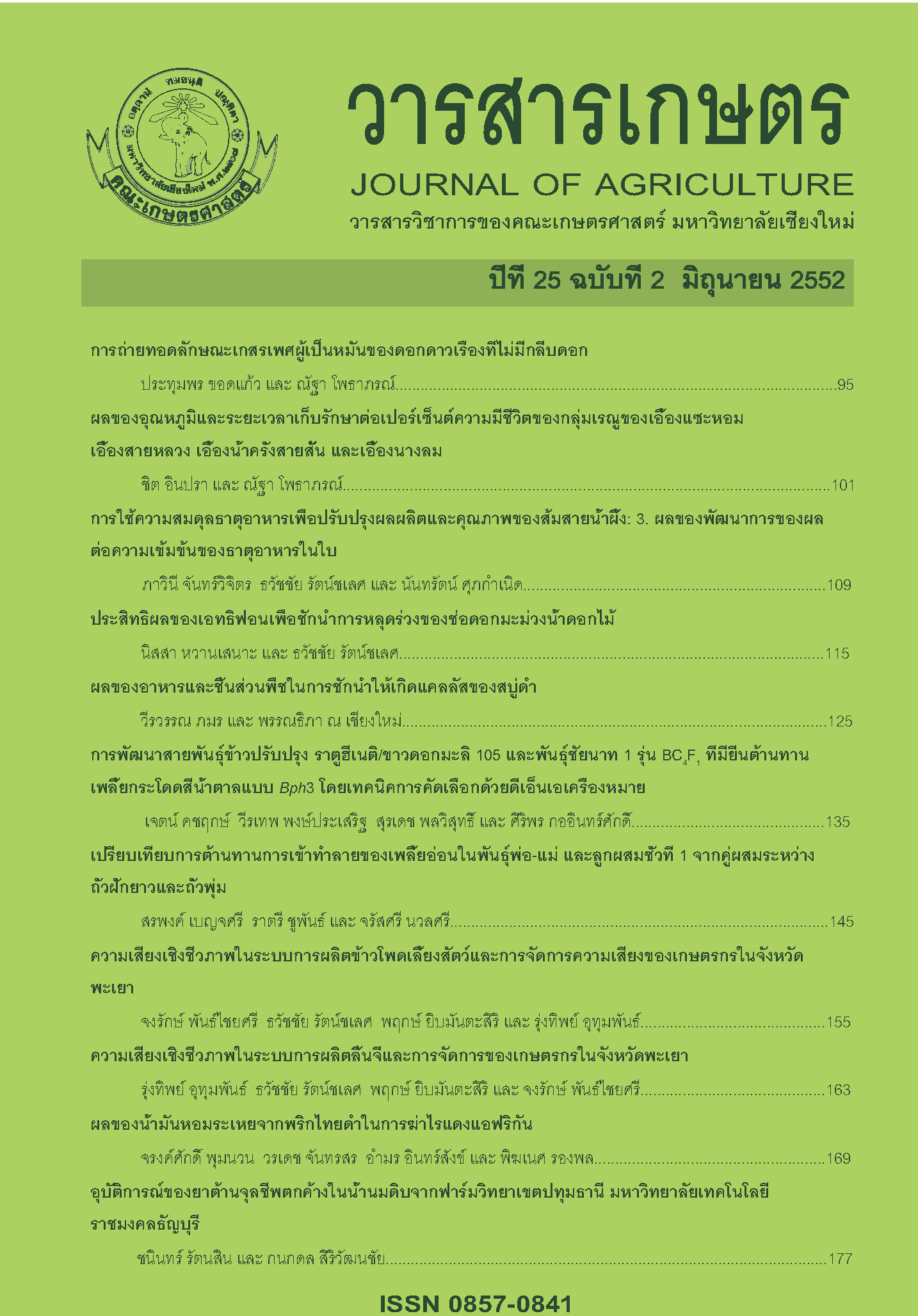
Biological Risks in Litchi Production System and Farmers’ Management in Phayao Province
Article Sidebar
Main Article Content
Abstract
Pests and narrow genetic base are two important biological risks in litchi production. The study aimed to assess the extent of biological risks, with emphasis on pests, and farmers’ management practices to overcome or reduce the risks. The field research was conducted at major litchi production areas in four sub-districts of Mae Chai district and one sub-district of Mueang district of Phayao province with a total of 113 farm samples. The study covered one season of fruit production from November 2006 to July 2007. The methods consisted of farm survey, and semi-structured interview. Each sampled farm was located with GPS. Biological risks from pests were assessed by farmers. The study showed that almost all litchi varieties planted by farmers was Honghuai variety, distributed on rainfed uplands with varying topography from flat to undulating and sloping uplands. The production constraints as identified by farmers were pests (28.7 percent), followed by price fluctuation, climatic variation, water shortage, and increasing production cost, respectively. Among the biological pests, plant diseases, such as sun burn and fruit rot, constituted the highest risk with 10.4 percent. This was then followed by insects, weeds, and animal pests with severity index of 2.9, 2.6, and 2.3 percent, respectively. About 79.3 percent of farmers used chemicals to control plant diseases, insects, and animal pests. Farmers used cultural methods as weed management practice. A few farmers had adopted integrated pest management (11.7 percent), and cultural practices (9.0) to reduce agro-chemical use. Almost all farmers (99.1 percent) carried out tree pruning practice after fruit harvest.
Article Details
References
กรมพัฒนาที่ดิน. 2549. การสำรวจและคาดการณ์ผลผลิตลิ้นจี่ปีการผลิต 2549 โดยใช้เทคโนโลยีการสำรวจระยะไกลและระบบสารสนเทศภูมิศาสตร์. (ระบบออนไลน์). แหล่งข้อมูล: http://www. ldd.go.th/Lddwebsite/web_osl/pdf/book/2549_lychee.pdf (12 กรกฎาคม 2550).
กรมวิชาการเกษตร. 2549. การจัดการศัตรูพืชแบบผสมผสานในประเทศไทย. (ระบบออนไลน์). แหล่งข้อมูล: http://www.doa.go.th/field crops/ipm/th/index.htm (1 สิงหาคม 2550).
ธวัชชัย รัตน์ชเลศ พฤกษ์ ยิบมันตะสิริ รุ่งทิพย์ อุทุมพันธ์ และ จงรักษ์ พันธ์ไชยศรี. 2550. ระบบสนับสนุนการวางแผนการจัดการทรัพยากรเพื่อการเกษตรและบริการ ระยะที่ 2 ภาคเหนือตอนบน: ความเสี่ยงและการลดความเสี่ยงเชิงชีวภาพทางเกษตร. รายงานวิจัยฉบับสมบูรณ์. ศูนย์วิจัยเพื่อเพิ่มผลผลิตทางเกษตร คณะเกษตรศาสตร์ มหาวิทยาลัยเชียงใหม่, เชียงใหม่. 238 หน้า.
ธวัชชัย รัตน์ชเลศ พฤกษ์ ยิบมันตะสิริ รุ่งทิพย์ อุทุมพันธ์ และ จงรักษ์ มูลเฟย. 2548. ระบบการผลิตลิ้นจี่ในเขตภาคเหนือตอนบน. หน้า 99-138. ใน: ระบบสนับสนุนการวางแผนจัดการทรัพยากรเพื่อการเกษตรและบริการ ระยะที่ 1 ภาคเหนือตอนบน: องค์ความรู้และยุทธศาสตร์ในระบบการผลิตไม้ผล. รายงานวิจัยฉบับสมบูรณ์. ศูนย์วิจัยเพื่อเพิ่มผลผลิตทางเกษตร คณะเกษตรศาสตร์ มหาวิทยาลัยเชียงใหม่, เชียงใหม่.
นุชนารถ จงเลขา. 2548. การจัดการศัตรูพืชในทศวรรษหน้า-โรคพืช. หน้า 18-31. ใน: เอกสารประกอบการฝึกอบรมเชิงปฏิบัติการเรื่อง เทคโนโลยีที่เหมาะสมในการลดการใช้สารเคมีเกษตรเพื่อความปลอดภัยของผู้บริโภค. 10 พฤษภาคม 2548. ณ ห้องประชุมใหญ่ คณะเกษตรศาสตร์ มหาวิทยาลัยเชียงใหม่, เชียงใหม่.
วิจิตร วังใน. 2546. ชนิดและพันธุ์ไม้ผลเมืองไทย. หจก.มิตรเกษตรการตลาดและโฆษณา, กรุงเทพฯ. 224 หน้า.
ศานิต รัตนภุมมะ. 2548. การจัดการศัตรูพืชในทศวรรษหน้า-แมลงศัตรูพืช. หน้า 32-53. ใน: เอกสารประกอบการฝึกอบรมเชิงปฏิบัติการเรื่อง เทคโนโลยีที่เหมาะสมในการลดการใช้สารเคมีเกษตรเพื่อความปลอดภัยของผู้บริโภค. 10 พฤษภาคม 2548. ณ ห้องประชุมใหญ่ คณะเกษตรศาสตร์ มหาวิทยาลัยเชียงใหม่, เชียงใหม่.
สุรเชษฐ์ จามรมาน วิบูลย์ จงรัตนเมธีกุล สืบศักดิ์ สนธิรัตน และ ดวงพร สุวรรณกุล. 2543. หลักการและวิธีการจัดการ. หน้า 44-58. ใน: สืบศักดิ์ สนธิรัตน (บก.). การจัดการศัตรูพืช. โรงพิมพ์ลินคอร์น, กรุงเทพฯ.
สำนักงานเกษตรจังหวัดพะเยา. 2550. สถิติการปลูกพืชจังหวัดพะเยา. (ระบบออนไลน์). แหล่งข้อมูล: http://www.phayao.doae.go.th/phayaoplantdata.htm (15 สิงหาคม 2550).
สำนักปลัดกระทรวงเกษตรและสหกรณ์. 2550. ข้อมูลไม้ผลยืนต้น. (ระบบออนไลน์). แหล่งข้อมูล: http://job.haii.or.th/moac/index.php?module=reports&method=report_ integration& report_id=33 (30 ตุลาคม 2550).
