
Quantity of Plant Nutrients in Solution from Different Fermented Organic Materials
Article Sidebar
Main Article Content
Abstract
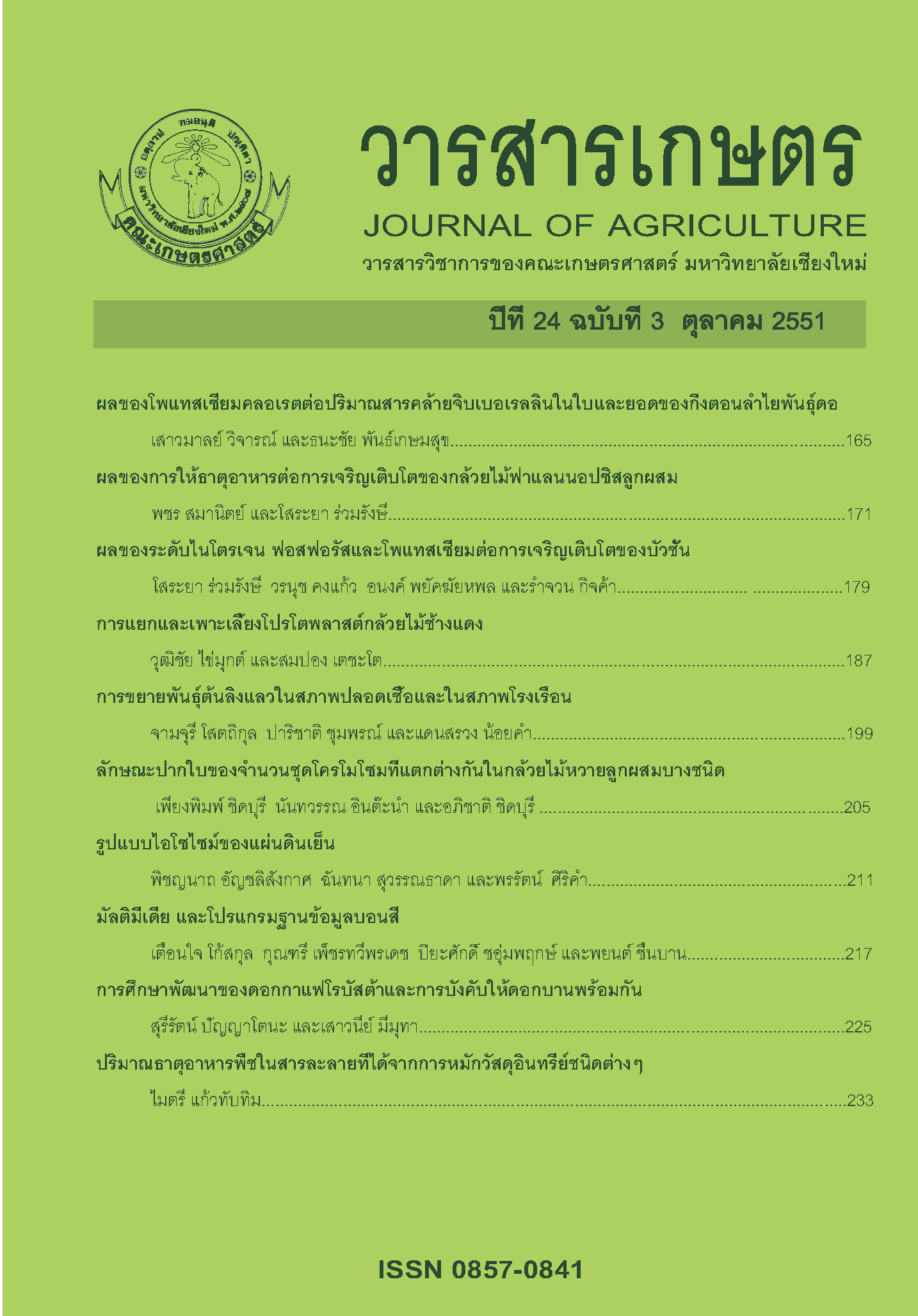
The quantity plant nutrient contents in solution fermented from different organic materials was studied during March to August 2006 at Office of Extension and Continuing Education, Prince of Songkla University. This research was focused on 4 sources of micro-organisms i.e. Kyusei Foundation, Land Development Department (LDD), nature and natural micro-organisms from coconut and papaya syrup culture and 5 sources of organic materials (fruits, kitchen leavings, marine animals, fish heads and weeds). It was found that LDD micro-organism gave the highest total of primary nutrients as 2.193 percent and secondary nutrients contents as 0.320 percent. In addition, this micro-organism source also gave the highest in micronutrient contents and the lowest cost production. Comparing with 5 sources of organic materials it was found that solution fermented from fish heads gave the highest total of primary nutrients contents (i.e. 1.878 percents). Solution from kitchen leavings gave the highest total of secondary nutrients contents (i.e. 0.460 percents). This materials source also gave the highest iron and zinc contents as 64.09 and 3.92 ppm respectively. The maximum manganese content was found in solution fermented from fruits as 9.78 ppm whereas the solution obtained form marine animals gave the highest copper contents as 0.61 ppm. The aforementioned results could be summarized that, the micro-organisms form the LDD sources and marine animals are appropriate micro-organisms sources and organic materials for plant nutrient solution production.
Article Details
References
กรมวิชาการเกษตร. 2546. ฮอร์โมนพืชและธาตุอาหารพืชในน้ำหมักชีวภาพ. กองเกษตรเคมี กรมวิชาการเกษตร, กรุงเทพฯ. 134 หน้า.
กรมวิชาการเกษตร. 2547. ข้อมูลทางวิทยาศาสตร์น้ำหมักชีวภาพ. กรมวิชาการเกษตร, กรุงเทพฯ. 51 หน้า.
กรมวิชาการเกษตร. 2548. คู่มือปุ๋ยอินทรีย์. กรมวิชาการเกษตร, กรุงเทพฯ. 162 หน้า.
กาญจนา วันเสาร์ และเอื้องฟ้า บรรเทาวงษ์. 2544. ปุ๋ยน้ำหมักดีจริงหรือ. วารสารเคหการเกษตร 25(4): 179-186.
จีระภา ชัยวงศ์ และยุทธศักดิ์ สุบการี. 2547. การเตรียมปุ๋ยน้ำชีวภาพจากหอยขยะ. โครงงานนักศึกษา
คณะวิทยาศาสตร์และเทคโนโลยี มหาวิทยาลัยสงขลานครินทร์, ปัตตานี. 94 หน้า.
ฝ่ายถ่ายทอดเทคโนโลยี. 2544. ปุ๋ยเคมี อินทรีย์ และชีวภาพ. สถาบันวิจัยวิทยาศาสตร์และเทคโนโลยีแห่งประเทศไทย, กรุงเทพฯ. 48 หน้า.
มุกดา สุขสวัสดิ์. 2545. ปุ๋ยอินทรีย์. สำนักพิมพ์บ้าน และสวน. กรุงเทพฯ. 215 หน้า.
วรรณา เลี้ยววาริณ. 2538. คู่มือวิเคราะห์ดินและปุ๋ย.หน่วยปฏิบัติการวิเคราะห์กลาง คณะทรัพยากรธรรมชาติ มหาวิทยาลัยสงขลานครินทร์, สงขลา. 37 หน้า
สัมฤทธิ์ เฟื่องจันทร์. 2538. แร่ธาตุอาหารพืชสวน. ภาควิชาพืชสวน คณะเกษตรศาสตร์ มหาวิทยาลัยขอนแก่น, ขอนแก่น. 604 หน้า.
สุมาลี สุทธิประดิษฐ์. 2536. ความอุดมสมบูรณ์ของดิน. ภาควิชาธรณีศาสตร์ คณะทรัพยากรธรรมชาติ มหาวิทยาลัยสงขลานครินทร์, สงขลา. 349 หน้า.
สำนักงานเศรษฐกิจการเกษตร. 2549. สถิติการนำเข้าส่งออก. (ระบบออนไลน์). แหล่งข้อมูล: http://www.oae.go.th/oae website/oae imex.php (20 กันยายน 2549).
Kaewtubtim, M. 2008. A study on amounts plant nutrients in soluble organic fertilizer from fermentation of fish heads, fruits, food leftovers, weeds and marine animals. pp. 390-395. In: Proceedings of 46th Kasetsart University Annual Conference Subject: Plants. 29 January – 1 February 2008, Bangkok.
Salisbury, F.B. and C.W. Ross. 1992. Plant Physiology. Wadsworth Publishing Company, Belmont. 682 pp.
Tan, K.H. and V. Nopamornbodi. 1979. Effect of different levels of humic acids on nutrient content and growth of corn (Zea mays L.). Plant and Soil 51(2): 283-287.
