
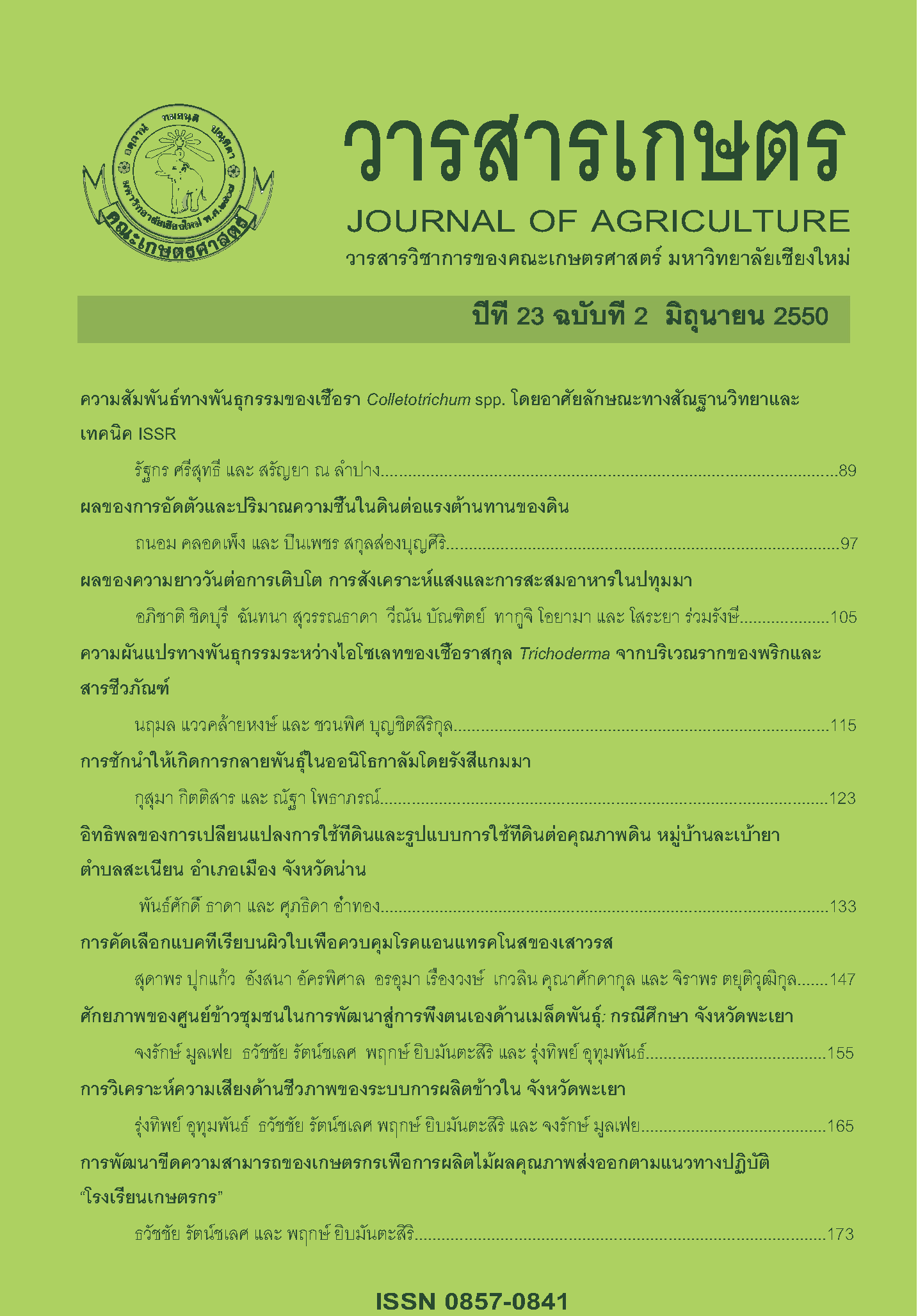
Influence of Land Use Changes and Land Use Practices on Soil Quality at Labouya Village, Sanean Subdistrict, Muang District, Nan Province
Article Sidebar
Main Article Content
Abstract
The soil quality of various land use types was examined through evaluation of its different properties as indicators. Soil samples were collected from 30 locations representing 4 different land use types, e.g. secondary forest (SCF), fruit tree (FT), fallow area (FA) and mixed crop (MC) and were then analyzed for their chemical and physical properties. Results showed that the change of land use in the highland from secondary forest into different kinds of cultivation area, indicated much finer soil texture. Soil bulk density (Bd) was significantly low in no-cultivated soil. For pH values, results indicated that cultivated soil were significantly lower than SCF and FA areas. Additional results showed that soil organic matter content (OM) in cultivated areas was lower than in SCF because the accumulation was lower than its decomposition.
Furthermore, results of the study showed that cation exchange capacity (CEC) in cultivated soil tended to be lower than in SCF, and especially in MC. Similarly, total nitrogen was significantly low in cultivated soil particularly in FT but in FA, available phosphorous was found to be significantly higher than the other land use types. Meanwhile in FA, exchangeable K, Ca and Mg were highest as compared to other land use types. In this study, however, permanganate oxidizable carbon (POC) was highest in MC, there was no reaction in POC from the change in land use. As for soil electrical conductivity (EC), the lower values were found in cultivated areas.
Article Details
References
ปัทมา วิตยากร. 2533. ดิน: แหล่งธาตุอาหารของพืช. ภาควิชาปฐพีวิทยา คณะเกษตรศาสตร์ มหาวิทยาลัยขอนแก่น, ขอนแก่น. 211 หน้า.
พันธ์ศักดิ์ ธาดา. 2550. ผลของการเปลี่ยนแปลงการใช้ที่ดินและรูปแบบการใช้ที่ดินต่อคุณภาพดินกรณีศึกษา: หมู่บ้านละเบ้ายา ต.สะเนียน อ.เมือง จ.น่าน. วิทยานิพนธ์ปริญญาโท. มหาวิทยาลัยแม่โจ้, เชียงใหม่.105 หน้า.
ระวี รัตนาคม. 2548. ผลกระทบของไฟต่อดินในป่าเต็งรัง ณ อุทยานแห่งชาติดอยสุเทพ-ปุย. วิทยานิพนธ์ปริญญาโท. มหาวิทยาลัยแม่โจ้, เชียงใหม่.167 หน้า.
Alexander, T.G. and J. A. Robertson. 1970. Ascorbic acid as a reductant for inorganic phosphorus determination in Chang and Jackson fractionation procedure. Soil Science 110:361-362.
Anderson, J.A. and J.S.I. Ingram. 1993. Tropical soil biology and fertility: a handbook of methods 2nd edition. CAB International, Wallingford, Oxon, UK. 240 pp.
Aumtong, S. 2005. Soil carbon fractions and carbon fractions stock under agroecological land use succession in Khun Samun Watershed, Northern Thailand. The paper presented at academic seminar on “Sustainable of Land Use and Resource Management”, 16-17 December 2005, Maejo University, Thailand.13 pp.
Boonyanuphap, J. 2005. Soil nutrient status affected by burning practice and fallow period in lower Northern Thailand. Proceedings of the 31st Congress on Science and Technology of Thailand at Suranaree University of Technology, 18 – 20 October 2005, Nakhon Ratchasima, Thailand.
Borggaard, O.K. and B. Elberling. 2004a. Pedological Biogeochemistry, Part 1. Paritas Grafik A/S Brondby. 276 pp.
Borggaard, O.K. and B. Elberling. 2004b. Pedological Biogeochemistry, Part 2. Paritas Grafik A/S Brondby. 488 pp.
Bremner, J. M. and C.S. Mulvaney. 1982. Total nitrogen. pp. 595-622 In: Page A.L., R.H. Miller ,and D.R. Keeney (eds). Methods of soil analysis, Part 2. Chemical and Microbiological Properties , Second Edition. American Society of Agronomy, Medison, WI. 1159 pp.
Bruun, T.B., O. Mertz and B. Elberling. 2006. Linking yields of upland rice in shifting cultivation to fallow length and soil properties. Agriculture Ecosystems and Environment 113:139-149.
Buol, S .W., R.J. Southard, R. C. Graham and P.A. McDaniel. 2003. Soil Genesis and Classification ,5 th edition. The Iowa State Univ. Press., Ames, Iowa. 494 pp.
Chen, J.S. and C.Y. Chiu. 2000. Effect of topography on the composition of soil organic substances in a perhumid sub-tropical montane forest ecosystem in Taiwan. Geoderma 96:19-30.
Fynn, R. W.S., R. J. Haynes and T.G. O’ Connor. 2003. Burning causes long-term changes in soil organic matter content of a South African grassland. Soil Biology and Biochemistry 35: 677-687.
Gee, G.W. and J.W. Bauder. 1986. Particle-size analysis. pp. 383-411. In Klute, A. (ed.). Methods of Soil analysis, Part I. Physical and Mineralogical Methods. Agronomy Monograph 9, 2nd edition. America Society of Agronomy, Madison, WI.1188 pp.
Giardina, C.P., R.L. Sanford Jr., I.C. Dockersmith, and V.J.Jaramillo. 2000. The effects of slash burning on ecosystems nutrients during the land preparation phase of shifting cultivation. Plant and Soil 220:247-260.
Gimeno-García, E. , V. Andreu and J.L. Rubio. 2000. Changes in organic matter, nitrogen, phosphorus and cations in soil as a result of fire and water erosion in a Mediterranean landscape. European Journal of Soil Science 51: 201–210.
Harrison, A.F. 1982. 32P-method to compare rates of mineralization of labile organic phosphorus in woodland soils. Soil Biology and Biochemistry 14: 337-341.
Jackson, M.L. 1958. Soil chemical analysis, 4th Edition. Prentice-Hall, Englewood Clifts, NJ. 498 pp.
Mertz, O. and J. Magid. 2001. Shifting cultivation as conservation framing for humid tropical areas. pp. 55-59. In: Proceedings of the First World Congress on Conservation Agriculture, Madrid.
Mills, A. J. and M.V. Fey. 2004. Frequent fires intensify soil crusting: physicochemical feedback in the pedoderm of long-term burn experiments in South Africa. Geoderma 121: 45-64.
Möller, A., K. Kaiser, W. Amelung, C. Niamskul, S. Udosri, M. Puthawong, L. Haumaier and W. Zech. 2000. Forms of organic C and P extracted from tropical soils as assessed by liquid-state 13C- and 31P-NMR spectroscopy. Australian Journal of Soil Research 38:1017-1035.
Oguntunde, P. G. , M. Fosa , A. E. Ajaya and N. van de Giesen. 2004. Effects of charcoal production on maize yield, chemical properties and texture of soil. Biology and Fertility of Soils 39: 295-299.
Peech, M. 1945. Determination of exchangeable cations and exchange capacity of soil: rapid micro methods ultilizing centrifuge and spectrophotometer. Soil Science 59: 25-28.
Ramakrishnan, P.S. and O.P. Toky. 1981. Soil nutrient status of hill agro-ecosystems and recovery pattern after slash and burn agriculture (jhum) in North-eastern India. Plant and Soil 60: 41-64.
Ranamukhaarachchi, S.L., M. Mizanur Rahman and N.B. Shamsun. 2005. Soil fertility and land productivity under different cropping patterns in highlands and medium highlands of Chandina Upazilla, Bangladesh. Asia-Pacific Journal of Rural Development 15: 63-76.
Soto, B. and F. Díaz-Fierros. 1998. Runoff and soil erosion from areas of burnt scrub: Comparison of experimental results with those predicted by the WEPP model. Catena 31: 257-270.
Snyman, H.A. 2003. Short-term response of rangeland following an unplanned fire in terms of soil characteristics in semi-arid climate of South Africa. Journal of Arid Environments 55: 160-180.
Tanaka, S., T. Ando, S. Funakawa, C. Sukhrun, T. Kaewkhongkha and K. Sakurai. 2001. Effect of burning on soil organic matter content and N mineralization under shifting cultivation system of Karen people in Northern Thailand. Soil Science and Plant Nutrition 47: 547-558.
Tiessen, H. J., W.B. Stewart and C.V. Cole. 1984. Pathways of phosphorus transformations in soils of differing pedogenesis. Soil Science Society of America Journal 48: 853-858.
Walkley, A. and I.A. Black. 1934. An examination of the degtjarff method for determining soil organic matter, and a proposed modification of the chromic acid titration method. Soil Science 37: 29-38.
Weil, R.R., K.R. Islem, M.A. Stien, J.J. Gruver and S.E. Samson-Liebig. 2003. Estimate active carbon for soil quality assessment: A simplified method for laboratory and field use. American Journal of Alternative Agriculture 18: 1-16.
