
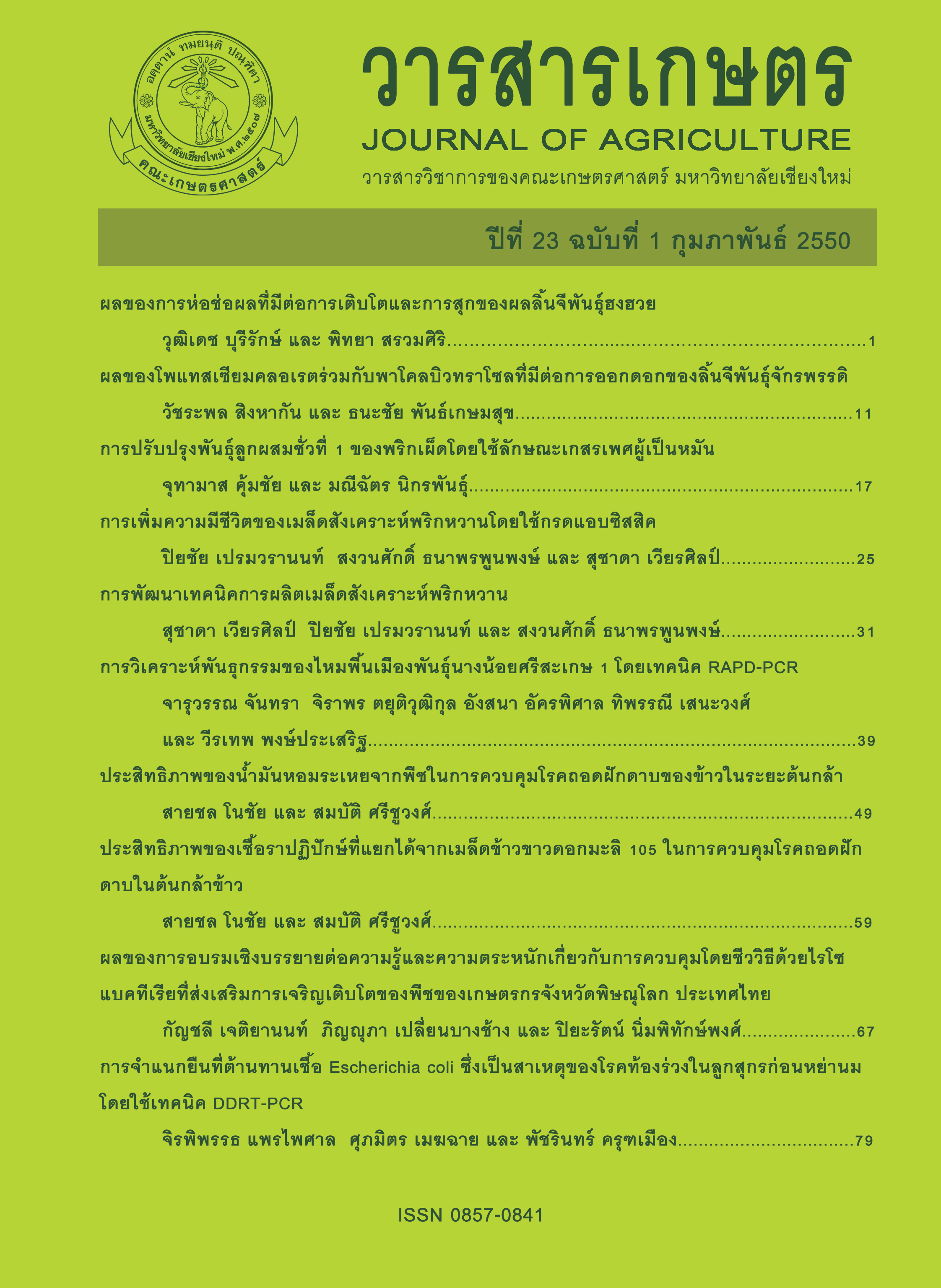
Improvement of F1 Hybrid Chili Using Male Sterility
Article Sidebar
Main Article Content
Abstract
F1 hybrid seeds are expensive and the uses of male sterility to produced F1 hybrid seeds would decrease cost of production. Three female lines (Smsms) were crossed to two male lines. Six F1 hybrids were obtained. It was shown that F1 hybrid variety, 2735BC2 #16-1-4 × PG. 5-3-1-1, gave the best yield, 1,538.47 kg/rai and the highest heterosis among the 6 F1. PG. 5-3-1-1 variety was used a male line, the F1 hybrid varieties yielded range from 1,081.13 to 1,538.47 kg/rai, which were not significantly different from PG. 5-3-1-1 which was the male parent (1,376.87 kg/rai) and commercial varieties, Maeping 80 and Chakrapat (1,346.81 and 2,076.81 kg/rai) respectively. When varieties PG. 25-1-1-1 variety was used as a male line, the F1 hybrids yielded 545.06 - 987.56 kg/rai which were lower than their own male parental variety (1,157.91 kg/rai) and commercial varieties Maeping 80 and Chakrapat (1,346.81 and 2,076.81 kg/rai) respectively.
Article Details
References
กนกวรรณ วชิรบรรจง. 2545. การศึกษาความเป็นหมันในพริกเผ็ด (Capsicum annuum L.). ปัญหาพิเศษ. ภาควิชาพืชสวน คณะเกษตรศาสตร์ มหาวิทยาลัยเชียงใหม่, เชียงใหม่. 40 หน้า.
กรมวิชาการเกษตร. 2548. ฐานความรู้ด้านพืชกรมวิชาการเกษตร. (ระบบออนไลน์). แหล่งที่มา: http://www.doa.go.th./pl_data/02_LOCAL/oard4/chili/body.html (15 กรกฎาคม 2548).
กฤษฎา สุขวิวัฒน์. 2544. การพัฒนาพ่อแม่พันธุ์ลูกผสมชั่วที่หนึ่งของพริกเผ็ด. วิทยานิพนธ์วิทยาศาสตรมหาบัณฑิต. มหาวิทยาลัยเชียงใหม่, เชียงใหม่. 90 หน้า.
ดำเนิน กาละดี. 2545. เทคโนโลยีการปรับปรุงพันธุ์พืช. มิ่งเมือง, เชียงใหม่. 256 หน้า.
มณีฉัตร นิกรพันธุ์. 2541. พริก. โอเดียนสโตร์, กรุงเทพฯ. 196 หน้า.
Ahmed, N., M. I. Tanki and J. Nayeema. 1999. Heterosis and combining ability studies in hot pepper (Capsicum annuum L.). Applied Biological Research 1(1): 11-14.
Ahmed, Z. and V. Pandey. 2002. Heterosis and combining ability in diallel crosses of sweet pepper (Capsicum annuum L.). Vegetable Science 29(1): 66-67.
Basset, M. J. 1986. Breeding Vegetable Crops. AVI Publishing Company, Inc., Westport, Connecticut. 584 pp.
Berke, T. G. 2000. Hybrid seed production in Capsicum. Journal of New Seeds 1(3/4): 49-67
Bosland, P. W., J. Iglesias and M.M. Gonzales. 1993. ‘Numex Sweet’ paprika chile. Hortscience 28(8): 860-861.
Damke, M. M. and V. J. Kawarkhe. 1996. “Surakta” (AKC 79-18) an improved chili variety. Plant Breeding Abstracts 67(9).
Doshi, K. M. and P. T. Shukla. 2000. Genetic of yield and its components in chilli (Capsicum annuum L.). Capsicum and Eggplant Newsletter 19: 78-81.
Nikolova, V., V. Todorova, S. Daskalov, Y. Todorov and V. Stoeva. 2001. Pollen fertility of pepper cultivars and their hybrids on male sterility basis. Capsicum and Eggplant Newsletter 20: 50-52.
Patel, J. A., M. J. Patel, A. S. Bhanvadia, R. R. Acharya and M. K. Bhalala. 2001. Extent of natural cross pollination with GMS lines in chilli (Capsicum annuum L.). Capsicum and Eggplant Newsletter 20: 35-37.
Purseglove, J. W. 1968. Tropical Crops: Dicotyledons. Vol. 2. Longmans, London. 719 pp.
