
NHAM PRODUCT DEVELOPMENT USING MIXED BACTERIAL STARTER CULTURES 1. SUITABLE SOURCE OF CARBOHYDRATE FOR NHAM PRODUCTION
Article Sidebar
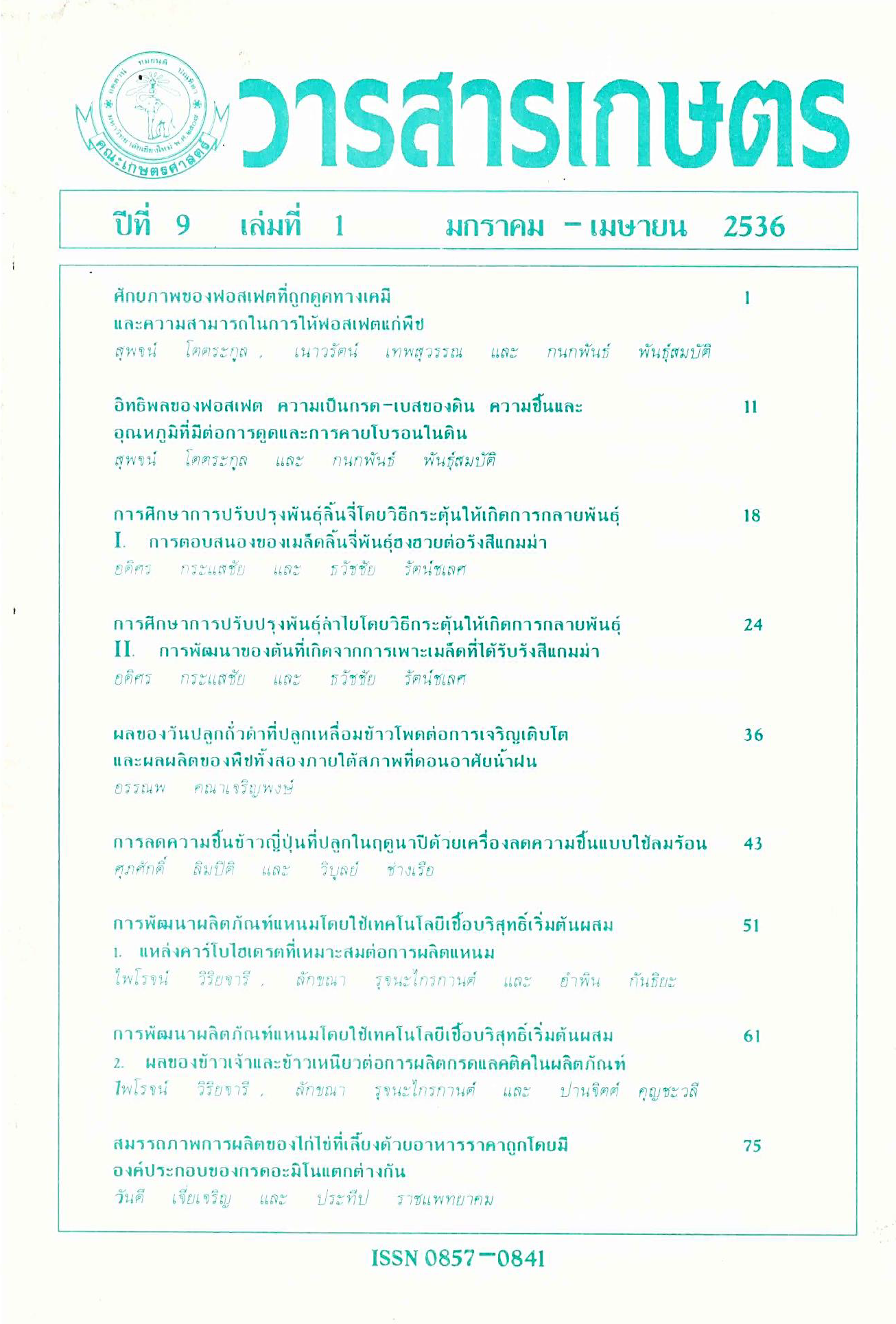
Main Article Content
Abstract
6 types of carbohydrate sources; cooked rice, sticky rice, soya bean flour, tapioca, wheat flour, and corn starch; were used for this study. This experiment is to investigate a suitable carbohydrate source for Nham production using mixed bacterial starter cultures. For this experiment, it was found that 6% of cooked rice used in Nham formulation made the good quality of the product. The Nham is composed of high reducing sugars (1.0120±0.0897%) which was suitable for the growth of nitrate reducing bacteria and then the culture effectively reduced nitrate to nitrite (187.4067 ± 1.3914 ppm). Additionally, the lactic acid bacteria used the residual reducing sugars to produce lactic acid. After 48 hours of fermentation, the product had total acidity as lactic acid (1.1200 ± 0.0200%), pH (4,54±0.02) and residual carbohydrate (2.76 ±0.08%). The panelists accepted the final product with colour score, firmness score, sourness score, spiciness score and overall acceptability score of 4.12 ± 0.72, 3,67 ± 0.60, 3.56 ± 0.51, 3.18 ± 0.66, and 3.62 ± 0.62 respectively
Article Details
References
วิทยานิพนธ์ปริญญาตรี มหาวิทยาลัยเกษตรศาสตร์ กรุงเทพ.
เตชะภิญญาวัฒน์, สมบูรณ์. (2518). การศึกษาจุลินทรีย์ที่เป็นตัวการในระหว่างการทำแหนม. วิทยานิพนธ์
ปริญญาโท มหาวิทยาลัยเกษตรศาสตร์ กรุงเทพ.
วิริยจารี, ไพโรจน์. และ หันพงศ์กิตติกุล, อรัญ. (255, 2535). ปฏิบัติการอุตสาหกรรมการหมัก. ภาควิชา
วิทยาศาสตร์ และเทคโนโลยีการอาหาร คณะอุตสาหกรรมเกษตร มหาวิทยาลัยเชียงใหม่.
วิริยจารี, ไพโรจน์. (2535). การวางแผนและการวิเคราะห์ทางด้านประสาทสัมผัส. ภาควิชาวิทยาศาสตร์และ
เทคโนโลยีการอาหาร คณะอุตสาหกรรมเกษตร มหาวิทยาลัยเชียงใหม่.
โสมะฐิติ, สุขใจ. (2525). การสำรวจเชื้อโรคลำไส้บางชนิดในแหนม. วิทยานิพนธ์ปริญญาโท
มหาวิทยาลัยเกษตรศาสตร์ กรุงเทพ.
AOAC. (1984). Official Methods of Analysis (13rd edition) Association of official Analytical Chemists,
Washington, D.C.
Bacus, J. (1984). Utilization of Microorganisms in Meat Processing. Research Studies Press, Ltd.,
England.
Deibel, RH., Niven, C.F. Jr., and Wilson, G.D. (1961). Microbiology of meat curing III. Some
microbiological and related technological aspects in the manufacture of fermented sausages. Appl. Microbiol., 9: 156-165.
Gatchalian, M.M. (1981). Sensory Evaluation Methods with Statistical Analysis. Collage of Home
Economics, University of the Philippines, Philippines.
Gibbs, P.A. (1987). Novel uses for lactic acid fermentation in food preservation. J. Appl. Bacteriol.
Symposium Supplement, 51S -58S.
Institute of Food Technologists. (1981) Sensory evaluation guide for testing food and beverage
products. Food Technology, 35(11): 50-59.
Miller, G.L (1959). Use of dinitrosalicylic acid reagent for determination of reducing sugars. Analytical
Chemistry 31: 426-428.
Pearson, D. (1976). The Chemical Analysis of Food. Churchill Livingstone. London and New York. Srisomwong. P. (1985). The study of lactic acid bacteria in Nham. M. Appl. Sci. Thesis, University of
New South Wales, Australia.
Tanasupawat, S., and Daengsubha, W. 1983. Pediococcus species and related bacteria found in
fermented foods and related materials in Thailand. J. Gen. Appl. Microbiol., 29: 487-506.
Walonick, D.S. (1987). Stat-Packets. Walonick Associates Inc., Minneapoils, MN
Wiriyacharee, P. (1990). The Systematic Development of a Controlled Fermentation Process Using
Mixed Bacterial Starter Cultures for Nham, a Thai Semi-day Sausage. Ph.D. Thesis in Product Development in Food Fermentation, Massey University, New Zealand.
