
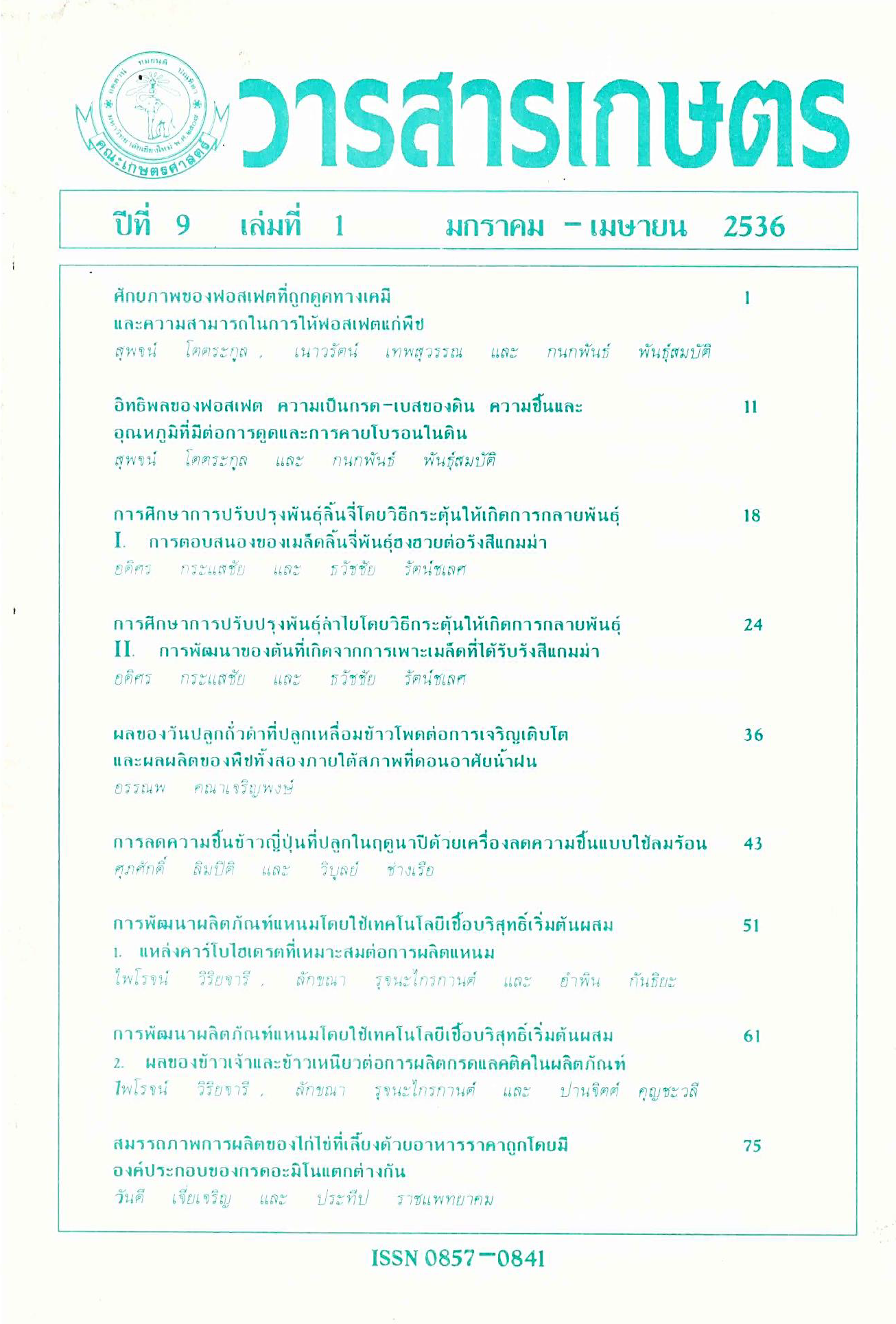
NHAM PRODUCT DEVELOPMENT USING MIXED BACTERIAL STARTER CULTURES 2. EFFECT OF COOKED RICE AND STICKY RICE ON LACTIC ACID PRODUCTION
Article Sidebar
Main Article Content
Abstract
1-3% of cooked rice and sticky rice was used as carbohydrate source for Nham production using mixed bacterial starter cultures. It was used by the cultures for lactic acid production affecting the good quality of Nham. For this experiment, it was found that 3% of cooked rice and 1% of sticky rice were suitable for Nham production. The carbohydrate was changed into reducing sugars rapidly at 6 hours of fermentation. The reducing sugars then decreased later since they were used to produce lactic acid. As a result of this, the Nham was composed of total acidity as lactic acid (1.03%), pH (4.36), and residual carbohydrate (1.203%) after 48 hours of fermentation. Additionally, the product was accepted with the mean ideal ratio score of 0.86 ± 0.17. It was also to be high quality in terms of many attributes except colour and saltiness which was higher mean ideal ratio score.
Article Details
References
วิริยจารี, ไพโรจน์. (2535). การวางแผนและการวิเคราะห์ทางด้านประสาทสัมผัส. ภาควิชาวิทยาศาสตร์และ
เทคโนโลยีการอาหาร คณะอุตสาหกรรมเกษตร มหาวิทยาลัยเชียงใหม่.
วิริยจารี, ไพโรจน์. และ หันพงศ์กิตติกุล, อรัญ. (255, 2535). ปฏิบัติการอุตสาหกรรมการหมัก. ภาควิชา
วิทยาศาสตร์ และเทคโนโลยีการอาหาร คณะอุตสาหกรรมเกษตร มหาวิทยาลัยเชียงใหม่.
AOAC. (1984). Official Methods of Analysis (13rd edition) Association of official Analytical Chemists,
Washington, D.C.
Buchanan, R.E., and Gibbons, N.E. (1974). Bergey's Manual of Determinative Bacteriology. The
Williams and Wilkins Compang, Baltimore.
H-kittikun, A., Wiriyacharee, P., and Rujanakraikarn, L (1988). Nham (Thai fermented pork) making
with starter cultures. p. 427-429. In: Proccedings 34 th International Congress of Meat Science and Technology. Brisbane, Australia.
Miller, G.L. (1959). Use of dinitrosalicylic acid reagent for determi-nation of reducing sugar. Analytical
Chemistry, 31: 426-428.
Pearson, D. (1976). The Chemical Analysis of Foods. Churchill Livingstone. London and New York. Pezacki, W. (1978). Technological control of dry sausage ripening. VIII. Effect of predrying on the
dynamics of carbohydrate changes taking place at the beginning of ripening. Fleischwirtschaft, 58: 124-126, 129-132, 135.
Walonick, D.S. (1987). Stat-Packets. Walonick Associates Inc., Minneapoils, MN.
Wiriyacharee, P. (1990). The Systematic Development of a Controlled Fermentation Process Using
Mixed Bacterial Starter Cultures for Nham, a Thai Semi-day Sausage. Ph.D. Thesis in Product Development in Food Fermentation, Massey University, New Zealand.
Wiriyacharee, P, Brooks, J.D, Earle, MD, and Page, G. (1990). The improvement of a traditional Thai
fermented pork sausage by use of mixed starter cultures. In: Fermentation Technologies: Industrial Applications Conference, Massey University; Palmerston North, New Zealand.
