
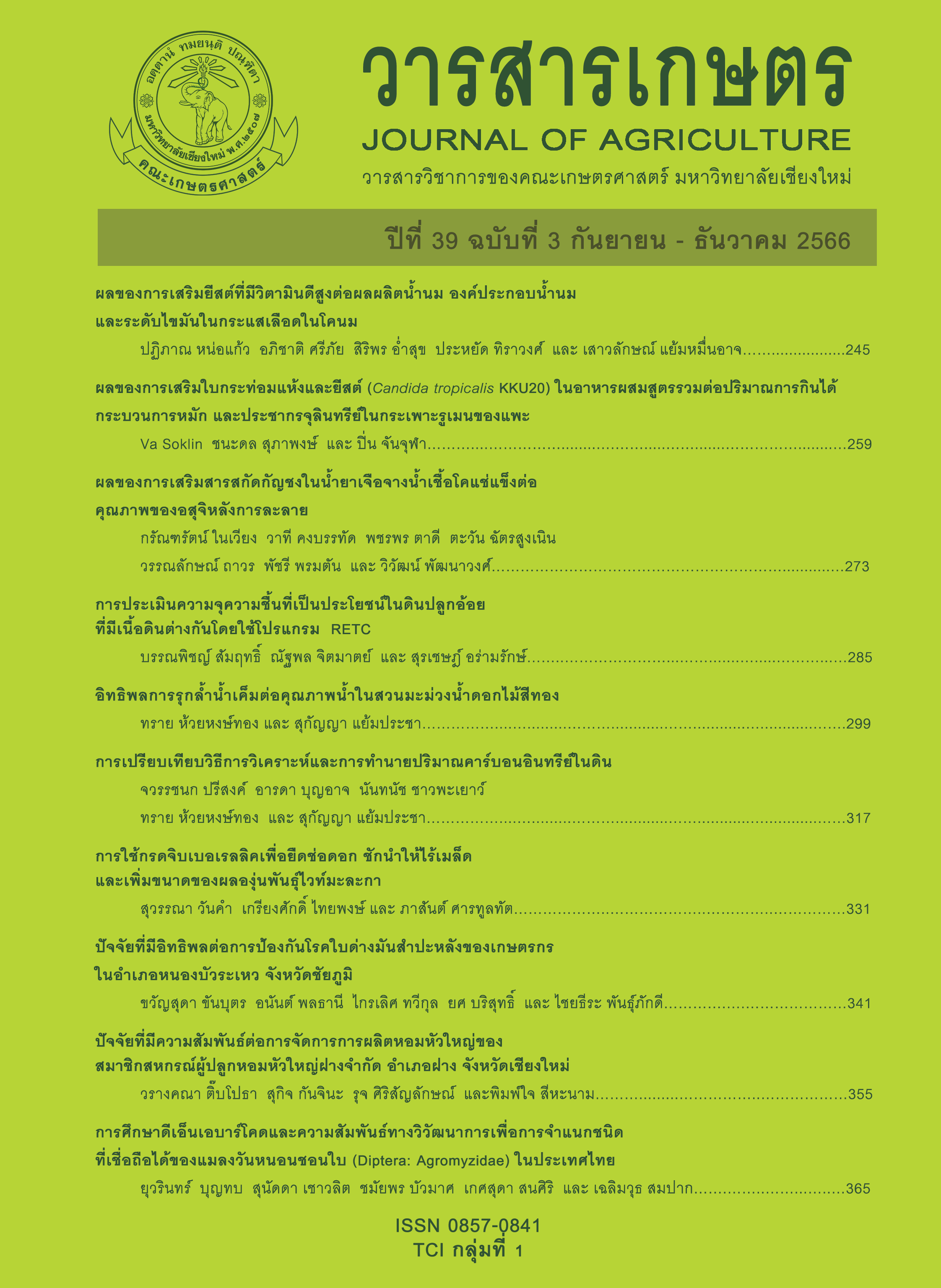
Factors Influencing Prevention of Cassava Mosaic Disease (CMD) of Farmers in Nong Bua Rawe District, Chaiyaphum Province
Article Sidebar
Main Article Content
Abstract
The purpose of this study was to investigate factors that influence the prevention of Cassava Mosaic Disease (CMD) of farmers in Nong Bua Rawe district, Chaiyaphum province. The sample size was 359 farmers of 3 Sub-districts, namely Wang Takhe, Huai Yae and Khok Sa-at. Data was gathered using an interview form with the computation of statistic methods of frequency, percentage, mean, minimum and maximum value, standard deviation, and multiple regression analysis. The results showed that most of the farmers were female (62.7 percent) with an average age of 52.8 years old. Their experience in cassava planting was 26.1 years, with average numbers of cassava planting areas and yields were 34.3 rai and 3.2 tons/rai respectively, received training and advice about cassava mosaic disease (CMD) from agricultural extension officers average 1 time/year, knowledge of CMD was at a moderate level. Regarding practices against CMD, most farmers had been conducted by not importing cassava stems from foreign countries. This had simultaneously done with, if cassava leaves were seen infectious, they would be exterminated for the benefit of prevention. From hypothesis testing, it was found that the factors that significantly correlated with the prevention of CMD (P < 0.05) were production costs, income, and knowledge of CMD.
Article Details

This work is licensed under a Creative Commons Attribution-NonCommercial-NoDerivatives 4.0 International License.
References
Abuhamda, E.A.A., I.A. Ismail and T.R.K. Bsharat. 2021. Understanding quantitative and qualitative research methods: A theoretical perspective for young researchers. International Journal of Research 8(2): 71-87.
Alabi, O.J., P.L. Kumar and R.A. Naidu. 2011. Cassava mosaic disease: A curse to food security in Sub-Saharan Africa. The American Phytopathological Society (APS), doi: 10.1094/APSnetFeature-2011- 0701.
Bizabani, C., S.J. Rogans and M.E.C. Rey. 2021. Differential miRNA profiles in South African cassava mosaic virus-infected cassava landraces reveal clues to susceptibility and tolerance to cassava mosaic disease. Virus Research 303: 198400, doi: 10.1016/j.virusres.2021.198400.
Bunyanit, A. and R. Sirisunyaluck. 2019. Factors influencing obtaining good agricultural practice certification of rice growers in Phrao district, Chiang Mai province. Khon Kaen Agriculture Journal 47(1): 167-172. (in Thai)
Bureau of Agricultural and Industrial Trade Promotion. 2021. Cassava products. (Online). Available: http://ditp.go.th/ditp_web61/index.php (September 12, 2021). (in Thai)
Carr, A., K. Balasubramanian, R. Atieno and J. Onyango. 2018. Lifelong learning to empowerment: Beyond formal education. Distance Education 39(1): 69-86.
Chaiyaphum Provincial Agricultural Extension Office. 2021. Report area of cassava mosaic disease outbreak Chaiyaphum province in 2021. Chaiyaphum Provincial Agricultural Extension Office, Chaiyaphum. 1 p. (in Thai)
Department of Agricultural Extension. 2022. Management of cassava mosaic disease and related laws. Department of Agricultural Extension, Bangkok. 8 p. (in Thai)
El-Sharkawy, M.A. 2012. Stress-tolerant cassava: The role of integrative ecophysiology-breeding research in crop improvement. Open Journal Soil Science 2: 162-186.
Howeler, R., N. Lutaladio and G. Thomas. 2013. Save and Grow: Cassava: A Guide to Sustainable Production Intensification. FAO, Rome. 129 p.
Jowsey, T., C. Deng and J. Weller. 2021. General-purpose thematic analysis: A useful qualitative method for anaesthesia research. BJA Education 21(12): 472-478.
Kanokhong, K., N. Rattanawan and P. Jeerat. 2018. Adoption of crop growing methods under the standards of good agricultural practice (GAP) of farmers, Mon Ngo royal project development center Mae Tang district, Chiang Mai. Journal of Agricultural Research and Extension 36(1): 75-84. (in Thai)
Komchadluek. 2021. Department of Agricultural Extension accelerates the cure of cassava mosaic disease, joins KU researchers to find disease-resistant varieties to plant instead. (Online). Available: http://www.komchadluek. net/news/457726 (November 27, 2021). (in Thai)
Krejcie, R.V. and D.W. Morgan. 1970. Determining sample sizes for research activities. Educational and Psychological Measurement 30(3): 607-610.
Krungsri Research. 2021. Industry Outlook 2022-2024: Cassava Industry. (Online).Available: https://www.krungsri.com/en/research/industry/industry-outlook/agriculture/cassava/io/ io-cassava-21 (April 9, 2023).
Legg, J.P., P.L. Kumar, T. Makeshkumar, L. Tripathi, M. Ferguson, E. Kanju, P. Ntawuruhunga and W. Cuellar. 2015. Chapter four - Cassava virus diseases: biology, epidemiology, and management. Advances in Virus Research 91: 85-142.
National Agricultural Big Data Center. 2020. Analysis of situation of cassava mosaic disease. (Online). Available: http://www.nabc.go.th/disaster/baidang (December 12, 2020). (in Thai)
Nong Bua Rawe District Agricultural Extension Office. 2020. Result of registration of cassava farmers in 2020/2021. Nong Bua Rawe District Agricultural Extension Office, Chaiyaphum. 1 p. (in Thai)
Nong Bua Rawe District Agricultural Extension Office. 2021. Report area of cassava mosaic disease outbreak. Nong Bua Rawe District Agricultural Extension Office, Chaiyaphum. 1 p. (in Thai)
Office of Agricultural Economics. 2021. Agricultural Statistics of Thailand 2020. Office of Agricultural Economics, Bangkok. 214 p. (in Thai)
Office of Agricultural Economics. 2022. Agricultural Statistics of Thailand 2021. Office of Agricultural Economics, Bangkok. 210 p. (in Thai)
Panpakdee, C., S. Simaraks and C. Sookcharoen. 2022. Using the Delphi method to develop social-ecological resilience indicators of organic rice production in Thailand. Forest and Society 6(1): 157-174.
Ploddee, P., S. Phoona and B. Mokmoor. 2017. Soil Capacity Assessment Guidelines for Planting Cassava in Nakhon Ratchasima. Land Development Department, Bangkok. 132 p. (in Thai)
Prasara-A, J. and S.H. Gheewala. 2021. An assessment of social sustainability of sugarcane and cassava cultivation in Thailand. Sustainable Production and Consumption 27: 372-382.
Sangklinhrom, O., S. Seesang and P. Saranrom. 2015. Appropriate technology utilization for cassava production by farmers participating in the project of increasing production efficiency of industrial and export crops in Mueang district of Kanchanaburi province. pp. 1-15. In: The 5th STOU Graduate Research Conference, Nonthaburi. (in Thai)
Siriwan, W., N. Hemniam, J. Thawinampan, S. Roekwan, K. Saokham, S. Hunsawattanakul, P. Pleeprom and C. Phumichai. 2020. Study of disease incidence in cassava mosaic disease clean seed. Agricultural Science Journal 51(2): 181-191. (in Thai)
Thresh, J.M. and R.J. Cooter. 2005. Strategies for controlling cassava mosaic virus disease in Africa. Plant Pathology 54(5): 587-614.
