
Response of Rice to Silicon Fertilizer Application and Its Effects on Silicon Availability in Soil of Phra Nakhon Si Ayutthaya, Thailand
Article Sidebar
Main Article Content
Abstract
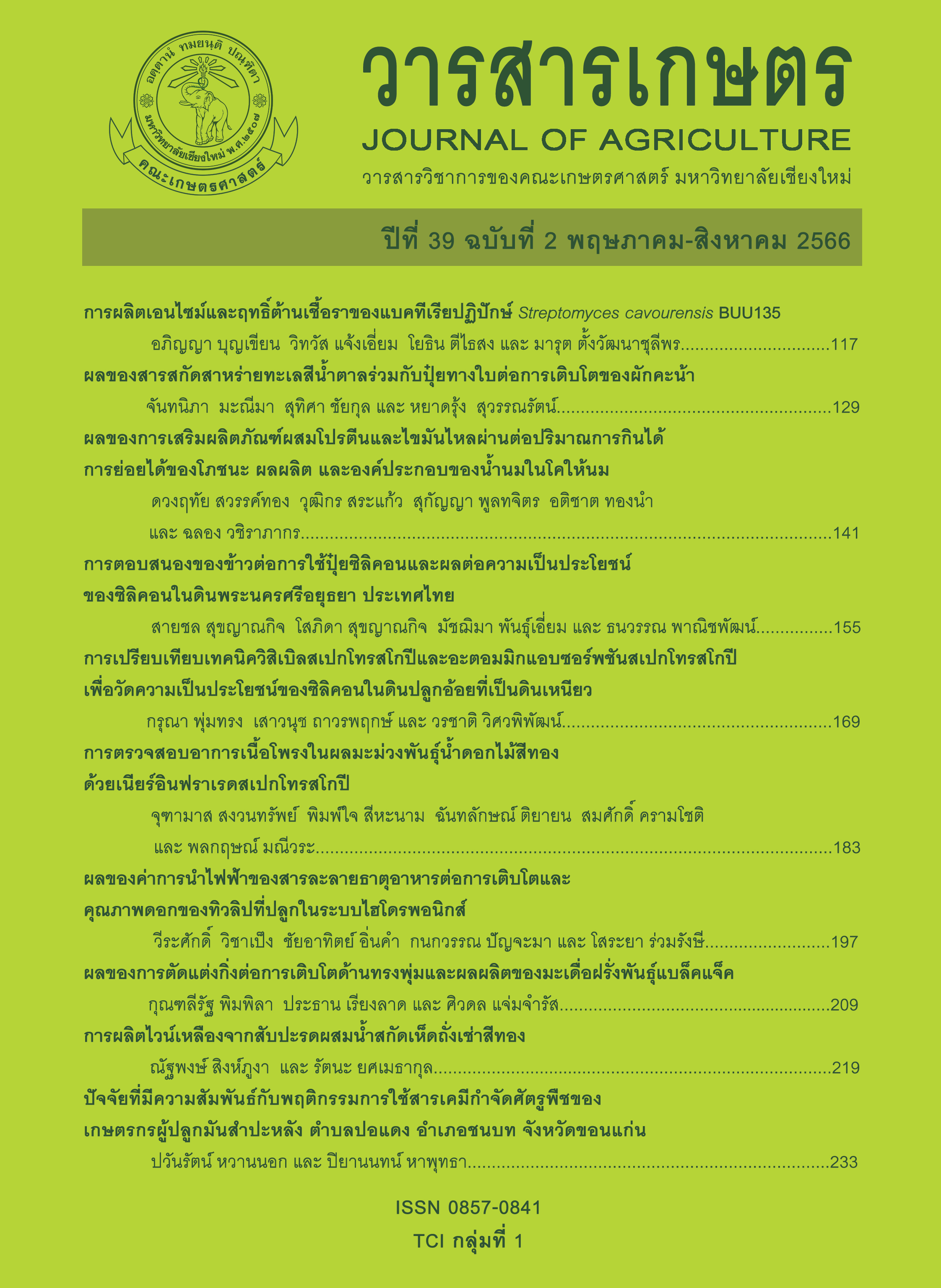
This research aimed to evaluate the optimal rates of silicon (Si) fertilizer on the growth, yield components, yield, and Si uptake in each part of Pathum Thani 1 rice and its effects on Si availability in the soil of the Phra Nakhon Si Ayutthaya province. The experiment was arranged in a 2x5 factorial in a completely randomized design with three replications and two factors. The first factor was the soil series; Tha Rua (Tr), and Ayutthaya (Ay). The second factor was the Si fertilizer, which was set at five different levels; 0, 0.42, 0.84, 1.26, and 1.68 g SiO2/pot. The findings revealed that soil types significantly impacted plant growth, yield, and the amount of Si content in various plant parts. The rice planted in the Se soil series illustrated higher leaf greenness, number of panicles per hill, rice yield (straw and grain), and Si uptake in various plant parts; more than that of the Tr soil series. Applying Si fertilizer at 0.42 g SiO2/pot gave the highest grain yield, particularly in the Se soil series (26.6 g/hill). The application of Si fertilizer at 1.68 g SiO2/pot provided the highest Si content in culms, leaves, and grain; at 0.38, 0.48, and 0.50 g/hill, respectively. Increases in Si fertilizer rates noticeably increased the Si availability in both soil types. Applying Si fertilizer at 1.68 g SiO2/pot gave the highest amount of Si in water-soluble, exchangeable, available, and residual fractions at (49, 224, 274, and 15,278 mg/kg in the Tr soil series and 56, 87, 143, and 13,692 mg/kg in the Se soil series, respectively).
Article Details

This work is licensed under a Creative Commons Attribution-NonCommercial-NoDerivatives 4.0 International License.
References
Babu, T. 2015. Calibration and categorization of plant available silicon in Louisiana soils. Ph.D. Dissertation. Louisiana State University, Boston Rouge, LA. 159 p.
Bray, R.H. and L.T. Kurtz. 1945. Determination of total, organic, and available forms of phosphorus in soils. Soil Science 59(1): 39-46.
Chaiwong, N., T. Pusadee, S. Jamjod and C. Prom-u-thai. 2022. Silicon application promotes productivity, silicon accumulation and upregulates silicon transporter gene expression in rice. Plants 11(7): 989, doi: 10.3390/plants11070989.
Cuong, T.X., H. Ullah, A. Datta and T.C. Hanh. 2017. Effects of silicon-based fertilizer on growth, yield and nutrient uptake of rice in tropical zone of Vietnam. Rice Science 24(5): 283-290.
Division of Soil Survey and Soil Resource Research. 2019. Soil map of Phra Nakhon Si Ayutthaya province (Online). Available: http://oss101.ldd.go.th/web_thaisoilinf/central/Ayutthaya/ay_map/ay_series/ay_series58.html (July 7, 2019). (in Thai)
Dobermann, A. and T. Fairhurst. 2000. Rice: Nutrient Disorders and Nutrient Management. Oxford Graphic Printers, Singapore. 191 p.
FAO Project Staff and Land Classification Division. 1973. Soil Interpretation Handbook for Thailand. Land Classification Division, Department of Land Development, Bangkok. 169 p.
Gee, G.W. and J.W. Bauder. 1986. Particle-size analysis. pp. 383-411. In: A. Klute (ed.). Methods of Soil Analysis Part 1: Physical and Mineralogical Methods. Soil Science Society of America, Inc., Madison, Wisconsin.
Hallmark, C.T., L.P. Wilding and N.E. Smeck. 1982. Silicon. pp. 263-273. In: A.L. Page, R.H. Miller and D.R. Keeney (eds.). Methods of Soil Analysis Part 2: Chemical and Microbiological Properties. Soil Science Society of America, Inc., Madison, Wisconsin.
Jones, R.L. and G.B. Dreher. 1996. Silicon. pp. 627-637. In: D.L. Sparks, A.L. Page, P.A. Helmke, R.H. Loeppert, P.N. Soltanpour, M.A.
Tabatabai, C.T. Johnston and M.E. Sumner (eds.). Methods of Soil Analysis Part 3: Chemical Methods. Soil Science Society of America, Inc., Madison, Wisconsin.
Ju, S., L. Wang and J. Chen. 2020. Effects of silicon on the growth, photosynthesis and chloroplast ultrastructure of Oryza sativa L. seedlings under acid rain stress. Silicon 12: 655-664.
Kabata-Pendias, A. and H. Pendias. 1992. Trace Elements in Soils and Plants. CRC Press, Boca Raton. 365 p.
Khalid, R.A., J.A. Silva and R.L. Fox. 1978. Residual effects of calcium silicate in tropical soils: I. Fate of applied silicon during five years of cropping. Soil Science Society America Journal 42(1): 89-94.
Korndorfer, G.H., M.N. Coelho, G.H. Snyder and C.T. Mizutani. 1999. Evaluation of soil extractants for silicon availability in upland rice. Revista Brasileira de Ciência do Solo 23(1): 101-106.
Ma, J. 2004. Role of silicon in enhancing the resistance of plants to biotic and abiotic stresses. Soil Science and Plant Nutrition 50(1): 11-18.
Ma, J., K. Nishimura and E. Takahashi. 1989. Effect of silicon on the growth of rice plant at different growth stages. Soil Science and Plant Nutrition 35(3): 347-356.
Meena, V.D., M.L. Dotaniya, V. Coumar, S. Rajendiran, Ajay, S. Kundu and A.S. Rao. 2014. A case for silicon fertilization to improve crop yields in tropical soils. Proceedings of the National Academy of Sciences, India-Section B: Biological Sciences 84(3): 505-518.
Narayanaswamy, C. and N.B. Prakash. 2009. Calibration and categorization of plant available silicon in rice soils of south India. Journal of Plant Nutrition 32(8): 1237-1254.
Nayar, P.K., A.K. Misra and S. Patnaik. 1975. Rapid microdetermination of silicon in rice plant. Plant and Soil 42(2): 491-494.
Phommuangkhuk, A., S. Amkha, Y. Osotsapar and N. Udomprasert. 2020. Effects of Si application on growth, yield and Si concentration in rice under nutrient solution system. Agricultural Science and Management Journal 3(2): 70-80.
Rhoades, J.D. 1996. Salinity: Electrical conductivity and total dissolved solids. pp. 471-435. In: D.L. Sparks, A.L. Page, P.A. Helmke, R.H. Loeppert, P.N. Soltanpour, M.A. Tabatabai, C.T. Johnston and M.E. Sumner (eds.). Methods of Soil Analysis Part 3: Chemical Methods. Soil Science Society of America, Inc., Madison, Wisconsin.
Sailaja, V., K. Rajamani and B.H. Kumara. 2019. Research review on extracting methods of silicon from soil. International Journal of Chemical Studies 7(6): 477-481.
Sandhya, K. and N.B. Prakash. 2019. Bioavailability of silicon from different sources and its effect on the yield of rice in acidic, neutral, and alkaline soils of Karnataka, south India. Communications in Soil Science and Plant Analysis 50(3): 295-306.
Savant, N.K., G.H. Snyder and L.E. Datnoff. 1996. Silicon management and sustainable rice production. Advances in Agronomy 58: 151-199.
Schaller, J., D. Puppe, D. Kaczorek, R. Ellerbrock and M. Sommer. 2021. Silicon cycling in soils revisited. Plants 10(2): 295, doi: 10.3390/plants10020295.
Sommer, M., D. Kaczorek, Y. Kuzyakov and J. Breuer. 2006. Silicon pools and fluxes in soils and landscapes – A review. Journal of Plant Nutrition and Soil Science 169(3): 310-329.
Song, A., P. Li, F. Fan, Z. Li and Y. Liang. 2014. The effect of silicon on photosynthesis and expression of its relevant genes in rice (Oryza sativa L.) under high-zinc stress. PLoS ONE 9(11): e113782, doi: 10.1371/journal.pone.0113782.
Sukyankij, S., S. Sukyankij, S. Samithiarporn and T. Panich-pat. 2022. Optimum rate of phosphorus fertilizer for Pathum Thani 1 rice variety grown in soils of Phra Nakhon Si Ayutthaya province. Journal of Agriculture 38(3): 357-368. (in Thai)
Surapornpiboon, P., S. Julsrigival, C. Senthong and D. Karladee. 2008. Effects of silicon on upland rice under drought condition. Chiang Mai University Journal of Natural Sciences 7(1): 163-171.
Szulc, W., B. Rutkowska, M. Hoch, D. Ptasinski and W. Kazberuk. 2019. Plant available silicon in differentiated fertilizing conditions. Plant, Soil and Environment 65(5): 233-237.
Thomas, G.W. 1982. Exchangeable cations. 1982. pp. 159-165. In: A.L. Page, R.H. Miller and D.R. Keeney (eds.). Methods of Soil Analysis Part 2: Chemical and Microbiological Properties. Soil Science Society of America, Inc, Madison, Wisconsin.
Thomas, G.W. 1996. Soil pH and soil acidity. pp. 475-490. In: D.L. Sparks, A.L. Page, P.A. Helmke, R.H. Loeppert, P.N. Soltanpour, M.A. Tabatabai, C.T. Johnston and M.E. Sumner (eds.). Methods of Soil Analysis Part 3: Chemical Methods. Soil Science Society of America, Inc., Madison, Wisconsin.
Walkley, A. and I.A. Black. 1934. An examination of Degtjareff methods for determining soil organic matter, and a proposed modification of the chromic acid titration method. Soil Science 37(1): 29-38.
Yan, G-C., M. Nikolic, M-J. Ye, Z-X. Xiao and Y-C. Liang. 2018. Silicon acquisition and accumulation in plant and its significance for agriculture. Journal of Integrative Agriculture 17(10): 2138-2150.
Yang, X., Z. Song, C. Yu and F. Ding. 2020. Quantification of different silicon fractions in broadleaf and conifer forests of northern China and consequent implications for biogeochemical Si cycling. Geoderma 361: 114036, doi: 10.1016/j.geoderma.2019.114036.
