
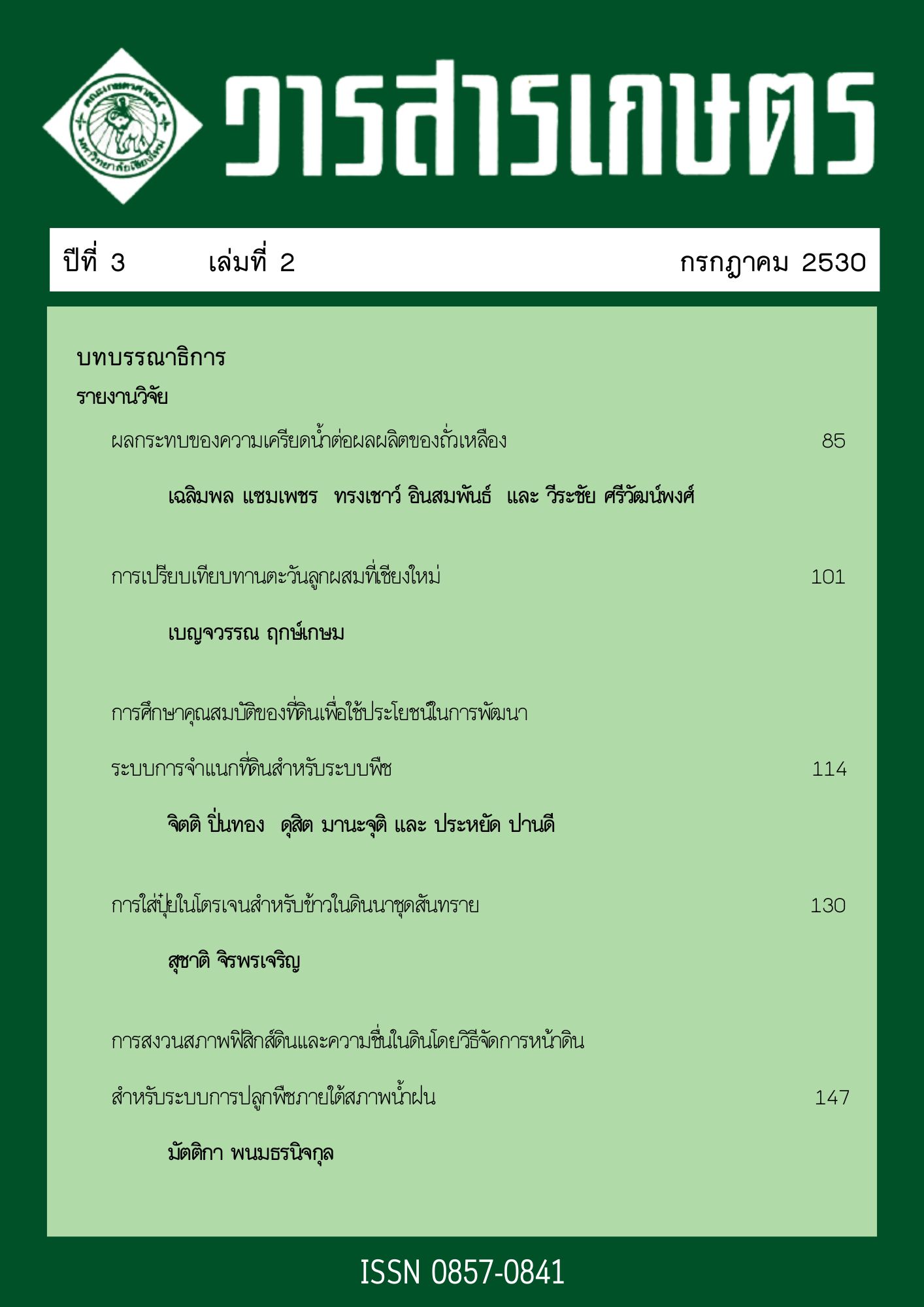
NITROGEN FERTILIZATION FOR RICE IN SANSAI PADDY SOIL
Article Sidebar
Main Article Content
Abstract
A study conducted to find a suitable source and method of supplying fertilizer nitrogen to rice was established in the experimental field of the Multiple Cropping Center, Chiang Mai University, during the 1984 rainy season. Two sources of fertilizer nitrogen, ammonium sulfate and urea, were compared and applied to the soil by 3 different methods: basal incorporation, split application and a mudball technique at the rate of 60 kg N/ha. Rice variety R.D. 7 was used as the test crop and was transplanted at spacings of 25 x 25 cm.
The results obtained indicated the importance of fertilizer nitrogen application in increasing total dry matter production and grain yield over control (no-N). While there were no significant differences in rice yield between the different methods of ammonium sulfate application, those for urea did affect grain yield. Rice yield was significantly increased when urea was applied in the form of mudball. Data from chemical analysis of the soil-plant system also demonstrated the important role of fertilizer nitrogen in rice production. In this soil series, of ammonium sulfate was superior to urea, except when it was applied in the form of mudball. The influence of the method of fertilizer nitrogen application on plant uptake was reflected in the variations of 45-61 % and 30-56 %of total-N applied in the ammonium sulfate and urea series respectively. Most of the nitrogen taken up by the rice plant was accumulated in the above ground portion, large amount being used for grain production. A considerable portion of the fertilizer nitrogen, ranging from 8-40 % of the total-N applied, still remained in the soil. The accumulated amount was observed to be the largest in split application followed by mudball and basal incorporation treatments. Experimental results also suggested for this soil series that urea should not be applied by basal incorporation due to large losses (62 % of total-N added) and low consumption by the rice plant (30 % of total-N added). However, the application of both sources of fertilizer nitrogen as mudball seems to be a promising technique in terms of minimizing Losses while, at the same time, maximizing nitrogen recovery in the soil-plant system at a satisfactory level as well as yield.
Article Details

This work is licensed under a Creative Commons Attribution-NonCommercial-NoDerivatives 4.0 International License.
References
Bremner, J.M. (1965). Total nitrogen. In. Methods of soil analysis, part 2. Am. Soc. of Agron. No. 9. Madison, Wisconsin, USA. 1149-1176.
Craswell, E.T. and VIck, P.L.G. (1979). Fate of fertilizer nitrogen applied to Wetland rice. In. Nitrogen and rice. IRRI: 173-192.
Craswell, E.T. and De Datta. S.K. (1980). Recent developments in research on nitrogen fertilizers for rice. RRI Res. Pap. Ser. 49:1-11.
De Datta, S.K. (1978). Fertilizer management for efficient use in wetland rice soils. In. Soils and rice. IRRI: 671-701.
De Datta, S.K. (1981). Evaluation of nitrogen fertility and increasing fertilizer efficiency in wetland rice soils. Proc. Symp on Paddy Soil. Inst. of Soil Sci. Press. Beijing: 171-206.
IAEA (1970). Rice fertilization; a six-year isotope study on nitrogen and phosphorus fertilizer utilization. Tech. Rep. Ser. 108:1 184.
IRRI. (1978). Summary report (Agronomic data and economic analysis) on the first and second international trials on nitrogen fertilizer efficiency in rice (1975-1977). Los Banos, Philippines: 1-30.
Ishizuka, Y. (1980). The importance of nitrogen for the growth of the rice plant. In. Increasing nitrogen efficiency for rice cultivation. ASPAC. Food. Fert. Tech. Center. Taiwan: 1-12.
Jiraporncharoen, S. (1984). Significance of fertilizer and straw nitrogen in crop production and fertility of lowland rice soil. Ph.D. thesis, Kyushu University, Fukuoka, Japan: 1-330.
Juang, T.C. (1980). Increasing nitrogen efficiency through deep placement of urea super granules under tropical and subtropical paddy conditions. In. Increasing nitrogen efficiency for rice cultivation. ASPAC. Food. Fert. Tech Center. Taiwan: 83-99.
