
Effects of different bio-extract formulas on the growth performance of Nile tilapia (Oreochromis niloticus) in biofloc system
Article Sidebar
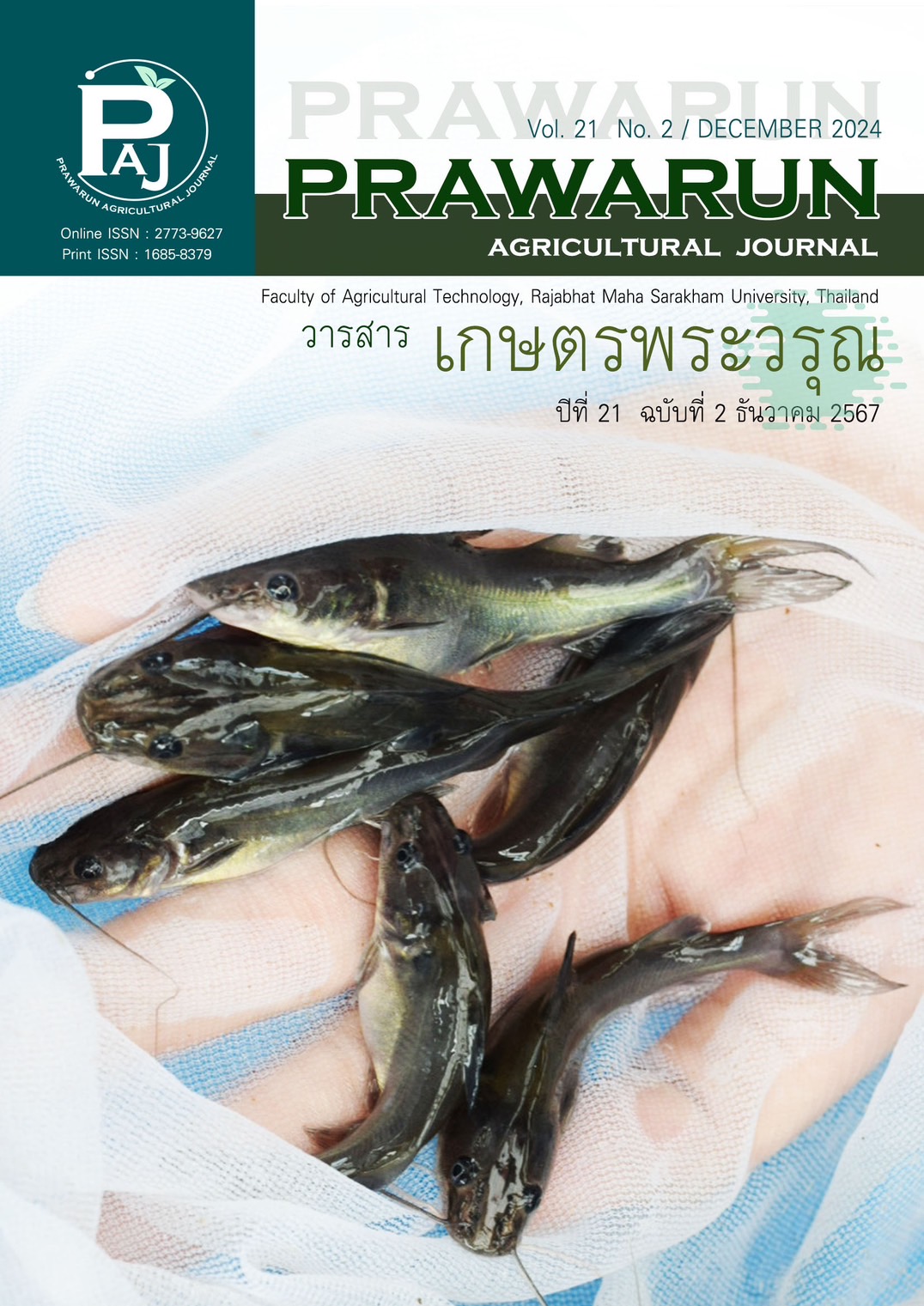
Main Article Content
Abstract
This research aimed to investigate the growth and survival rates of Nile tilapia (Oreochromis niloticus) using biofloc technology with various groups of microorganisms. The study employed a completely randomized design comprising four sets of experiments, with each experiment repeated three times. The four sets of experiments consisted of the following: In experiment set 1, tilapias were raised under normal conditions (control group); experiment set 2 utilized biofloc technology for tilapia cultivation with naturally fermented effective microorganisms (EM); experiment set 3 utilized biofloc technology for tilapia cultivation with bacillus bacteria; and experiment set 4 utilized biofloc technology for tilapia cultivation with photosynthetic bacteria (PSB). The tilapia, with an average size of 7.68±0.48 g and 6.52±0.40 cm, were raised at a density of 45 fish per square meter in 24x12x15 inch (54 L) tanks. Ready-made food was given to feed them twice a day. Consecutive water quality monitoring was done in different raising forms for a period of six weeks. The results at the end of the experiment showed that raising the tilapia with naturally fermented EM in experiment set 2 yielded the best results. It affected the good growth rate and had a high survival rate (100 %). Additionally, it resulted in a low feed conversion ratio due to the microbial sludge, which comprised 23.43 % protein of dry unit weight. Temperature ranged from 28 to 32 °C, pH from 6.7 to 8.3, alkalinity from 68 to 119 mg/L CaCO3, nitrite from 0 to 0.5 mg/L NO2-N, ammonia from 0 to 0.2 mg/L NH3-N, dissolved oxygen concentrations from 4.0 to 5.0 mg/L, and total suspended solids concentrations from 100 to 500 mg/L, respectively, with no significant differences between the mean values calculated for the control culture. Finally, various kinds of zooplankton, e.g., Moina macrocopa and Brachionus sp., were found in wastewater treatment systems, which can be used as supplementary food for the tilapia. Furthermore, using photosynthetic bacteria (PSB) with naturally fermented EM affected ammonia treatment and helped reduce the frequency of changing the water in the fish tank, thus reducing costs
Article Details
References
Association of Official Analytical Chemists (AOAC). (1995). Official methods of analysis (16th ed.). Washington D. C., United States: Association of Official Analytical Chemists.
Avnimelech, Y. (2014). Biofloc technology: a practical guide book (3rd ed.). Baton Rouge, Louisiana, United States: The World Aquaculture Society.
Azim, M. E., & Little, D. C. (2008). The biofloc technology (BFT) in indoor tanks: water quality, biofloc composition, and growth and welfare of Nile Tilapia (Oreochromis niloticus). Aquaculture, 283(1-4), 29-35. doi: 10.1016/j.aquaculture.2008.06.036
Caipang, C. M, A., Choo, H. X., Bai, Z., Huang, H., & Lay-yag, C. M. (2015). Viability of sweet potato flour as carbon source for the production of biofloc in freshwater culture of tilapia, Oreochromis sp. International Aquatic Research, 7(4), 329-336. doi: 10.1007/s40071-015-0117-7
Castro-Nieto, L. M., Castro–Barrera, T., De Lara-Andrade, R., Castro-Mejía, J., & Castro-Mejía, G. (2012). Biofloc systems in aquaculture biofloc systems: a technological breakthrough in aquaculture. Revista Digital del Departamento El Hombre y su Ambiente, 1(1), 1-5.
Chu, C. P., & Lee, D. J. (2004). Multiscale structures of biological flocs. Chemical Engineering Science, 59(8-9), 1875-1883. doi: 10.1016/j.ces.2004.01.040
Emerenciano, M., Ballester, E. L. C., Cavalli, R. O., & Wasielesky, W. (2011). Biofloc technology application as a food resource in a limited water exchange nursery system for pink shrimp Farfantepenaeus brasiliensis (Latreille, 1817). Aquaculture research, 43(3), 447-457. doi: 10.1111/j.1365-2109.2011.02848.x
Fisheries department. (2008a). Nile Tilapia culture. Bangkok, Thailand: Ministry of Agriculture and Cooperatives. (in Thai)
Fisheries department. (2008b). Hormonal Sex-reversed Nile Tilapia culture. Bangkok, Thailand: Ministry of Agriculture and Cooperatives. (in Thai)
Hmadhloo, S., Tanyaros, S., & Phumee, P. (2013). Effect of C:N ratio in integrated culture of white shrimp (Litopenaeus vannamei) and Nile tilapia (Oreochromis niloticus) using biofloc technology. Rajamangala University of Technology Srivijaya Research Journal, 5(1), 96-106. (in Thai)
Jitmanowan, S. (2020). Effect of carbon/nitrogen ratio (C:N) on geosmin in Nile tilapia (Oreochromis niloticus) under biofloc system (Master’s thesis). Chiangmai, Thailand: Maejo University. (in Thai)
Khumsat, U., Lopbamrung, Y., & Buaban, T. (2018). Culture of Nile Tilapia (Oreochromis niloticus) with biofloc technology (Special problem). Nakhonsawan, Thailand: Nakhonsawan Rajabhat University. (in Thai)
Klinngam, S., & Thaklaewphan, C. (2022). Driving AIC Phetchaburi Province towards a high performance AIC center (AIC Phetchaburi Province annual report). Phetchaburi, Thailand: Phetchaburi Rajabhat University. (in Thai)
Nootong K., Pavasant, P., & Powtongsook, S. (2011). Effects of organic carbon addition in controlling inorganic nitrogen concentrations in a biofloc system. Journal of the World Aquaculture Society, 42(3), 339-346. doi: 10.1111/j.1749-7345.2011.00472.x
Nurhatijah, N., Muchlisin, Z. A., Sarong, M. A., & Supriatna, A. (2016). Application of biofloc to maintain the water quality in culture system of the tiger prawn (Penaeus monodon). AACL Bioflux, 9(4), 923-928.
National Research Council (NRC). (1983). Nutrient requirements of warmwater fishes and shellfishes. Washington D. C., United States: National Academy Press.
Phonpisuttimas, S. (2012). Fermented bio-extracts and agricultures. Journal of Research Unit on Science, Technology and Environment for Learning, 3(1), 59-65. (in Thai)
Ray, A. J., Lewis, B. L., Browdy, C. L., & Leffler, J. W. (2010a). Suspended solids removal to improve shrimp (Litopenaeus vannamei) production and an evaluation of a plant-based feed in minimal- exchange, superintensive culture systems. Aquaculture, 299(1-4), 89-98. doi: 10.1016/j.aquaculture.2009.11.021
Ray, A. J., Seaborn, G., Leffler, J. W., Wilde, S. B., Lawson, A., & Browdy, C. L. (2010b). Characterization of microbial communities in minimal-exchange, intensive aquaculture systems and the effects of suspended solids management. Aquaculture, 310(1-2), 130-138. doi: 10.1016/j.aquaculture.2010.10.019
Rucksapram, S., Tungse, W., & Rachuphimon, N. (2021). Biofloc technology and bio-extract applications for indoor culture of Nile Tilapia (Oreochromis niloticus). Journal of Agriculture, 37(3), 243-253. (in Thai)
Sittplangkoon, P., Pungrasmi, W., & Noothong, K. (2012). Control of inorganic nitrogen concentrations and ammonium removal rates by biological sludge from closed aquaculture cultivating system. Proceeding of the 9th Kasetsart University Kamphaeng Saen Campus Conference (pp. 317-323). Bangkok, Thailand: Kasetsart University. (in Thai)
Thanakitpairin, A., Noothong, K., & Pungrasmi, W. (2016). The Effects of biological flocculation from recirculating aquaculture system on controlling the inorganic nitrogen concentrations. Burapha Science Journal, 21(3), 50-57. (in Thai)
Timmons, M. B., Ebeling, J. M., Wheaton, F. W., Summerfelt, S. T., & Vinci, B. J. (2002). Recirculating aquaculture systems (2nd ed.). New York, United States: Cayuga Aqua Ventures Llc.
Vadivelu, V. M., Keller, J., & Yuan, Z. (2007). Effect of free ammonia on the respiration and growth processes of an enriched Nitrobacter culture. Water Research, 41(4), 826-834. doi: 10.1016/j.watres.2006.11.030
Wangwibulkit, S. (2009). Water quality for fisheries. Bangkok, Thailand: Department of Fisheries Science, Faculty of Agricultural Technology, King Mongkut's Institute of Technology Ladkrabang. (in Thai)
Yankay, S. (2022). Effects of different aeration systems on ammonia removal efficiency of biofloc in closed aquaculture system for Litopenaeus vannamei (Master’s thesis). Bangkok, Thailand: Chulalongkorn University. (in Thai)
