Effect of nutrient management combined with chitosan spraying on yield and nutritional value of sunflower sprouts
Article Sidebar
Main Article Content
Abstract
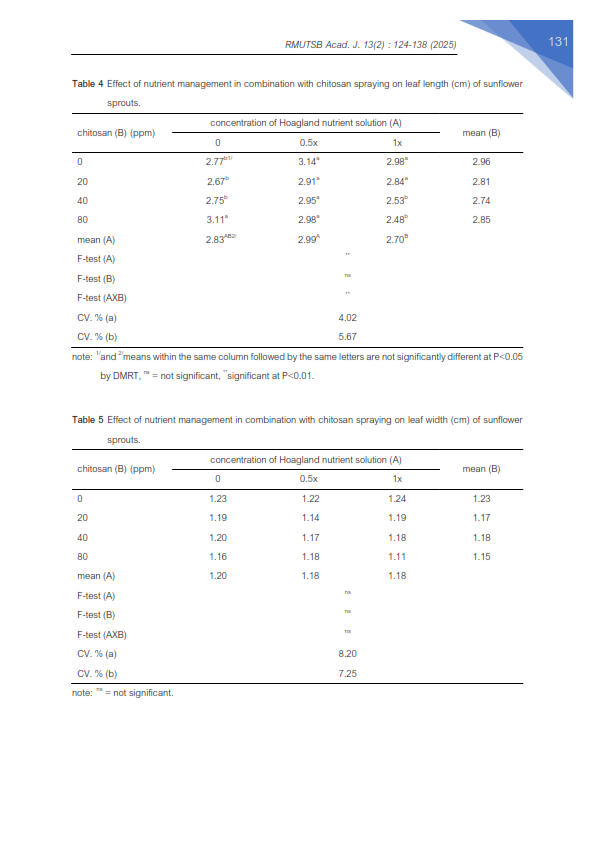
Hydroponic sunflower sprouts production using nutrient management resulted in an increased yield and nutritional value. This research was conducted to study the optimal concentration of Hoagland nutrient solution combined with chitosan spraying on germination, yield, and nutritional value of sunflower sprouts. The experiment was designed using a split-plot in a randomized complete block design (RCBD) with four replications. The main plot was the concentration of Hoagland nutrient solution at three levels, namely 0, 0.5x, and 1x. The sub-plot was chitosan at four levels, namely 0, 20, 40 and 80 ppm. The results showed that different concentrations of Hoagland nutrient solution did not affect the germination, speed of germination, leaf width, fresh weight and carotenoid content. However, these solutions caused significant differences in shoot length, leaf length, phenolic compound content and antioxidant activity. Hoagland solution 1x caused higher shoot length and antioxidant activity than other concentrations. Meanwhile, spraying with different concentrations of chitosan did not cause significant differences in germination, speed of germination, shoot length, leaf length and width, and antioxidant activity. However, chitosan caused significant differences in fresh weight, phenolic compound and carotenoid contents. Spraying with 80 ppm chitosan caused higher fresh weight and phenolic compound content than other concentrations. Therefore, growing sunflower seedlings in Hoagland 1x solution and spraying with 80 ppm chitosan would increase speed of germination, yield, phenolic compound content, and antioxidant activity.
Article Details

This work is licensed under a Creative Commons Attribution-NonCommercial-NoDerivatives 4.0 International License.
Published manuscript are the rights of their original owners and RMUTSB Academic Journal. The manuscript content belongs to the authors' idea, it is not the opinion of the journal's committee and not the responsibility of Rajamangala University of Technology Suvarnabhumi
References
Baker, K. F., & Cook, R. J. (1974). Biological control of plant pathogens. San Francisco, CA: W.H. Freeman and Company.
Boonlertnirun, S., Suvannasara, R., Boonlertnirun, K., & Promsomboon, P. (2013). Effect of chitosan spraying on rice yield potential under drought stress at various growth stages. RMUTSB Academic Journal, 1(1), 30-40. https://li01.tci-thaijo.org/index.php/rmutsb-sci/article/view/98182 (in Thai)
Chainan, C., & Wongruang, S. (2009). Effect of chitosan on seed germination of rice (cv. Luang San Pah-Tawng) and inhibition of some rice seed fungi. Thai Science and Technology Journal, 17(1), 78-84. https://li01.tci-thaijo.org/index.php/tstj/article/view/15042/13798 (in Thai)
Fayezizadeh, M. R., Ansari, N. A., Sourestani, M. M., & Hasanuzzaman, M. (2023). Balancing yield and antioxidant capacity in basil microgreens: An exploration of nutrient solution concentrations in a floating system. Agriculture, 13, 1691. https://doi.org/10.3390/agriculture13091691
Ganesh, K. A., Randeep, R., Shigeru, T., Masami, Y., Akihiro, K., & Hikaru, S. (2002). Chitosan activates defense/stress response(s) in the leaves of Oryza sativa seedling. Plant Physiology and Biochemistry, 40(12), 1061-1069. https://doi.org/10.1016/S0981-9428(02)01471-7
Harakotr, B., Suriharn, B., Tangwongchai, R., Scott, M. P., & Lertrat, K. (2014). Anthocyanin, phenolics and antioxidant activity changes in purple waxy corn as affected by traditional cooking. Food Chemistry, 164, 510-517. https://doi.org/10.1016/j.foodchem.2014.05.069
Harakotr, B., Jirakiattikul, Y., & Rittichai, P. (2019). Effect of biostimulants on antioxidant content and free radical scavenging capacity in microgreens of native Brassicaceae vegetables. Thai Science and Technology Journal, 27(1), 109-123. https://li01.tci-thaijo.org/index.php/tstj/article/view/172553/123818 (in Thai)
International Seed Testing Association (ISTA). (2008). International rules for seed testing. International Seed Testing Association, Bassersdorf, Switzerland.
Jirakiattikul, Y., Rittichai, P., & Jetsadakarun, K. (2013). Effect of chitosan on the proliferation of Oryza rufipogon in aseptic conditions. Thai Science and Technology Journal, 21(1), 11-18. https://li01.tci-thaijo.org/index.php/tstj/article/view/12745/11445 (in Thai)
Khanam, U. K. S., Oba, S., Yanase, E., & Murakami, Y. (2012). Phenolic acids, flavonoids, and total antioxidant capacity of selected leaf vegetables. Journal of Functional Foods, 4(4), 979-987. https://doi.org/10.1016/j.jff.2012.07.006
Kiba, A., & Sakakibara, M. (2021). Nutritional deficiencies in plant using Hoagland solution. Frontiers in Plant Science, Switzerland. 12 pp.
Knott, J. E., & Deanon, J. R. (1980). Knott’s handbook for vegetable growers (2nd ed.). Wiley.
Lizarraga-Paulin, E. G., Torres-Pacheco, L., Moreno-Martinez, E., & Miranda-Castro, S. P. (2011). Chitosan application in maize (Zea mays) to counteract the effects of abiotic stress at the seedling level. Journal of Biotechnology, 10(34), 6439-6446. https://academicjournals.org/journal/AJB/article-abstract/CC3402A34556
Lueangthanawat, S., Amkha, S., Mala, T., & Teeranitayatarn, K. (2017). The utilization of chitosan on growth and flower quality of marigold. Khon Kaen Agriculture Journal, 45(S1), 411-418. https://ag2.kku.ac.th/kaj/PDF.cfm?filename=O069%20Soi06.pdf&id=2678&keeptrack=2 (in Thai)
Misra, G., & Gibson, K. E. (2021). Characterization of microgreen growing operations and associated food safety practices. Food Protection Trends, 41(1), 56-69. https://www.foodprotection.org/members/fpt-archive-articles/2021-01-characterization-of-microgreen-growing-operations-and-associated-food-safety-practices
Munpattanakarn, A. (2024, August 25). Study of phytotoxicity of neem extract on seed germination and seedling growth. https://www.scimath.org/project-mathematics/item/5807-phytotoxicity
Nagata, M., & Yamashita, I. (1992). Simple method for simultaneous determinations of chlorophyll and carotenoids in tomato fruit. Nippon Shokuhin Kogyo Gakkaish, 39(10), 925-928. https://www.jstage.jst.go.jp/article/nskkk1962/39/10/39_10_925/_article
Phinyosri, J. (2024, August 25). The benefits of sunflower sprouts. https://news.msu.ac.th/msumagaz/smain/readpost.php?mid=547
Resh, H. M. (2013). Hydroponic food production: A definitive guidebook for the advanced home gardener and the commercial hydroponic grower. CRC Press.
Salimgandomi, S., & Shabrangi, A. (2016). The effect of chitosan on antioxidant activity and some secondary metabolites of Mentha piperita L. Journal of Pharmaceutical and Health Sciences, 4, 135-142. https://journals.iau.ir/article_527130_b3a8d1d741cc86a99277adcff5501fee.pdf
Somsamran, S. (2018). Effect of sodium chloride and chitosan on growth and antioxidant activity in sunflower sprouts (Master’s thesis). Srinakharinwirot University, Bangkok. http://ir-ithesis.swu.ac.th/dspace/bitstream/123456789/1151/1/gs582110002.pdf
Sreenualpan, S., & Aswatreerattanakul, P. (2016). Effect of chitosan on antioxidant content and resistance to blast disease in Sangyod Phatthalung rice. RMUTP Research Journal Sciences and Technology, 10(2), 114-124. https://doi.org/10.14456/jrmutp.2016.27 (in Thai)
Salachna, P., & Zawadzinska, A. (2014). Effect of chitosan on plant growth, flowering and corms yield of potted freesia. Journal of Ecological Engineering, 15(3), 97-102. https://doi.org/10.12911/22998993.1110223
Sellappan, S., Akoh, C. C., & Krewer G. (2002). Phenolic compounds and antioxidant capacity of Georgia-grown blueberries and blackberries. Journal of Agricultural and Food Chemistry, 50(8), 2432-2438. https://doi.org/10.1021/jf011097r
Sittikijyothin, W., & Cherdwongcharoensuk, D. (2011). Free radical scavenging activity of seed coat extracts of sweet and sour tamarinds. Burapha Science Journal, 16(1), 47-55. https://ojs.lib.buu.ac.th/index.php/science/article/view/7344 (in Thai)
Sun, Z., Chwen, J., Ma, J., Jiang, Y., Wang, M., Ren, G., & Chen, F. (2012). Cynarin-rich sunflower (Helianthus annuus) sprouts possess both antiglycative and antioxidant activities. Journal of Agricultural and Food Chemistry, 60(12), 3260-3265. https://doi.org/10.1021/jf300737y
Taghavi, S., Barac, T., Greenberg, B., Borremans, B., Vangronsveld, J., & Lelie, D. (2005). Horizontal gene transfer to endogenous endophytic bacteria from poplar improves phytoremediation of toluene. Applied and Environmental Microbiology, 71(12), 8500-8505. https://doi.org/10.1128/AEM.71.12.8500-8505.2005
Tandavanit, O. (2024, February 24). Sprouted sunflower seeds: High nutritional value. https://soclaimon.wordpress.com (in Thai)
Xiao, Z. G., Lester, E., Luo, Y., & Wang, Q. (2012). Assessment of vitamin and carotenoid concentrations of emerging food products: Edible microgreens. Journal of Agricultural and Food Chemistry, 60(31), 7644-7651. https://doi.org/10.1021/jf300459b
