
Arena-based queue simulation for improving delivery process management in housing development projects
Article Sidebar
Main Article Content
Abstract
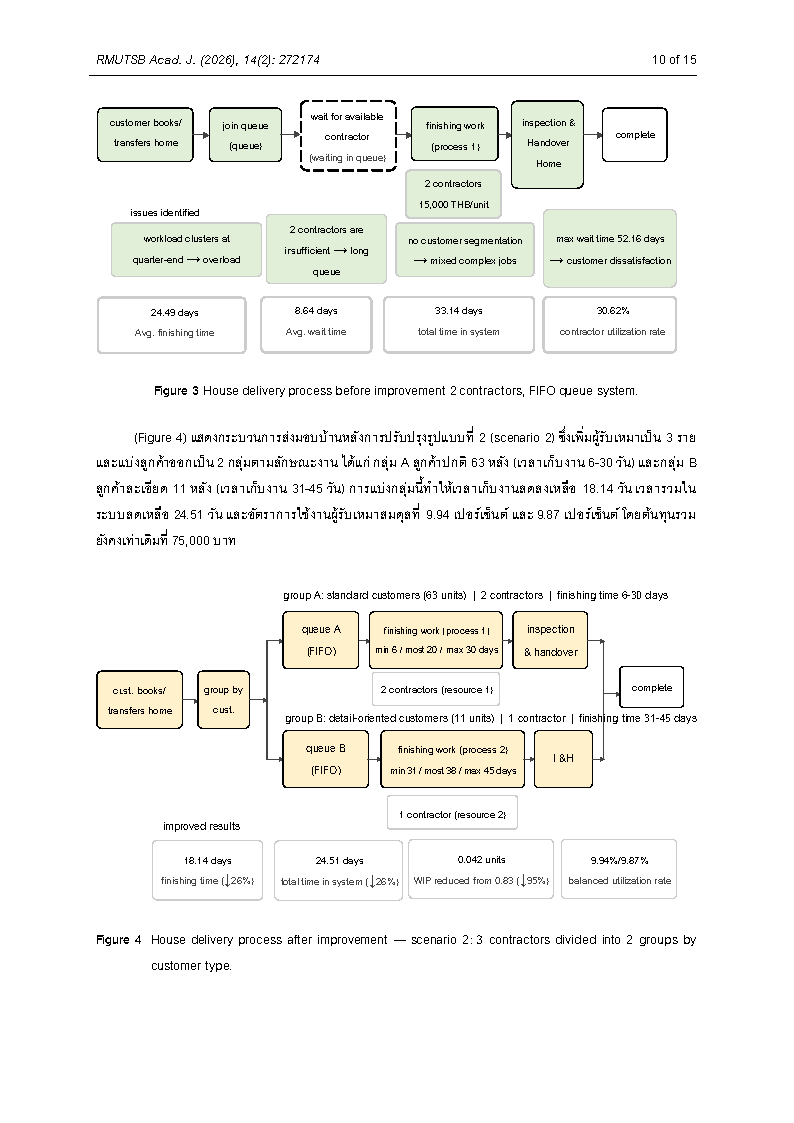
The delivery process in housing development projects exhibits queuing system characteristics, where delays directly affect customer satisfaction. This study investigated and analyzed delivery process management across four housing development projects in Bangkok and its metropolitan areas, using real data collected from 74 housing units over 12 months (January-December 2022). The primary objectives were to identify key problems and delay factors, and to evaluate improvement strategies through queueing theory-based simulation. Data analysis revealed that the main problems stem from end-of-quarter concentration of property bookings and transfers, combined with insufficient subcontractor numbers and unbalanced workload distribution, resulting in an average customer waiting time of 8.64 days and an average total time in system of 33.14 days per unit. This study applied Arena Discrete-Event Simulation (DES) with 500 replications to test two improvement scenarios: Scenario 1 — increasing the number of subcontractors from 2 to 3, and Scenario 2 — segmenting customers and subcontractors based on work complexity. Simulation results showed that Scenario 1 reduced average waiting time to 2.86 days and total system time to 25.48 days. Scenario 2 produced superior outcomes, reducing value-added activity duration to 18.14 days and total time in system to 24.51 days, while balancing subcontractor utilization at 9.94% and 9.87% respectively, with total inspection costs remaining constant at 75,000 Baht. The findings demonstrate that customer segmentation with specialized subcontractor assignment outperforms simply adding resources, and the simulation framework can be applied to other real estate projects with similar operational characteristics.
Article Details

This work is licensed under a Creative Commons Attribution-NonCommercial-NoDerivatives 4.0 International License.
Published manuscript are the rights of their original owners and RMUTSB Academic Journal. The manuscript content belongs to the authors' idea, it is not the opinion of the journal's committee and not the responsibility of Rajamangala University of Technology Suvarnabhumi
References
Abbaspour, S., Aghsami, A., Jolai, F., & Yazdani, M. (2022). An integrated queueing-inventory-routing problem in a green dual-channel supply chain considering pricing and delivery period: A case study of construction material supplier. Journal of Computational Design and Engineering, 9(5), 1917-1951. https://doi.org/10.1093/jcde/qwac089
Altiok, T., & Melamed, B. (2007). Simulation modeling and analysis with Arena. Academic Press.
Athikulrat, K., Praisont, C., & Jangruxsakul, S. (2023). Application of factor rating for production layout selection to improve production: Case study rail joint production. RMUTSB Academic Journal, 11(2), 223-238. https://li01.tci-thaijo.org/index.php/rmutsb-sci/article/view/258628
Chen, H. M., & Huang, P. H. (2013). 3D AR-based modeling for discrete-event simulation of transport operations in construction. Automation in Construction, 33, 123-136. https://doi.org/10.1016/j.autcon.2012.09.015
Cheung, W. M., Xiao, X., Choy, K. L., & Chiu, C. H. (2022). Managing inert construction waste through queuing theory in reverse logistics network. Advanced Engineering Informatics, 52, 101585. https://doi.org/10.1016/j.aei.2022.101585
Corrotea, H., Portales, H., Amigo, L., Gatica, G., Troncoso-Palacio, A., Mondragon, D., & Ramos, M. (2024). Maintenance process analysis in a port cargo company through discrete event simulation. Procedia Computer Science, 231, 415-420. https://doi.org/10.1016/j.procs.2023.12.227
González, V., & Echaveguren, T. (2012). Exploring the environmental modeling of road construction operations using discrete-event simulation. Automation in Construction, 24, 100-110. https://doi.org/10.1016/j.autcon.2012.02.011
Ham, N. H., & Yuh, O. K. (2023). Performance analysis and assessment of BIM-based construction support with priority queuing policy. Buildings, 13(1), 153. https://doi.org/10.3390/buildings13010153
Han, J., & Lee, S. (2024). Discrete event simulation in construction engineering and management: A scientometric review of research trends and applications. Advanced Engineering Informatics, 54, 101790. https://doi.org/10.1016/j.aei.2024.101790
Hassin, R., Haviv, M., & Oz, B. (2023). Strategic behavior in queues with arrival rate uncertainty. European Journal of Operational Research, 309(1), 217-224. https://doi.org/10.1016/j.ejor.2023.01.015
Huang, Z., & Su, X. (2024). Research on M/M/1/WV queuing system with single working vacation [Preprint]. https://doi.org/10.21203/rs.3.rs-3948469/v1
Kim, J. W., Ham, N., & Kim, J. J. (2021). Quantitative analysis of waiting length and waiting time for frame construction work activities using a queue model: Focusing on Korean apartment construction. Sustainability, 13(7), 3778. https://doi.org/10.3390/su13073778
Kim, J., Park, S., & Lee, H. (2023). Equilibrium analysis of partially observable priority queuing systems. European Journal of Operational Research, 312(2), 589-602. https://doi.org/10.1016/j.ejor.2023.06.021
Kittidecha, C., Saramath, S., & Narapinij, P. (2023). Plant layout improvement of the stainless-steel cookware manufacturing using CORELAP and graph-based method. RMUTSB Academic Journal, 11(1), 110-122. https://li01.tci-thaijo.org/index.php/rmutsb-sci/article/view/257060
Naeimi Rad, M., & Maghrebi, M. (2024). Bi-level integration of discrete-event simulation (DES) and social force modeling (SFM) for construction labor productivity. Automation in Construction, 160, 105317. https://doi.org/10.1016/j.autcon.2024.105317
Rockwell Automation. (2024). Arena simulation software (Version 24.1) [Computer software]. https://www.arenasimulation.com
Shiji, P., Rangaswamy, K., & Chandramohan, A. (2021). Resource utilization analysis of highway projects using ARENA. Malaysian Journal of Civil Engineering, 33(2), 47-55. https://doi.org/10.11113/mjce.v33.16846
Su, T. S., & Chang, L. M. (2019). Development of the construction scheduling based on fuzzy discrete event simulation for a TFT-LCD plant. Procedia Manufacturing, 38, 1130-1137. https://doi.org/10.1016/j.promfg.2020.01.201
Tao, Y., Hu, H., Xue, J., Zhang, Z., & Xu, F. (2024). Evaluation of ergonomic risks for construction workers based on multicriteria decision framework with the integration of spherical fuzzy set and alternative queuing method. Sustainability, 16(10), 3950. https://doi.org/10.3390/su16103950
Teknomo, K. (2012a). Application of queuing theory in construction management. In D. Hardjito, A. Antoni, & I. Muljati (Eds.). Developments in structural engineering and construction technology (pp. 76-88). Petra Christian University.
Teknomo, K. (2012b). Queuing rule of thumb based on M/M/s queuing theory with applications in construction management. Civil Engineering Dimension, 14(3), 139-146. https://doi.org/10.9744/ced.14.3.139-146
Usmanov, V., & Jarský, C. (2023). Application of queuing theory in construction industry. Department of Construction Technology, FCE, CTU Prague.
Wee, K., Ham, N., & Kim, J. J. (2022). Microscopical resource allocation for large-scale apartment foundation work using queuing systems. Buildings, 12(2), 89. https://doi.org/10.3390/buildings12020089
Zeng, M., Zhao, D., Yang, L., Lu, Y., Shi, L., & Zhao, H. (2021). Research on the impact of crowd queuing behavior on construction personnel evacuation. E3S Web of Conferences, 261, 03045. https://doi.org/10.1051/e3sconf/202126103045
Zhang, H., & Lin, Y. (2023). Modeling and evaluation of ergonomic risks and controlling plans through discrete-event simulation. Automation in Construction, 152, 104920. https://doi.org/10.1016/j.autcon.2023.104920
