การศึกษาสภาวะของการสกัดชาต่อฤทธิ์ต้านอนุมูลอิสระและปริมาณฟีนอลิกรวม เพื่อพัฒนาผลิตภัณฑ์ชาใบหม่อนและชาผลหม่อนพร้อมดื่ม
Article Sidebar
Main Article Content
บทคัดย่อ
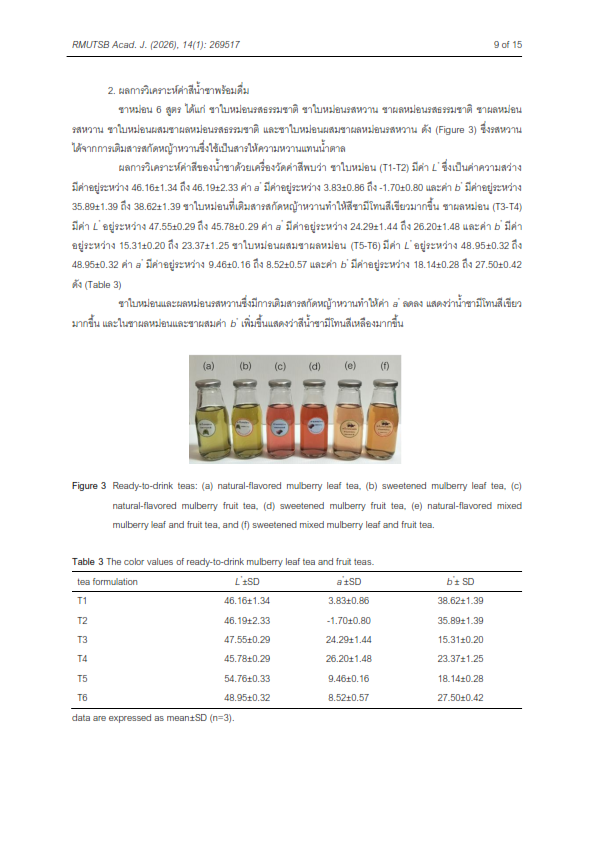
วัตถุประสงค์ของงานวิจัยนี้คือการพัฒนาผลิตภัณฑ์เครื่องดื่มชาใบหม่อนและผลหม่อน (Morus alba L.) ที่ปลูกในจังหวัดลพบุรี โดยศึกษาสภาวะที่เหมาะสมในการเตรียมเครื่องดื่มชาหม่อนพร้อมดื่มเพื่อสุขภาพ ซึ่งสภาวะที่ศึกษาคือผลของระยะเวลาการสกัดและอุณหภูมิในการสกัดที่มีผลต่อฤทธิ์การต้านอนุมูลอิสระและปริมาณฟีนอลิกรวมของน้ำชาที่มาจากชาใบหม่อน ชาผลหม่อน และชาใบหม่อนผสมชาผลหม่อน ผลการทดลองพบว่าสภาวะที่เหมาะสมในการสกัดชาใบหม่อนคืออุณหภูมิ 100±0.50 องศาเซลเซียส เป็นเวลา 3 นาที และสภาวะที่เหมาะสมในการสกัดชาผลหม่อนคืออุณหภูมิ 100±0.50 องศาเซลเซียส เป็นเวลา 10 นาที ซึ่งฤทธิ์การต้านอนุมูลอิสระของชาใบหม่อนที่ได้จากการศึกษาด้วยวิธี DPPH และ ABTS มีค่าเท่ากับ 273.53±1.96 AAE ต่อกรัมชา และ 15.18±0.11 TEAC ต่อกรัมชา ตามลำดับ และมีปริมาณฟีนอลิกรวม 183.69±1.52 GAE ต่อกรัมชา ส่วนฤทธิ์การต้านอนุมูลอิสระของชาผลหม่อน (100±0.50 องศาเซลเซียส 10 นาที) ที่ได้จากการศึกษาด้วยวิธี DPPH และ ABTS มีค่าเท่ากับ 256.71±1.25 AAE ต่อกรัมชา และ 11.57±0.34 TEAC ต่อกรัมชา ตามลำดับ และมีปริมาณฟีนอลิกรวม 98.18±2.86 GAE ต่อกรัมชา ดังนั้นจึงใช้สภาวะการสกัดชานี้เพื่อเตรียมชาใบหม่อน ชาผลหม่อน และชาใบหม่อนผสมชาผลหม่อนพร้อมดื่มรสธรรมชาติและรสหวานโดยเติมสารสกัดหญ้าหวาน จากการวิเคราะห์ค่าสีชาพร้อมดื่มด้วยเครื่องวัดค่าสีพบว่าชาแต่ละสูตรมีค่าสีที่แตกต่างกัน และผลการศึกษาการเก็บรักษาผลิตภัณฑ์ชาพร้อมดื่มในตู้เย็นอุณหภูมิ 4 องศาเซลเซียส พบว่าสามารถเก็บรักษา 2 สัปดาห์
Article Details

อนุญาตภายใต้เงื่อนไข Creative Commons Attribution-NonCommercial-NoDerivatives 4.0 International License.
ต้นฉบับที่ได้รับการตีพิมพ์ถือเป็นสิทธิของเจ้าของต้นฉบับและของวารสารวิชาการ มทร.สุวรรณภูมิ เนื้อหาบทความในวารสารเป็นแนวคิดของผู้แต่ง มิใช่เป็นความคิดเห็นของคณะกรรมการการจัดทำวารสาร และมิใช่ความรับผิดชอบของมหาวิทยาลัยเทคโนโลยีราชมงคลสุวรรณภูมิ
เอกสารอ้างอิง
Buhrman, K., Aravena-Calvo, J., Ross Zaulich, C., Hinz, K., & Laursen, T. (2022). Anthocyanic vacuolar inclusions: From biosynthesis to storage and possible applications. Frontiers in Chemistry, 10, 913324. https://doi.org/10.3389/fchem.2022.913324
Chansataporn, W., Chaitaweep, Y., Dawruang, C., Srahongthong, P., Rakmaelamao, S., & Jirasatid, S. (2025). Development of a reduced-sugar banana and passion fruit jam substituted with stevia as a health-oriented product. Journal of Health and Food Creation, 3(1), 1-12. https://he03.tci-thaijo.org/index.php/JHFC/article/view/4311 (in Thai)
Chen, T., Shuang, F. F., Fu, Q. Y., Ju, Y. X., Zong, C. M., Zhao, W. G., Zhang, D. Y., Yao, X. H., & Cao, F. L. (2022). Evaluation of the chemical composition and antioxidant activity of mulberry (Morus alba L.) fruits from different varieties in China. Molecules, 27, 2688. https://doi.org/10.3390/molecules27092688
Halee, A., & Rattanapun, B. (2017). Study of antioxidant efficacies of 15 local herbs. KMUTT Research & Development Journal, 40(2), 283-293. https://www.thaiscience.info/journals/Article/KMIT/10985073.pdf (in Thai)
He, X., Fang, J., Ruan, Y., Wang, X., Sun, Y., Wu, N., Zhao, Z., Chang, Y., Ning, N., Guo, H., & Huang, L. (2018). Structures, bioactivities and future prospective of polysaccharides from Morus alba (white mulberry): A review. Food Chemistry, 245, 899-910. https://doi.org/10.1016/j.foodchem.2017.11.084
Kattil, A., Hamid, Dash, K. K., Shams, R., & Sharma, S. (2024). Nutritional composition, phytochemical extraction, and pharmacological potential of mulberry: A comprehensive review. Future Foods, 9, 100295. https://doi.org/10.1016/j.fufo.2024.100295
Khruithong, P. (2025). Evaluation of chiffon cake quality using stevia as a sugar substitute. Proceedings of the 15th Benjamit National and International Conference (pp. 654-662). https://benjamit.thonburi-u.ac.th/ojs/bmv15/article/view/388 (in Thai)
Klongdee, S. (2015). Stevia: Natural sweetener in low calorie food products. Food, 45(4), 53-56. https://kukr.lib.ku.ac.th/BKN/Detail/info/20000877 (in Thai)
Kowalska, J., Marzec, A., Domian, E., Galus, S., Ciurzynska, A., Brzezinska, R., & Kowalska, H. (2021). Influence of tea brewing parameters on the antioxidant potential of infusions and extracts depending on the degree of processing of the leaves of Camellia sinensis. Molecules, 26(16), 4773. https://doi.org/10.3390/molecules26164773
Liu, Y., Luo, L., Liao, C., Chen, L., Wang, J., & Zeng, L. (2018). Effects of brewing conditions on the phytochemical composition, sensory qualities and antioxidant activity of green tea infusion: A study using response surface methodology. Food Chemistry, 269, 24-34. https://doi.org/10.1016/j.foodchem.2018.06.130
Ma, L., Xiao, G., Wu, J., Wen, J., Bu, Z., & Tang, D. (2020). Nutritional value and processing technology of mulberry fruit products (pp. 21-39). CRC Press. https://doi.org/10.1201/9780429286476-2
Manthong, N., Wilairat, P., Nacapricha, D., & Chaneam, S. (2019). Simultaneous colorimetric measurements of antioxidant capacity by flow injection analysis with paired emitter detector diode. Analytical Sciences, 35, 535-541. https://doi.org/10.2116/analsci.18P512
Maqsood, M., Saeed, R. A., Sahar, A., & Khan, M. I. (2022). Mulberry plant as a source of functional food with therapeutic and nutritional applications: A review. Journal of Food Biochemistry, 46(11), e14263. https://doi.org/10.1111/jfbc.14263
Matthayom, W., Nochai, K., KoKaew, K., Pisapak, K., & Robmuang, D. (2020). Investigation of antioxidant capacity and antioxidant activity of Ma-huad (Lepisanthes rubiginosa (Roxb.) Leenh.) juice. RMUTSB Academic Journal, 8(2), 187-198. https://li01.tci-thaijo.org/index.php/rmutsb-sci/article/view/242052 (in Thai)
Methaakkharadecha, N., & Srisopa, A. (2020). Phenolic contents and antioxidant activities of mulberry leaf tea and water soluble mulberry leaf tea powder. Thai Journal of Science and Technology, 9(2), 230-242. https://li01.tci-thaijo.org/index.php/tjst/article/view/240003 (in Thai)
Ministry of Public Health. (2021). Notification of the ministry of public health No. 426 B.E. 2564 (2021) Re: Herbal tea. Royal Thai Government Gazette. https://food.fda.moph.go.th/food-law/announ-moph-426 (in Thai)
Pérez-Burillo, S., Giméneza, R., Rufián-Henaresa, J. A., & Pastoriza, S. (2018). Effect of brewing time and temperature on antioxidant capacity and phenols of white tea: Relationship with sensory properties. Food Chemistry, 248, 111-118. https://doi.org/10.1016/j.foodchem.2017.12.056
Peng, S., Cui, Y., Yu, M., Song, M., Tian, Z., Deng, D., Liu, Z., & Ma, X. (2024). Effect of fermented mulberry leaves on gut health of finishing pigs. Animals, 14(19), 2911. https://doi.org/10.3390/ani14192911
Phansi, P., Sura, J., & Duangsrikaew, K. (2023). Study on antioxidant and antibacterial activity of mulberry leaf tea extract soap and mulberry leaf tea extract mixed with turmeric soap. RMUTP Research Journal, 17(2), 115-125. https://doi.org/10.14456/jrmutp.2023.26 (in Thai)
Phansi, P., Tumma, P., Thuankhunthod, C., Danchana, K., & Cerdà., V. (2021). Development of a digital microscope spectrophotometric system for determination of the antioxidant activity and total phenolic content in teas. Analytical Letters, 54(17), 2727-2735. https://doi.org/10.1080/00032719.2021.1886304
Pimrote, K., Teekayu, K., & Sudprasert, P. (2020). Antioxidant activity and inhibition effect on Pseudomonas aeruginosa of extracts from Pa-Yom (Shorea roxburghii G. Don). RMUTSB Academic Journal, 8(1), 15-27. https://li01.tci-thaijo.org/index.php/rmutsb-sci/article/view/222407 (in Thai)
Posawang, S., Khunkrai, P., Tongkhaw, K., Saenphom, C., Sripinta, P., Insung, L., & Nosuwan, S. (2020). Comparative study on botany and biochemical characteristics of Stevia rebaudiana bertoni. Journal of Agricultural Production, 2(1), 67-78. https://li01.tci-thaijo.org/index.php/japmju/article/view/241831 (in Thai)
Potu, R. B., Nagalakshmi, D., Venkateswarlu, M., Rama Rao, S. V., Swathi, B., & Prashanth Kumar, K. (2023). Effect of inclusion of Morus alba (Mulberry) leaves at varying levels in concentrate mixtures on total phenols, non-tannin phenols, tannins content and DPPH radical scavenging activity. The Pharma Innovation Journal, 12(7), 53-57. https://www.thepharmajournal.com/special-issue?ArticleId=21215&issue=7S&vol=12&year=2023&utm_source=chatgpt.com
Sakthivel, M. A., & Kumar, S. R. (2025). Stevia (Stevia rebaudiana Bertoni): Sweet medicine for a healthier world. Journal of Agriculture and Food Research, 21, 101980. https://doi.org/10.1016/j.jafr.2025.101980
Sánchez-Salcedo, E. M., Mena, P., García-Viguera, C., Hernández, F., & Martínez, J. J. (2015). (Poly)phenolic compounds and antioxidant activity of white (Morus alba) and black (Morus nigra) mulberry leaves: Their potential for new products rich in phytochemicals. Journal of Functional Foods, 18, 1039-1046. http://dx.doi.org/10.1016/j.jff.2015.03.053
Sourri, P., Tassou, C. C., Nychas, G. J. E., & Panagou, E. Z. (2022). Fruit juice spoilage by alicyclobacillus: Detection and control methods-a comprehensive review. Foods, 11(5), 747. https://doi.org/10.3390/foods11050747
Thai Industrial Standards Institute. (2015). Community product standard: Tea, TIS 120/2015. Ministry of Industry. https://tcps.tisi.go.th/pub/tcps0120_58(%e0%b8%8a%e0%b8%b2).pdf (in Thai)
The Queen Sirikit Institute of Sericulture. (2014). Mulberry leaf tea for industrial production. Office of the Permanent Secretary, Ministry of Agriculture and Cooperatives. https://qsds.go.th/wp-content/uploads/2017/pdf/2014-04-10-M1.pdf
Wang, B., Jia, Y., Li, Y., Wang, Z., Wen, L., He, Y., & Xu, X. (2023). Dehydration-rehydration vegetables: Evaluation and future challenges. Food Chemistry: X, 20, 100935. https://doi.org/10.1016/j.fochx.2023.100935
Wanyo, P., Chamsai, T., & Chomnawang, C. (2025). Enhancing bioactivity and bioaccessibility of mulberry leaf tea: the influence of pretreatment and kombucha fermentation. ACS Food Science & Technology, 5(3), 999-1009. https://doi.org/10.1021/acsfoodscitech.4c00769
Xuan, D., Wang, B., Zhou, Z., Chen, D., Wu, Q., Ye, S., Wang, L., & Ding, Y. (2025). Exploring the elegance and health secrets of mulberry leaf tea: A comprehensive study on decoding the aroma and flavor of mulberry leaf oolong tea and predicting its efficacy against fatty liver disease. Food Bioscience, 68, 106475. https://doi.org/10.1016/j.fbio.2025.106475
Xu, D. P., Li, Y., Meng, X., Zhou, T., Zhou, Y., Zheng, J., Zhang, J. J., & Li, H. B. (2017). Natural antioxidants in foods and medicinal plants: Extraction, assessment and resources. International Journal of Molecular Sciences, 18(1), 96. https://doi.org/10.3390/ijms18010096
Yuan, Q., & Zhao, L. (2017). The mulberry (Morus alba L.) fruit a review of characteristic components and health benefits. Journal of Agricultural and Food Chemistry, 65(48), 10383. https://doi.org/10.1021/acs.jafc.7b03614
Zhang, H., Ma, Z. F., Luo, X., & Li, X. (2018). Effects of mulberry fruit (Morus alba L.) consumption on health outcomes: A mini-review. Antioxidants, 7(5), 69. https://doi.org/10.3390/antiox7050069
