
การตอบสนองทางกายวิภาคของรากและสรีรวิทยาในอ้อยลูกผสมข้ามต่อสภาวะที่จำลองความเครียดแล้งในระบบการผลิตอ้อยช่วงต้นฤดูฝน
Article Sidebar
Main Article Content
บทคัดย่อ
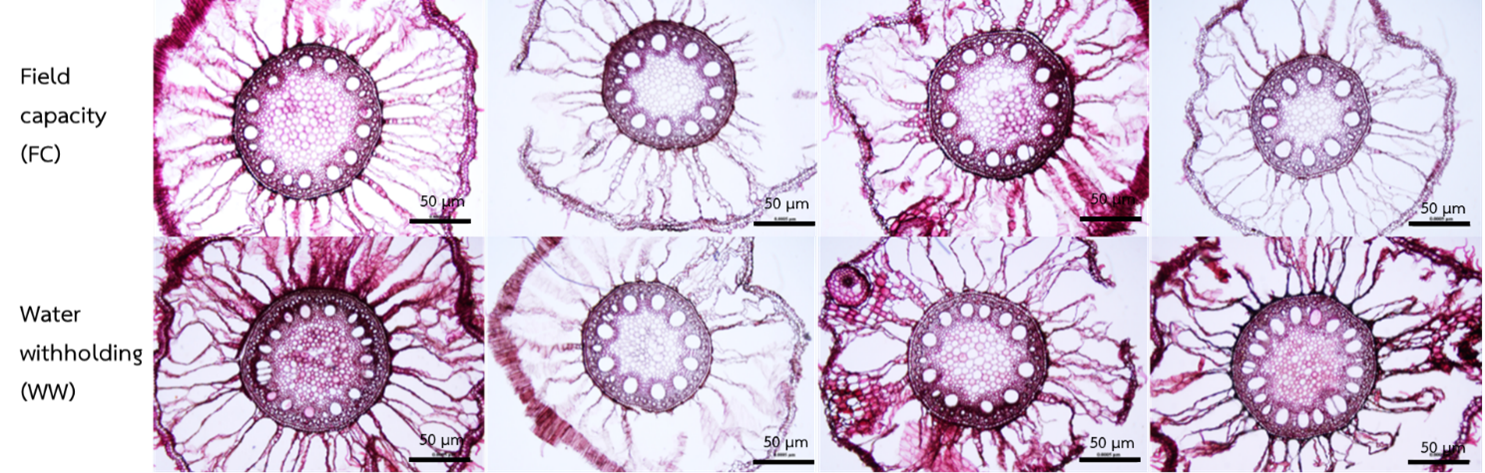
อ้อยลูกผสมข้ามช่วยเพิ่มความหลากหลายทางพันธุกรรมและความสามารถในการทนแล้ง การศึกษานี้มีวัตถุประสงค์เพื่อประเมินลักษณะทางกายวิภาคของราก และลักษณะทางสรีรวิทยาของอ้อยลูกผสมกลับชั่วรุ่นที่ 1 (backcross 1; BC1) ที่ทนทานต่อความแห้งแล้งแตกต่างกัน ดำเนินการทดลองในสภาพกระถางแบบ 2 × 4 Factorial in RCBD โดยปัจจัย A คือ การจัดการให้น้ำ 2 ระดับ ได้แก่ 1) ให้น้ำและควบคุมความชื้นดินที่ระดับความจุความชื้นระดับสนาม และ 2) ขาดน้ำช่วงต้นการเจริญเติบโตยาวนาน 18 วัน (ช่วง 30-48 วันหลังย้ายปลูก) และปัจจัย B คือ อ้อยลูกผสมกลับชั่วรุ่นที่ 1 จำนวน 4 โคลนพันธุ์ ได้แก่ BC1-21 BC1-44 BC1-50 และ BC1-63 พบว่า BC1-44 มีความสามารถในการรักษาการเจริญเติบโตและสรีรวิทยาได้ดีกว่าโคลนพันธุ์อื่น โดยแสดงค่าดัชนีความทนแล้งสูง (DTI) ทั้งในลักษณะจำนวนหน่อ อัตราการสังเคราะห์แสง ค่าความเขียวเข้มของสีใบ และการคายน้ำ พบว่า BC1-44 มีความยาวราก พื้นที่ผิวสัมผัส ปริมาตรของรากสูงกว่าพันธุ์อื่นๆ และลักษณะกายวิภาคของรากที่เอื้อต่อการลำเลียงน้ำ เช่น มีจำนวนท่อไซเล็มมาก ขนาดของมัดท่อลำเลียงในบริเวณโคนรากและปลายรากที่มีขนาดเล็ก ซึ่งจะช่วยสนับสนุนการปรับปรุงพันธุ์อ้อยลูกผสมข้ามชนิดให้ทนทานต่อความแห้งแล้งในช่วยต้นของการเจริญเติบโตในระบบการผลิตอ้อยช่วงต้นฤดูฝนให้มีประสิทธิภาพมากขึ้นได้
Article Details

อนุญาตภายใต้เงื่อนไข Creative Commons Attribution-NonCommercial-NoDerivatives 4.0 International License.
Journal of TCI is licensed under a Creative Commons Attribution-NonCommercial-NoDerivatives 4.0 International (CC BY-NC-ND 4.0) licence, unless otherwise stated. Please read our Policies page for more information...
เอกสารอ้างอิง
Basnayake, J., Jackson, P. A., & Inman-Bamber, N. G. (2012). Phenotyping sugarcane for drought response. Field Crops Research, 134, 146–157.
Budeguer, F., Enrique, R., Perera, M. F., Racedo,, J., Castagnaro, A. P., Noguera, A. S., & Welin, J. (2021): Genetic transformation of sugarcane, current status and future prospects. Frontiers in Plant Science, 12, 768609 doi.org/10.3389/fpls.2021.768609
FAO. (2020). Soil testing methods global soil doctors programme a farmer-to-farmer training program. https://openknowledge.fao.org /server/api/core/bitstreams /a673cac1-636c-486b-b4c5-a39d522b659f/content.
Fonta, J. E., Giri, J., Vejchasarn, P., Lynch, J. P., & Brown, K. M. (2022). Spatiotemporal responses of rice root architecture and anatomy to drought. Plant and Soil, 479, 443–464.
Khonghintaisong, J., Songsri, P., & Jongrungklang, N. (2023). Comparison of physiological, anatomical, and morphological traits between sugarcane hybrids and their parents with different stalk dry weights in the early growth stage under hydroponic conditions. Agriculture, 13(12), 2234.
Meena, M.R., R. Kumar, K. Ramaiyan, M.L. Chhabra, A.K. Raja, M. Krishnasamy, N. Kulshreshtha, S.K. Pandey, and B. Ram. (2020). Biomass potential of novel interspecific and intergeneric hybrids of Saccharum grown in subtropical climates. Scientific Reports, 10, 21560
Northeastern Meteorological Center. (2023). Daily rainfall in the Northeastern region. http://www.khonkaen. tmd.go.th/Home.php
Office of the Cane and Sugar Board. (2020). Sustainable Sugarcane Farming Guide. https:// www.ocsb.go.th/wp-content/uploads/2023/03/144-7354.pdf.
Ouyang, W., Yin, X., Yang, J., & Struik, P. C. (2020). Comparisons with wheat reveal root anatomical and histochemical constraints of rice under water-deficit stress. Plant Soil, 452, 547–568.
Ratnam, J., Anuradha, G., & Prasad, T. G. (2021). Screening of sugarcane clones for drought tolerance using physiological and morphological traits. Sugar Tech, 23(4), 512–521.
Robertson, M. J., Muchow, R.C., Donalson, R.A., Inman-Bamber, N. G., & Wood, A.W. (1999). Estimating the risk associated with drying-off strategies for irrigated sugarcane before harvest. Australian Journal of Agricultural and Resource Economics, 50, 65–77
Siangliw, J. L., Thunnom, B., Natividad, M. A., Quintana, M. R., Chebotarov, D., McNally, K. L., Lynch, J. P., Brown, K. M., & Henry, A. (2022). Response of Southeast Asian rice root architecture and anatomy phenotypes to drought stress. Frontiers in Plant Science, 13, 1008954.
Silva, M. A., Jifon, J. L., Silva, J. A. G., & Sharma, V. (2018). Drought stress effects on sugarcane physiology and growth parameters. Agricultural Water Management, 203, 290–296.
Tippa-art, M, Klomsa-ard, P, Songsri, P, & Jongrungklang, N. (2025). Effects of intermittent drought during tillering and stalk elongation stages on the physiological attributes of diverse sugarcane genotypes. Stresses, 5(1), 1
Tippayawat, A., Jogloy, S., Vorasoot, N., Songsri, P., Kimbeng, C. A., Jifon, J. A., Janket, A., Thangthong, N., & Jongrungklang, N. (2023). Differential physiological responses to different drought durations among a diverse det of dugarcane genotypes. Agronomy, 13(10), 259
Wiangwiset, K., Dermail, A., Piwpuan, N., Songsri, P., & Jongrungklang, N. (2023). Diversity and heterosis of leaf anatomical traits in backcross 1 (BC1) derived from interspecific hybridization between commercial cane (Saccharum spp. hybrid) and wild type (S. spontaneum). Agronomy, 13, 2457
Wirojsirasak, W., Songsri, P., Jongrungklang, N., Tangphatsornruang, S., Klomsa-ard, P., & Ukoskit, K. (2024). Determination of morpho physiological traits for assessing drought tolerance in sugarcane. Plants, 13, 1072.
