
Root Anatomical and Physiological Responses of Interspecific Sugarcane Hybrids to Simulated Drought Stress in Early Rainy Season Sugarcane Production Systems
Article Sidebar
Main Article Content
Abstract
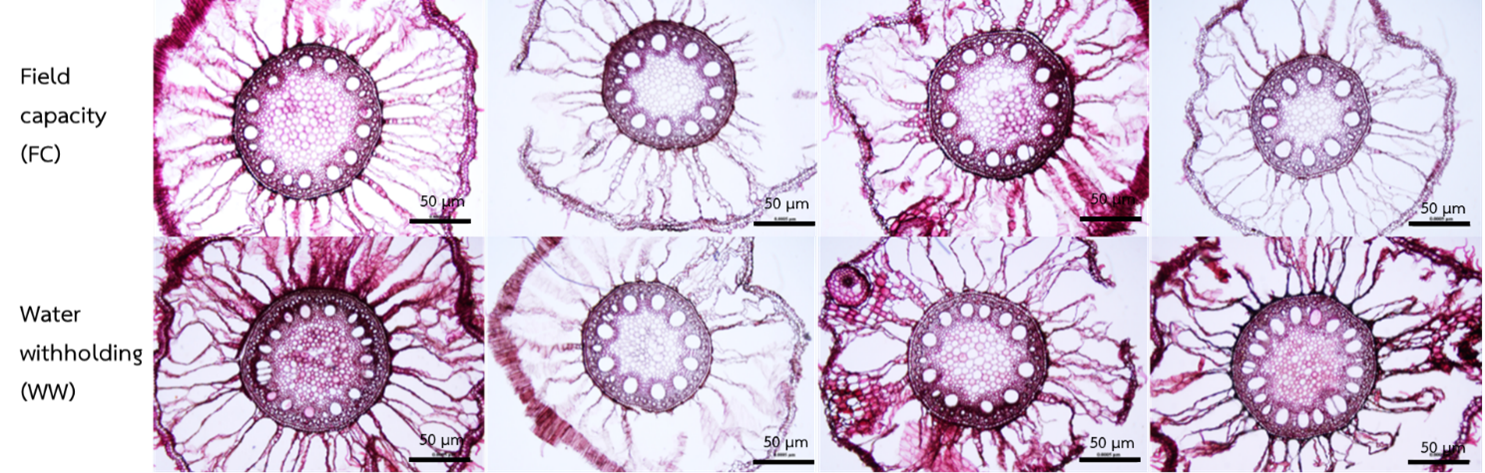
Interspecific hybrid sugarcane results from crosses between commercial sugarcane and wild sugarcane (Saccharum spontaneum), which enhances genetic diversity and drought tolerant capacity. This study aimed to evaluate root anatomical characteristics and physiological traits of BC1 sugarcane clones with varying degrees of drought tolerance. The experiment was conducted under pot conditions using a 2 × 4 factorial design in a randomized complete block design (RCBD). Factor A consisted of two water management levels: 1) well-watered with soil moisture maintained at field capacity, and 2) water-withholding during early growth for 18 days (30-48 days after transplanting). Factor B comprised four BC1 sugarcane clones: BC1-21, BC1-44, -tolerant clone BC1-50 and BC1-63 -susceptible clone. BC1-44 exhibited superior capacity to maintain growth and physiological functions compared to other clones, displaying high drought tolerant indices across multiple parameters including tiller number, photosynthetic rate, SPAD chlorophyll meter reading (SCMR), and transpiration rate. Root characteristics revealed particularly BC1-44, possessed greater root length, surface area, and volume compared to other genotypes. Additionally, this clone exhibited root anatomical features conducive to water transport efficiency, including abundant xylem vessels and appropriately sized vascular bundles at both the basal and distal regions of the root. In contrast, the susceptible clone BC1-63 demonstrated fewer but larger xylem vessels and lower drought tolerant index (DTI) values in certain characteristics. The understanding in the differential response of these clones will support the improvement of interspecific hybrid sugarcane breeding programs to enhance drought tolerance during early growth stages, thereby increasing the efficiency of sugarcane production systems during the early rainy season.
Article Details

This work is licensed under a Creative Commons Attribution-NonCommercial-NoDerivatives 4.0 International License.
บทความในวารสารเกษตรนเรศวรที่ได้รับการตีพิมพ์ เป็นลิขสิทธิ์ของ คณะเกษตรศาสตร์
ข้อความที่ปรากฏในบทความแต่ละเรื่องในวารสารนี้เป็นความคิดเห็นส่วนตัวของผู้เขียนแต่ละท่านไม่เกี่ยวข้องกับคณะเกษตรศาสตต์ฯ
References
Basnayake, J., Jackson, P. A., & Inman-Bamber, N. G. (2012). Phenotyping sugarcane for drought response. Field Crops Research, 134, 146–157.
Budeguer, F., Enrique, R., Perera, M. F., Racedo,, J., Castagnaro, A. P., Noguera, A. S., & Welin, J. (2021): Genetic transformation of sugarcane, current status and future prospects. Frontiers in Plant Science, 12, 768609 doi.org/10.3389/fpls.2021.768609
FAO. (2020). Soil testing methods global soil doctors programme a farmer-to-farmer training program. https://openknowledge.fao.org /server/api/core/bitstreams /a673cac1-636c-486b-b4c5-a39d522b659f/content.
Fonta, J. E., Giri, J., Vejchasarn, P., Lynch, J. P., & Brown, K. M. (2022). Spatiotemporal responses of rice root architecture and anatomy to drought. Plant and Soil, 479, 443–464.
Khonghintaisong, J., Songsri, P., & Jongrungklang, N. (2023). Comparison of physiological, anatomical, and morphological traits between sugarcane hybrids and their parents with different stalk dry weights in the early growth stage under hydroponic conditions. Agriculture, 13(12), 2234.
Meena, M.R., R. Kumar, K. Ramaiyan, M.L. Chhabra, A.K. Raja, M. Krishnasamy, N. Kulshreshtha, S.K. Pandey, and B. Ram. (2020). Biomass potential of novel interspecific and intergeneric hybrids of Saccharum grown in subtropical climates. Scientific Reports, 10, 21560
Northeastern Meteorological Center. (2023). Daily rainfall in the Northeastern region. http://www.khonkaen. tmd.go.th/Home.php
Office of the Cane and Sugar Board. (2020). Sustainable Sugarcane Farming Guide. https:// www.ocsb.go.th/wp-content/uploads/2023/03/144-7354.pdf.
Ouyang, W., Yin, X., Yang, J., & Struik, P. C. (2020). Comparisons with wheat reveal root anatomical and histochemical constraints of rice under water-deficit stress. Plant Soil, 452, 547–568.
Ratnam, J., Anuradha, G., & Prasad, T. G. (2021). Screening of sugarcane clones for drought tolerance using physiological and morphological traits. Sugar Tech, 23(4), 512–521.
Robertson, M. J., Muchow, R.C., Donalson, R.A., Inman-Bamber, N. G., & Wood, A.W. (1999). Estimating the risk associated with drying-off strategies for irrigated sugarcane before harvest. Australian Journal of Agricultural and Resource Economics, 50, 65–77
Siangliw, J. L., Thunnom, B., Natividad, M. A., Quintana, M. R., Chebotarov, D., McNally, K. L., Lynch, J. P., Brown, K. M., & Henry, A. (2022). Response of Southeast Asian rice root architecture and anatomy phenotypes to drought stress. Frontiers in Plant Science, 13, 1008954.
Silva, M. A., Jifon, J. L., Silva, J. A. G., & Sharma, V. (2018). Drought stress effects on sugarcane physiology and growth parameters. Agricultural Water Management, 203, 290–296.
Tippa-art, M, Klomsa-ard, P, Songsri, P, & Jongrungklang, N. (2025). Effects of intermittent drought during tillering and stalk elongation stages on the physiological attributes of diverse sugarcane genotypes. Stresses, 5(1), 1
Tippayawat, A., Jogloy, S., Vorasoot, N., Songsri, P., Kimbeng, C. A., Jifon, J. A., Janket, A., Thangthong, N., & Jongrungklang, N. (2023). Differential physiological responses to different drought durations among a diverse det of dugarcane genotypes. Agronomy, 13(10), 259
Wiangwiset, K., Dermail, A., Piwpuan, N., Songsri, P., & Jongrungklang, N. (2023). Diversity and heterosis of leaf anatomical traits in backcross 1 (BC1) derived from interspecific hybridization between commercial cane (Saccharum spp. hybrid) and wild type (S. spontaneum). Agronomy, 13, 2457
Wirojsirasak, W., Songsri, P., Jongrungklang, N., Tangphatsornruang, S., Klomsa-ard, P., & Ukoskit, K. (2024). Determination of morpho physiological traits for assessing drought tolerance in sugarcane. Plants, 13, 1072.
