
Efficiency of Plant Extracts on Evasion Behavior of Adult Maize Weevil (Sitophilus zeamais Motschulsky)
Article Sidebar
Main Article Content
Abstract
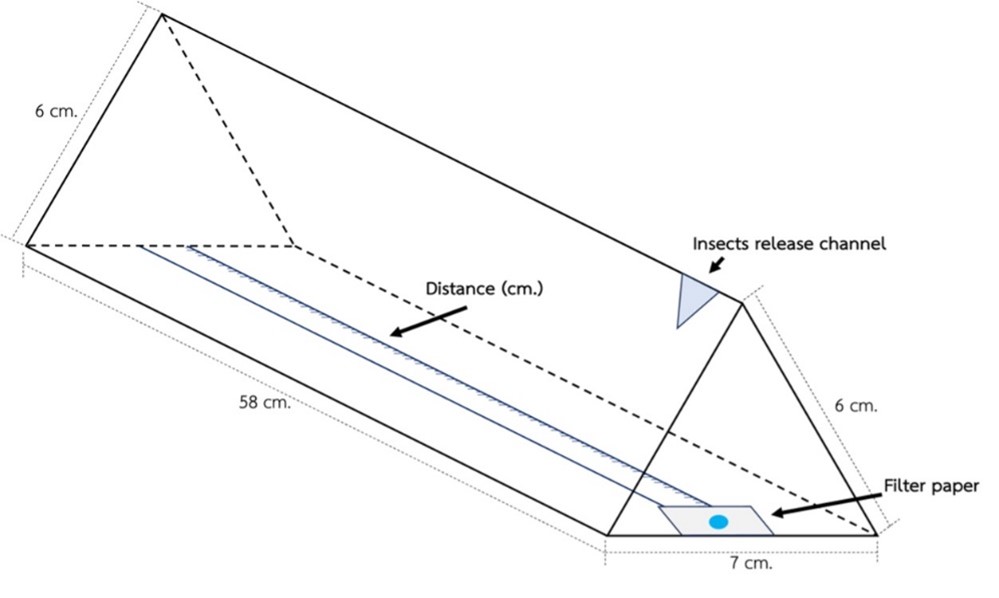
The maize weevil is a significant storage pest of rice and cereal grains. The weevil damages the grain by gnawing its surface, leading to both quality and quantity reductions during storage. This study aimed to evaluate the efficacy of plant extracts, including orange essential oil, eucalyptus essential oil, and pumpkin seedling extract at a concentration of 5%, on the evasion distance behavior of the maize weevil. The experiment was conducted in an artificial tunnel
at 58 cm The behavior and evasion distance of the maize weevils that responded most quickly
to each type of extract was recorded for 5 min. At 1, 2, 3, 4 and 5 min, the average evasion distance of maize weevils in control were 19.00±9.02, 24.40±8.05, 30.20±7.25, 28.20±8.04, and 27.40±10.59 cm, respectively. For orange essential oil treatment, the average evasion distances were 34.40±3.36, 53.80±6.26, 56.80±2.68, 58.00±0.00, and 58±00.00 cm, respectively. Eucalyptus essential oil significantly affected the evasion distances of maize weevils with average of distances of 31.00±10.46, 40.00±11.15, 50.20±12.43, 51.80±10.82, and 53.80±9.39, respectively. Pumpkin seedling extract resulted in average evasion distances of 24.20±10.42, 33.40±16.16, 32.20±9.70, 35.40±9.23, and 40.60±11.84 cm, respectively. The results of distance that maize weevils retreated from the area where the extract was applied to the end of the tunnel show that only the orange essential oil treatment resulted in the highest number of maize weevils retreating to the end of the tunnel (n=22).
Article Details

This work is licensed under a Creative Commons Attribution-NonCommercial-NoDerivatives 4.0 International License.
บทความในวารสารเกษตรนเรศวรที่ได้รับการตีพิมพ์ เป็นลิขสิทธิ์ของ คณะเกษตรศาสตร์
ข้อความที่ปรากฏในบทความแต่ละเรื่องในวารสารนี้เป็นความคิดเห็นส่วนตัวของผู้เขียนแต่ละท่านไม่เกี่ยวข้องกับคณะเกษตรศาสตต์ฯ
References
จิรวัฒน์ เอี่ยมใจดี. (2559). การศึกษาพฤติกรรมด้วงงวงข้าวโพดที่ตอบสนองต่อสารสกัดจากพืช (วิทยานิพนธ์วิทยาศาสตรมหาบัณฑิต). ภาควิชากีฏวิทยา คณะเกษตร กำแพงแสน มหาวิทยาลัยเกษตรศาสตร์.
ชวลิต จิตนันท์. (2556). ความต้านทานต่อสารรมฟอสฟีนและประสิทธิภาพของฟีโรโมนที่มีต่อสายพันธุ์ต้านทานและสายพันธุ์อ่อนแอของมอดแป้ง Tribolium castaneum (Herbst) (Coleoptera: Tenebrionidae) (วิทยานิพนธ์วิทยาศาสตรมหาบัณฑิต). มหาวิทยาลัยเกษตรศาสตร์, กรุงเทพฯ.
นันทิยา จิตธรรมมา และศิริพรรณ ตันตาคม. (2549). ประสิทธิภาพในการเป็นสารฆ่าแมลงของน้ำมันหอมระเหยจากใบยูคาลิปตัส (Eucalyptus camaldulensis Dehnh) ต่อหนอนกระทู้ผัก (Spodoptera litura Fabricius) (วิทยานิพนธ์ปริญญาวิทยาศาสตร์มหาบัณฑิต). มหาวิทยาลัยเกษตรศาสตร์.กรุงเทพฯ.
ฤชุอร วรรณะ และรัชฎาพร วันชูเสริม. (2558). ประสิทธิภาพของน้ำมันหอมระเหยจากเปลือกของผลพืชวงศ์ส้มกำจัดด้วงงวงข้าว. วารสารวิทยาศาสตร์เกษตร, 46(3), 371-374.
วีระพล จันทร์สวรรค์ และ ณรงค์ จึงสมานญาติ. (2537). ศึกษาฤทธิ์ฆ่าเห็บโคของน้ำมันจากเปลือกผลส้ม. มหาวิทยาลัยเกษตรศาสตร์ สถาบันวิจัยและพัฒนา. กรุงเทพฯ.
เสาวลักษณ์ ไชยชมภู. (2547). การใช้คลื่นเสียงตรวจสอบการเจริญเติบโตการเข้าทำลายและพฤติกรรมของด้วงงวงข้าวโพด (วิทยานิพนธ์วิทยาศาสตรมหาบัณฑิต). มหาวิทยาลัยเชียงใหม่, เชียงใหม่.
Aref, S. P., & Valizadegan, O. (2015). Fumigant toxicity and repellent effect of three Iranian Eucalyptus species against the lesser grain beetle, Rhyzopertha dominica (F.) (Col.: Bostrichidae). Journal of Entomology and Zoology Studies, 3(2), 198-202.
Batish, R. D., Singh H. P., Kohli R. K., & Kaur, S. (2008). Eucalyptus essential oil as a natural pesticide. Forest Ecology and Management, 256, 2166-2174.
Choi, W. I., Lee, E. H., Choi, B. R., Park, H. M., & Ahn, Y. J. (2003). Toxicity of plant essential oils to Trialeurodes vaporariorum (Homoptera: Aleyrodidae). Journal of Economic Entomology, 96(5), 1479-1484.
Čmiková, N., Galovičová, L., Schwarzová, M., Vukic, M. D., Vukovic, N. L., Kowalczewski, P. L., Bakay, L., Kluz, M. I., Puchalski, C., & Kačániová, M. (2023). Chemical composition and biological activities of Eucalyptus globulus essential oil. Plants, 12(5), 1076.
Daglish, G. J., Nayak M. K., & Pavi, H. (2014) Phosphine resistance in Sitophilus oryzae (L.) from eastern Australia: Inheritance, fitness and prevalence. Journal of Stored Products Research, 59, 237-244.
Del Carmen Razola-Díaz, M., Guerra-Hernández, E. J., García-Villanova, B., & Verardo, V. (2021). Recent developments in extraction and encapsulation techniques of orange essential oil. Food Chemistry, 354, 129575.
Fouad, H. A., & da Camara, C. A. G. (2017). Chemical composition and bioactivity of peel oils from Citrus aurantiifolia and Citrus reticulata and enantiomers of their major constituent against Sitophilus zeamais (Coleoptera: Curculionidae). Journal of Stored Products, 73, 30-36.
Halaweish, F, T. & Tallamy, D. W. (1993). A new cucurbitacin profile for Cucurbita andreana: A candidate for cucurbitacin tissue culture. Journal of Chemical Ecology, 19(6), 1135-1141.
Isman, M. (1999). Pesticides based on plant essential oils. Pesticide Outlook, 10(2), 68-72.
Jarrahi, A., Saeid, M., & Sohrab, I. (2016). Chemical composition and fumigant toxicity of essential oil from Thymus daenensis against two stored product pests. Journal of Crop Protection, 5(2), 243-250.
Jesser, E. N., Werdin-Gonzáleza, J. O., Murray, A.P., & Ferrero, A. A. (2017). Efficacy of essential oils to control the Indian meal moth, Plodia interpunctella (Hübner) (Lepidoptera: Pyralidae). Journal of Asia-Pacific Entomology, 20, 1122-1129.
Karr, L. L., & Coats, J.R. (1988). Insecticidal properties of d-limonene. Journal of Pesticide Science, 13, 287-290.
Kim, S. -I., Yoon, J. -S., Jung, J. W., Hong, K. -B., Ahn, Y. -J., & Kwon H. W. (2010). Toxicity and repellency of origanum essential oil and its components against Tribolium castaneum (Coleoptera: Tenebrionidae) adults. Journal of Asia-Pacific Entomology, 13(4), 369-373.
Ngan, T. T. K., Nguyen, O. B., Muoi, N. V., Truc, T. T., & My, V. T. N. (2020). Chemical composition and antibacterial activity of orange (Citrus sinensis) essential oils obtained by hydrodistillation and solvent free microwave extraction. In IOP Conference Series: Materials Science and Engineering, 991(1), 12-23.
Ryan, M. F., & Byrne, O. (1988). Plant-insect coevolution and inhibition of cetylcholinesterase. Journal of Chemical Ecology, 14(10), 1965-1975.
Sarac, A., & Tunc, I. (1995). Toxicity of essential oil vapours to stored-product insect pests. Journal of Plant Diseases and Protection, 102(1), 69-74.
Sim, H. S., Jang, B. C., Park, H. M., Jeng, B. Y. & Oh, M. J. (2008). Isolation of cucurbitacin E from sprouted pumpkin seed and analysis of its anti-cancer and anti-inflammatory activities. Journal of the Korean Society of Food Science and Nutrition, 37, 834-840.
Sinthusiri, J. & Soonwera, M. (2014). Oviposition deterrent and ovicidal activities of seven herbal essential oils against female adults of housefly, Musca domestica L. Parasitology Research, 113, 3015-3022.
Tapondjou, A. L., Alder, C., Fontem, A. D., Bouda, H., & Reichmuth, C. (2005). Bioactivities of cymol and essential oils of Cupressus sempervirens and Eucalyptus saligna against Sitophilus zeamais Motschulsky and Tribolium confusum du Val. Journal of Stored Product Research, 41, 91-102.
Throne, J. E. (1994). Life history of immature S. zeamais (Coleoptera: Curculionidae) on corn stored at constant temperatures and relative humidity in the laboratory. Environmental Entomology, 23(6), 1459-1471.
Tofel, K. H., Kosma, P., Stähler, M., Adler, C., & Nukenine, E. N. (2017). Insecticidal products from Azadirachta indica and Plectranthus glandulosus growing in Cameroon for the protection of stored cowpea and maize against their major insect pests. Industrial Crops and Products, 110, 58-64.
Ukeh, D. A., Sylvia, B. A. U., Alan, S. B., Jennifer, M. L. A., John, A. P., & Michael, A. B. (2012). Alligator pepper, Aframomum melegueta, and ginger, Zingiber officinale, reduce stored maize infestation by the maize weevil, Sitophilus zeamais in traditional African granaries. Crop Protection, 32, 99-103.
