
In vitro Galangal (Alpinia galanga (L.) Willd) to Produce Bacterial Wilt Disease Free Plants using tissue culture technique
Article Sidebar
Main Article Content
Abstract
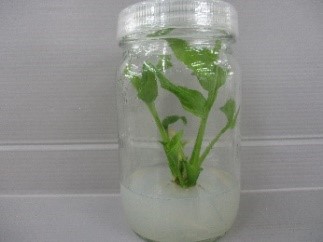
The objective of this study was to investigate the effect of plant growth regulators on shoot multiplication and root induction in Galangal at the Phichit Agricultural Research and Development Center. The shoot multiplication experiment was conducted using a completely randomized design (CRD) with six treatments and three replications. Young shoot bud explants were cultured on MS medium supplemented with BA concentrations at 0.0, 1.0, 2.0, 3.0, 4.0 and 5.0 mg/L. The result showed that MS medium containing 5.0 mg/L BA produced the highest number of shoot, averaging 3.83 shoots per explant. Additionally, it yielded the highest shoot height and leaf number, with mean values of 6.22 cm and 2.81 leaves, respectively, after 12 weeks of culture. For root induction experiment, a CRD with seven treatments and three replications. Shoot explants were cultured on MS medium supplemented with 5.0 mg/L BA in combination NAA or IAA concentrations of 0.0, 0.5, 1.0 and 2.0 mg/L. The result revealed that MS medium supplemented with 5.0 mg/L BA and 2.0 mg/L IAA promoted the highest root number, averaging 6.50 roots per explant, as well as the highest shoot number, shoot height and leaf number, with value of 4.25 shoots, 8.24 cm and 5.77 leaves, respectively, after 12 weeks of culture. When cultured for 16 weeks, this treatment resulted in the highest shoot number at 5.19 shoots, root number at 16.9 roots and leaf number at 6.23 leaves, respectively. Overall, young Galangal plants exhibited optimal growth before being transplanted to the nursery.
Article Details

This work is licensed under a Creative Commons Attribution-NonCommercial-NoDerivatives 4.0 International License.
บทความในวารสารเกษตรนเรศวรที่ได้รับการตีพิมพ์ เป็นลิขสิทธิ์ของ คณะเกษตรศาสตร์
ข้อความที่ปรากฏในบทความแต่ละเรื่องในวารสารนี้เป็นความคิดเห็นส่วนตัวของผู้เขียนแต่ละท่านไม่เกี่ยวข้องกับคณะเกษตรศาสตต์ฯ
References
กรมส่งเสริมการเกษตร. (2567). รายงานข้อมูลสถานการณ์การผลิตพืชเศรษฐกิจสำคัญของจังหวัดพิจิตร. www.doae.go.th.
คำนูณ กาญจนภูมิ. (2542). การเพาะเลี้ยงเนื้อเยื่อพืช. จุฬาลงกรณ์มหาวิทยาลัย.
ชยันต์ พิเชียรสุนทร, แม้นมาส ชวลิต และวิเชียร จีรวงส์. (2544). คำอธิบายตำราพระโอสถพระนารายณ์. อมรินทร์ พริ้นติ้งแอนด์พับลิชชิ่ง.
ณัฐพงค์ จันจุฬา. (2554). การเพาะเลี้ยงเอ็มบริโอและการเพิ่มปริมาณยอดของหงส์เหิน. ภาควิชาพืชสวนมหาวิทยาลัยเกษตรศาสตร์.
บูรณี พั่ววงษ์แพทย์, ณัฎฐิมา โฆษิตเจริญกุล, ทิพวรรณ กันหาญาติ, รุ่งนภา ทองเคร็ง, ลัดดาวัลย์ อินทร์สังข์ และจิตอาภา ชมเชย. (2556). การจัดการโรคเหี่ยวของขิงที่เกิดจากแบคทีเรีย Ralstonia solanacearum แบบผสมผสาน (รายงานผลงานวิจัยประจำปี 2556). สำนักวิจัยพัฒนาการอารักขาพืช กรมวิชาการเกษตร.
เบญจพร ภูกาบหิน. (2558). การเพาะเลี้ยงเนื้อเยื่อกระเจียวบัวและมหาอุดมแดงเพื่อการอนุรักษ์พืชหายากในประเทศไทย (วิทยานิพนธ์วิทยาศาสตรมหาบัณฑิต, มหาวิทยาลัยมหาสารคาม). ThaiLIS. https://tdc.thailis.or.th/tdc/search_result.php
เบญจพร ภูกาบหิน, สุรพล แสนสุข และปิยะพร แสนสุข. (2559). การเพาะเลี้ยงเนื้อเยื่อมหาอุดมแดง (Curcuma pierreana Gagnep.) เพื่อการอนุรักษ์พืชหายากในประเทศไทย. วารสารวิทยาศาสตร์ มข, 44(2), 294-306.
พันธิตรา กมล. (2552). การเพาะเลี้ยงเนื้อเยื่อและผลของรังสีแกมมาและโคลชิซินต่อการเปลี่ยนแปลงทางสัณฐานวิทยาของกระเจียวขาว (Curcuma parviflora Wall.) (วิทยานิพนธ์วิทยาศาสตร มหาบัณฑิต, มหาวิทยาลัยนเรศวร). ThaiLIS. https://tdc.thailis.or.th/tdc/search_result.php
รัตนา ขามฤทธิ์ และจิตรกร ปรีแม่น. (2562). การฟอกฆ่าเชื้อที่ผิวและการชักนำให้เกิดต้นจากไรโซมของไพลในหลอดทดลอง. แก่นเกษตร, 47(ฉบับพิเศษ 1), 1393-1398.
Murashige, T., & Skoog, F. (1962). A Revised Medium for Rapid Growth and Bio Assays with Tobacco Tissue Cultures. Plant Physiology, 15, 473-497.https://doi.org/10.1111/j.1399-3054.1962.tb08052.x
Nongmaithem, M.S., Chanu, L. A., Devi, Y. P., Singh, W. R. C., & Singh, H. B. (2014). Micropropagation an in vitro technique for the conservation of Alpinia galanga. Advances in Applied Science Research, 5(3), 259-263.
Rahayu, S., & Adil, W. H. (2012). The effect of BAP and Thidiazuron on in vitro growth of java turmeric (Curcuma xanthorrhiza Roxb.). Journal of Agricultural and Biological Science, 7(10), 820-824.
